Mushroom Coffee Caffeine Calculator
Estimate caffeine from mushroom coffee servings, scoop size, blend strength, body weight, and the time window you care about.
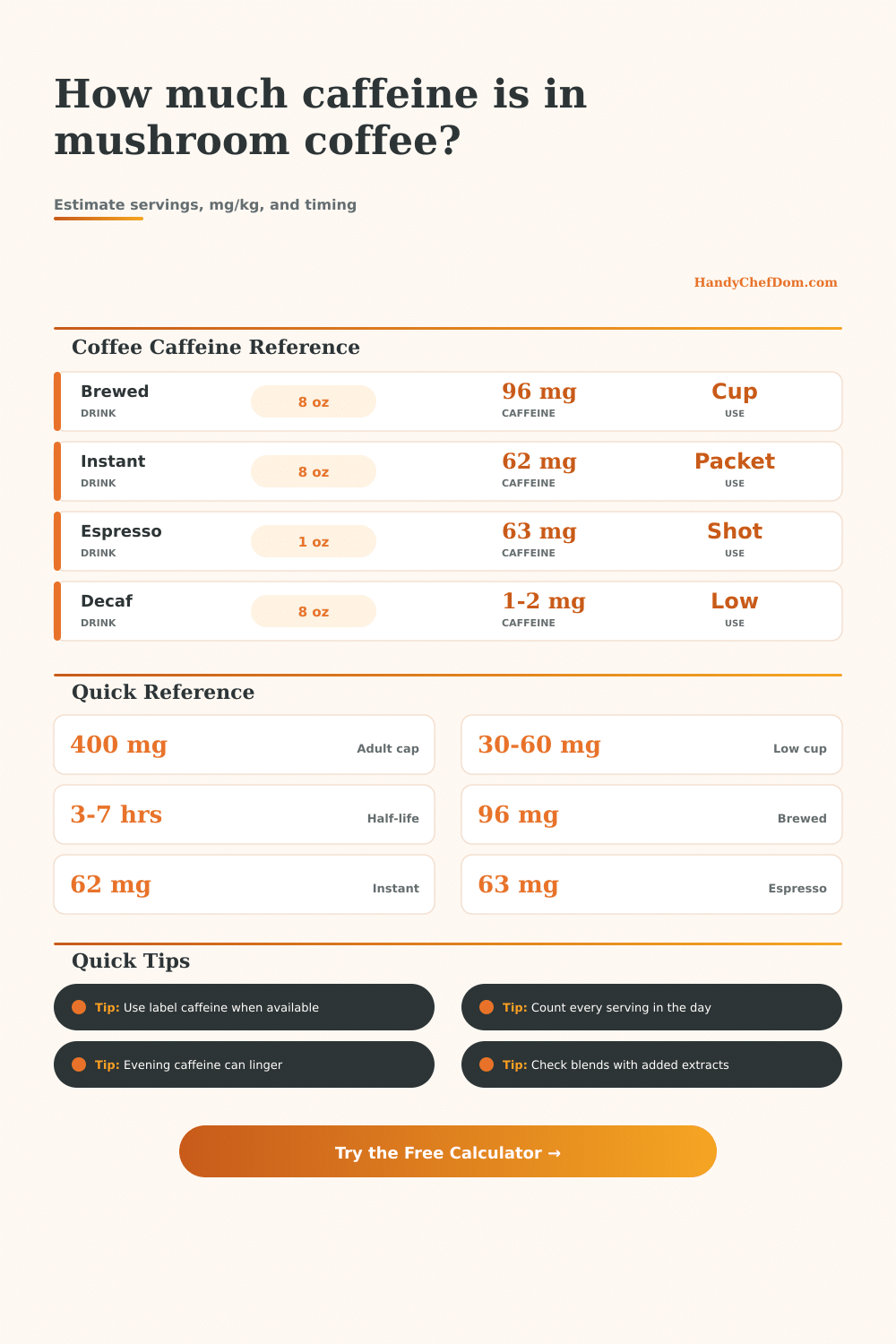
| Reference Drink | Serving Size | Caffeine | Calculator Use |
|---|---|---|---|
| Brewed coffee | 8 fl oz | 96 mg | Standard cup baseline |
| Instant coffee | 8 fl oz | 62 mg | Instant blend baseline |
| Espresso | 1 fl oz | 63 mg | Concentrated blend baseline |
| Decaf coffee | 8 fl oz | 1-2 mg | Low-caffeine baseline |
| Blend Type | Typical Caffeine | Coffee Share | Common Scoop |
|---|---|---|---|
| Standard mushroom coffee | 45-80 mg | 40-60% | 5-7 g |
| Low-caffeine blend | 25-45 mg | 20-40% | 5-7 g |
| Half-caf blend | 35-65 mg | 30-50% | 5-8 g |
| Decaf blend | 1-10 mg | 0-10% | 5-7 g |
| Intake Level | mg/kg | Example | How To Read |
|---|---|---|---|
| Light | Under 1 | 70 mg at 154 lb | Gentle daily amount |
| Moderate | 1-3 | 140 mg at 154 lb | Common coffee range |
| High | 3-5 | 280 mg at 154 lb | Track total day |
| Very high | Over 5 | 350+ mg at 154 lb | Approaches adult cap |
| Hours After Cup | Fast 3 hr | Typical 5 hr | Slow 7 hr |
|---|---|---|---|
| 3 hrs | 50% | 66% | 74% |
| 6 hrs | 25% | 44% | 55% |
| 9 hrs | 13% | 29% | 41% |
| 12 hrs | 6% | 19% | 30% |
But your morning ritual is different now, you grab the mushroom coffee, anticipating its earthiness. And yet, because marketers promise benefits not chemistry, you don’t look very closely at the ingredient list. And you won’t know exactly how caffeinated it actualy is.
Because it’s a blend rather than a single ingredient, the contents can vary greatly from product to product. Some has more roasted dandelion root or roasted chicory then anything else, perhaps with just a hint of coffee. Others may have strong shot of espresso hiding beneath mushrooms. If you’re trying to track your sleep patterns, or if you are particularly sensitive to stimulants, this lack of clarity could be risky.
Know Your Caffeine Amount
Lighter tasting coffee doesn’t have proportionally lower amounts of caffeine. This common misconception is wrong. Depending on how it’s ground and where the beans came from, a dark roast can taste bitter but still have just as much (or even more) caffeine in it compared to a light roast. With mushrooms added into the equation, you now have two variables operating at the same time. First is amount of mushroom being used compared to the amount of coffee. Second is how much of total cup of coffee the mushroom actualy extracts.
The calculator above use those variables when you describe your blend and specify weight of your mushroom “scoop.” It runs the numbers and forces you to face the numbers themselves instead of labels like “strong” and “mild. Because caffeine’s impact varies greatly on someone who weighs 60 pounds, like a teenager, versus someone weighing 200 pounds, like a marathon runner, that’s when this calculator really starts to come into play: it normalizes our caffeine intake based off our bodyweight so we have some sort of comparative frame of reference.
At what point do you start feeling the jitters? Do you feel anxiety? How much caffeine could I drink and still be okay? The breakdown part lets you see that without having to get out your chemistry book. It compares the amount you consumed to safe limits for healthy adult, showing you how much is too much.
The second cool part: Caffeine’s half life changes between 3 and 7 hours for most people, so half the amount you drank at eight in the morning will remain in your system at one in the afternoon. Add another cup at noon and you’re not starting from zero; you’re adding on to your leftover amount, which never fully clears out until bedtime. That’s why insomniacs can feel okay all day, but have trouble shutting off their brain at night. It’s an accumulation effect.
The time window feature estimates how many hours after a given cup of coffee there’s still caffeine hanging around. A little thing, but when trying to keep a deep sleep pattern or improve recovery it matters.
To break it down: the page has reference tables that compare mushroom blends to regular coffee types. Instant coffees range around sixty two milligrams for an eight ounce cup; brews are nearer to ninety six. Depending on their percentage of actual coffee in a blend, mushroom coffees will be generally between those figures. So if you have a blend with a listing of forty five percent coffee by weight, you’ll get about half as much caffeine per cup as a full strength version.
The ratio used to make the extracts matter, both in volume and perhaps caffeine content (though the mushrooms themselves don’t contribute much in the way of stimulants). So if you see a high extract claim, know that what might look like potency is really just concentration…of something else.
The bottom line: Caffeine isn’t something we have to cut out, but it’s also not a magical cure-all for life, it’s about information. If coffee suits your body, wallet, and health profile, then don’t give it up completely. Just know what you’re taking in. When we guess at our caffeine consumption, we get an unpredictable rollercoaster ride (energy crash!). We wake up at midnight. But when we are precise, we can enjoy the ritual without suffering the consequences.
First, make sure your package is clearly stating how much caffeine is inside. From there, adjust based off your own tolerance level. The point here isn’t to go cold turkey; it’s to know precisely what you’re putting into your body (and when). And that knowledge would of restored the peace of mind that accompanies every morning cup.