🍞 Desired Dough Temperature Calculator
Find the water temperature that hits your target dough temperature using flour temperature, room temperature, preferment temperature, mixer friction, and dough style.
Use actual measured ingredient temperatures. The standard formula is target dough temperature multiplied by the number of temperature factors, then flour, room, preferment, and friction heat are subtracted to solve for water temperature.
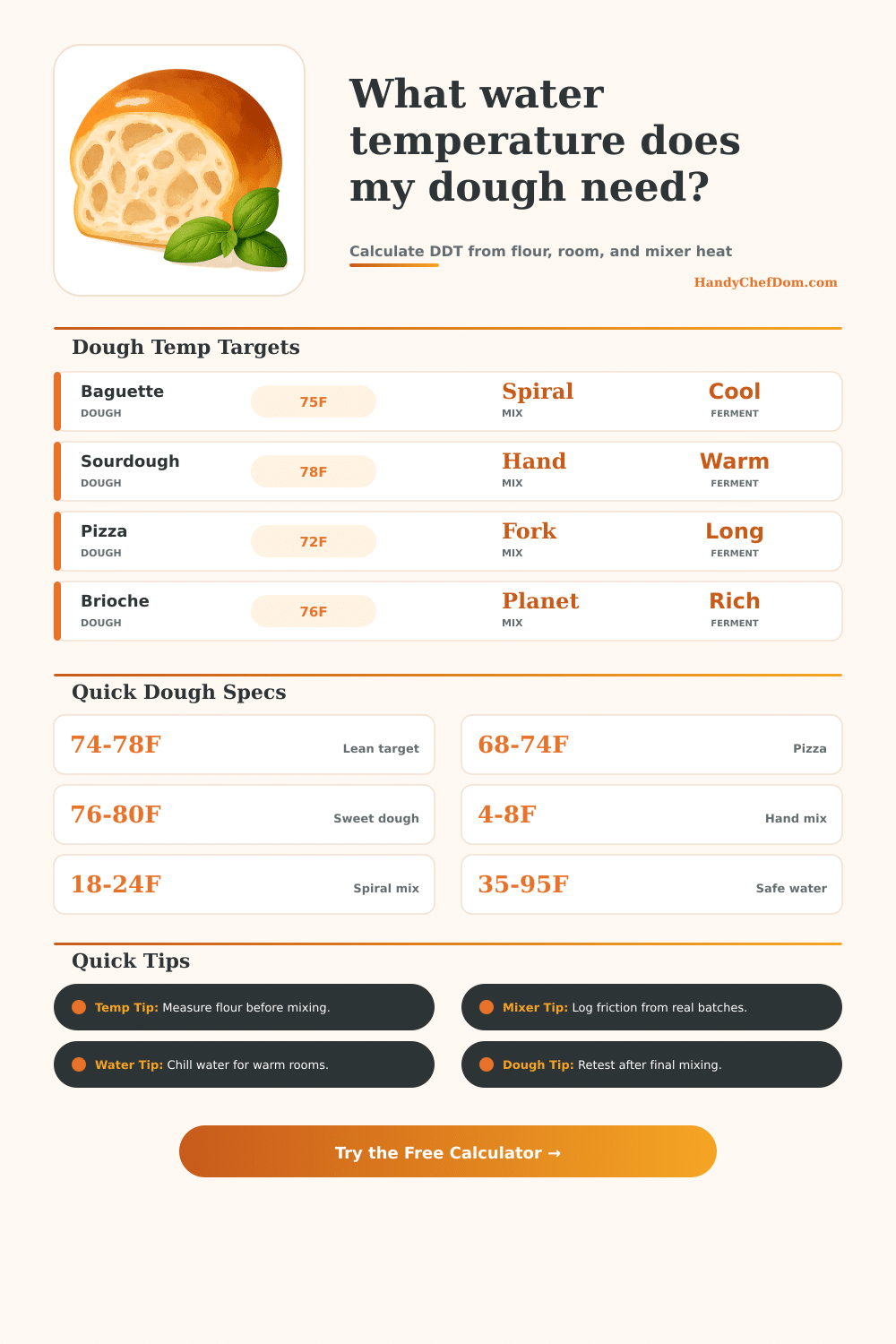
| Dough Type | Target DDT | Fermentation Style | Temperature Note |
|---|---|---|---|
| Lean baguette | 74-76F / 23-24C | Moderate bulk | Good balance of yeast activity and strength |
| Country sourdough | 76-80F / 24-27C | Warm bulk | Often favors steady acidity and volume |
| Neapolitan pizza | 68-74F / 20-23C | Long room or cold | Cooler dough supports long fermentation |
| Sandwich loaf | 76-80F / 24-27C | Same day proof | Warm enough for reliable pan rise |
| Brioche | 74-78F / 23-26C | Rich and chilled | Avoid melting butter during mixing |
| Bagel dough | 70-74F / 21-23C | Retarded proof | Stiff dough and long mix add heat |
| Mixer Method | Typical Friction | Best Starting Point | When To Adjust |
|---|---|---|---|
| Hand mix with folds | 4-8F / 2-4C | Start at 6F | Add if slap-and-fold is vigorous |
| Fork mixer | 10-18F / 6-10C | Start at 14F | Add for long stiff dough mixing |
| Spiral mixer low speed | 14-20F / 8-11C | Start at 18F | Raise if second speed is used |
| Spiral mixer medium | 20-26F / 11-14C | Start at 22F | Lower for short improved mixes |
| Planetary stand mixer | 22-30F / 12-17C | Start at 25F | Small batches heat faster |
| Intensive mixer | 28-36F / 16-20C | Start at 32F | Use colder water for long runs |
| Water Result | Meaning | Practical Move | Common Cause |
|---|---|---|---|
| Below 40F / 4C | Very cold water | Chill flour or reduce friction | Warm room or intensive mixing |
| 40-55F / 4-13C | Cold water | Use refrigerated water | Warm flour or warm preferment |
| 56-75F / 13-24C | Moderate water | Scale directly and mix | Balanced bakery conditions |
| 76-90F / 24-32C | Warm water | Use warm tap water | Cool room or cool flour |
| Over 90F / 32C | Very warm water | Warm flour or room first | Cold storage ingredients |
| Formula Situation | Factor Count | DDT Formula | Use This When |
|---|---|---|---|
| Straight dough | 3 | DDT x 3 - flour - room - friction | No preferment temperature is included |
| Prefermented dough | 4 | DDT x 4 - flour - room - preferment - friction | Levain, poolish, sponge, biga, or old dough |
| Cold bulk target | 3 or 4 | Use lower target DDT | Pizza, bagels, or delayed fermentation |
| Rich dough | 3 or 4 | Use moderate target DDT | Butter, egg, sugar, and long mixing |
| Warm sourdough | 4 | Include levain temperature | Large ripe levain affects final dough heat |
The desired dough temperatures is the temperature that the baker want the dough to reach after all ingredients have been mixed together. The desired dough temperature is important for the baking process because the desired dough temperature will determine how fast the yeast will work in the dough, how much acidity will develops in the dough, and how the dough will feel when the baker eats the finished bread. If the temperature of the dough is high, the yeast will work quick.
However, if the dough temperature is low, the yeast will work more slow. The activity of the yeast change according to the temperature of the dough. For instance, if the baker increases the temperature of the dough by ten degrees within the normal baking range, the activity of the yeast in the dough will roughly double.
How to Get the Right Dough Temperature
A dough that is mixed to 82 degrees will take longer to prove than a dough that is mixed to 72 degree. The temperature of the dough affect the flavor of the bread. For instance, dough that is cooler in temperature allow time for the yeast and bacteria to produce acid in the dough.
These organic acid contribute to the flavor of the dough. Warm dough will shorten the time for these acids to be produce in the dough. Thus, warm dough will have a different flavor then cool dough.
In order to reach the desired dough temperature, the baker must calculate the proper water temperature. In order to calculate the proper water temperature, the baker must first measure the temperature of the flour that will be used in the dough and the temperature of the room in which the baker will mix the dough. Water is an important ingredient in determining the final temperature of the dough.
In order to calculate the proper water temperature, the baker must subtract both the temperature of the flour and the room from the desired dough temperature. Additionally, if the baker plan to use a preferment, such as levain or poolish, the temperature of that preferment will also factor into the equation. The friction factor is the heat that is created during the mixing of the dough.
Friction create heat when dough is mixed with mixers. If the baker mixes the dough by hand, there is no friction factor. However, if a spiral mixer or stand mixer mixes the dough, there is a friction factor.
The friction factor with a stand mixer may be twenty-five degrees or more. The baker can determine the friction factor of a specific mixer by baking several batches of dough with that mixer. Another factor that impact the temperature of the dough is the temperature of the room.
The kitchen where the dough is mixed may become warmer during the mixing session. If the room is warmer, the dough will reach a higher temperature. Additionally, if the dough is mixed for longer period of time, the friction in the mixing will cause the dough to heat.
Thus, the baker should monitor the temperature of the room in which the dough is to be mixed. Not all type of bread have the same desired dough temperature. For instance, lean doughs are used to proof the dough the same day that it is prepared.
These types of dough have a higher desired dough temperature. Pizza dough and bagel dough tends to have cooler desired dough temperatures. This allow the dough to be fermented at a slower rate.
Enriched doughs contain ingredient like butter and sugar. The butters and sugars in enriched dough work to slow the activity of the yeast. Thus, enriched doughs have a middle temperature; it must be warm enough to allow the yeast to perform its functions, but not warm enough to melt the fat that is contain in the enriched dough.
Finally, it is also important to check the actual temperature of the dough once it has been mixed together. By measuring the actual temperature of the dough, the baker can ensure that the dough has reached the desired dough temperature. Furthermore, if the actual temperature of the dough is not the same as the desired dough temperature, the baker can adjust the friction factor or the water temperature for any future batch of dough that are to be prepared.
By ensuring that the actual dough temperature is the same as the desired dough temperature, the baker can ensure consistent fermentation time for the dough batches. Thus, the baker will be able to produce consistently baked bread.