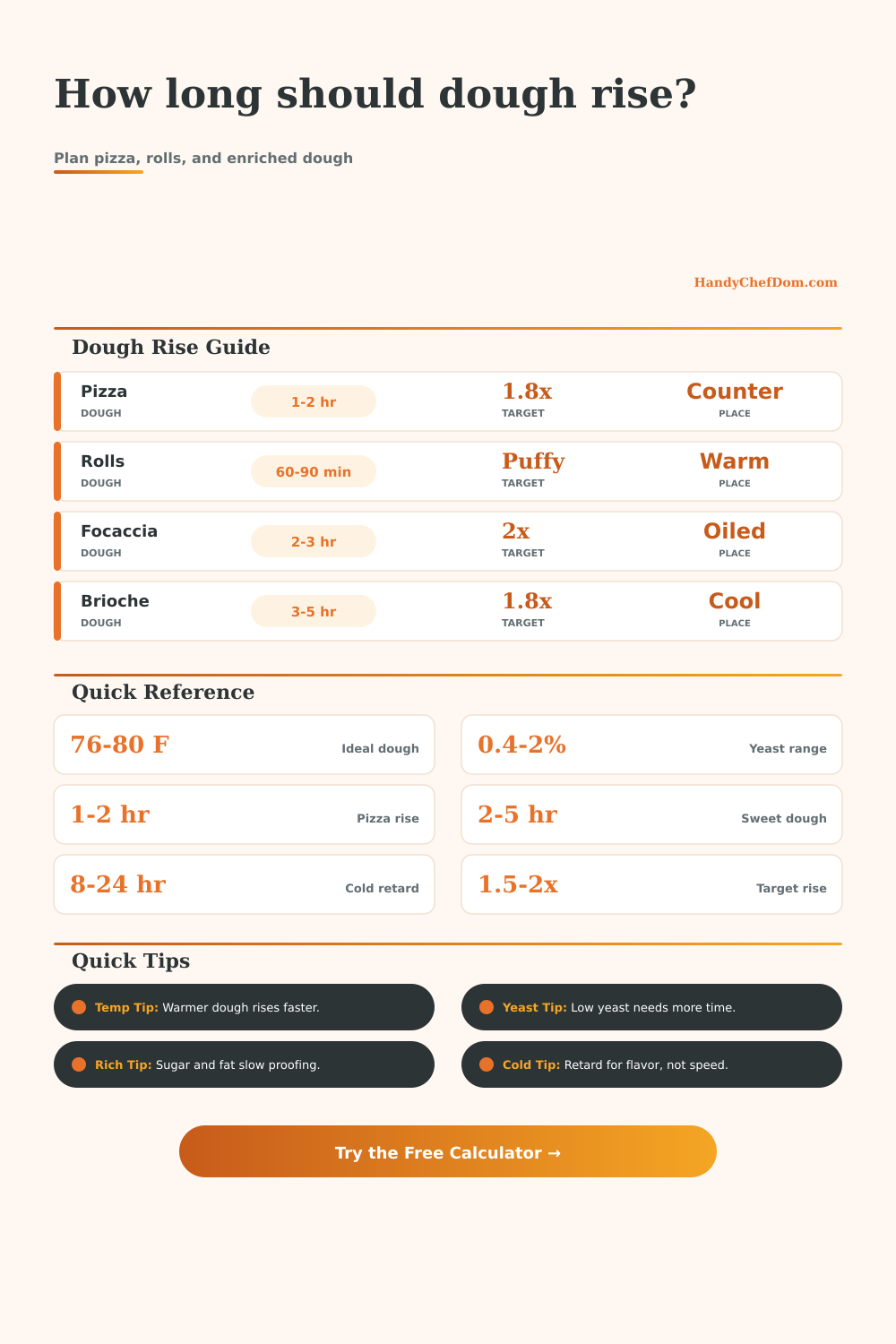
🍞 Dough Rising Time Calculator
Estimate dough rise timing for pizza, dinner rolls, focaccia, bagels, cinnamon rolls, and rich dough using yeast percent, temperature, hydration, enrichment, weight, target volume, and cold retard.
Enter baker percentages and temperatures. The model estimates active counter rise, total schedule time, a practical ready window, and whether cold retard has already contributed meaningful fermentation.
| Dough Type | Typical Yeast | Hydration | Target Volume |
|---|---|---|---|
| Pizza dough | 0.3-1.5% instant | 58-70% | 1.5x to 2x |
| Dinner rolls | 1.0-2.5% instant | 58-68% | Puffy, near 2x |
| Cinnamon rolls | 1.2-2.5% instant | 60-70% | Soft and expanded |
| Focaccia | 0.5-1.5% instant | 72-85% | Jiggly and bubbly |
| Bagels | 0.5-1.2% instant | 50-58% | Slightly puffy |
| Brioche | 1.5-3.0% instant | 50-65% | 1.5x to 1.8x |
| Temperature Zone | Typical Effect | Best For | Planning Note |
|---|---|---|---|
| 55-60 F cool room | About 2x slower | Slow pizza, bagels | Expect a long rise and stronger flavor. |
| 65-70 F mild room | Moderately slow | Same-day dough | Good for steady gluten relaxation. |
| 72-78 F warm room | Recipe baseline | Rolls, pizza, focaccia | Most dough timing estimates assume this range. |
| 80-85 F proof box | Faster rise | Sweet rolls | Watch closely so dough does not overproof. |
| 36-42 F refrigerator | Very slow activity | Cold retard | Flavor builds while fermentation slows. |
| Over 90 F | Risky acceleration | Short boosts only | Can weaken dough and create uneven proofing. |
| Yeast Choice | Instant Equivalent | Use Case | Calculator Meaning |
|---|---|---|---|
| Instant dry yeast | 1.00x | Most doughs | Use the baker percent directly. |
| Active dry yeast | 0.75x | Home baking | Same percent ferments a bit slower. |
| Fresh compressed yeast | 0.33x | Bakery-style dough | Needs roughly triple the dry yeast weight. |
| Osmotolerant instant | 1.10x | Sweet dough | Handles sugar better than standard yeast. |
| Low yeast pizza | 0.20-0.50% | Long room rise | Good for slower flavor development. |
| Fast roll dough | 1.50-2.50% | Same-day rolls | Speeds up proofing when dough is warm. |
| Dough Factor | Speeds Rise | Slows Rise | What To Watch |
|---|---|---|---|
| Hydration | 70% or higher | Under 58% | Wet dough bubbles earlier; stiff dough needs time. |
| Sugar | 0-3% | Over 8% | Sweet dough often needs more yeast or patience. |
| Fat or oil | 0-5% | Over 12% | Fat coats gluten and slows expansion. |
| Dough weight | Warm large batch | Cold small batch | Heavy dough changes temperature more slowly. |
| Target volume | 1.35x rest | 2x or more | More expansion needs more fermentation time. |
| Cold retard | Adds flavor | Slows gas | Let chilled dough warm if it still feels dense. |
There is a disconnect because yeast isn’t a mechanical timer; it’s a living thing that reacts to hydration, sugar, and temperature. Because of the disconnect between the clock and dough, it might over-expand or collapse by the time you get back from being out. To close this gap, calculator treats fermentation like science.
Temperature is the most prominent variable you’ll encounter. What seems normal to you (say, a seventy-four degree kitchen) are actualy warm for yeast. Eighty-five degrees? That’s a tropical storm for these guys. By comparing your room temperature to a baseline, tool adjusts the estimated rise time accordingly.
Why the Calculator Helps Your Dough Rise Better
Living in a drafty apartment? Your dough will take longer to rise then what’s written on the package. Using calculator will help you discover this adjustment; no need to put thermometer in the bowl.
But what about enriched doughs? The ones with sugar, eggs, and butter? Those ingredients aren’t just good; they’re speed bumps on yeast’s highway. Fat coats gluten strands, making it more difficult for gas bubbles to expand and stretch structure. And sugar draws water out of the yeast via osmosis (stressing the poor things before they’ve had a chance to get to work). When you pick an enriched style, model adjusts the estimated timing to reflect that physical drag. It’s a small adjustment but it makes all the difference when you want tender results.
The subtler part is hydration, which is important for the timing: More hydrated doughs (like focaccia) allows the yeast to grow in their moister environment; the additional moisture may speed up that first rush of action. Less hydrated doughs (like bagels) limit the space available to move around and thus slow expansion process down. The tool takes into account not just the amount of yeast you’re working with but also how it moves in its new home.
Do you understand why your slow-rise pizza on Saturday night has a different flavor than the quick bread on Tuesday after work? Speaking of cold retardation, there seems to be some confusion about this in today’s world of home baking. Many bakers put their dough into fridge, hope for magic, then forget about it.
Cold doesn’t halt fermentation; instead, it slow it down to a crawl. The calculator has an option for the number of hours you left your dough in the refrigerator so you can “credit” that time to the overall fermentation window. That way, you won’t make mistake of assuming that refrigerated dough is like fresh-out-of-the-mixer dough. Refrigerator fermentation needs to be accounted for.
No computer algorithm will ever be able to duplicate how a slow spring-back feels, or how a lazy bubble looks. So always trust your visual clues as last word. You should of trusted your eyes earlier. Think of this ready window as a starting point to plan around; not a mandate. Start at one end and work into the other. If it’s tight and dense, let it go longer. If it’s puffy with some air under it, it is there. Visuals help you set a pace. Your fingers and eyeballs tells you what happened.
There’s a fine line between baking by instinct and baking by measurement. Sure, you can calculate the room temperature and weigh each grain of flour, but dough will have a mind of its own. Instead of eradicating variables, you learn to control them so that you’re confident enough to know when to stand aside and when to intervene.
When you get into the rhythm, ticking clock goes from being a source of stress to something you’re satisfied with, timing it just right. The mechanics of baking become second nature to you. You see how the magic works and you begin to trust the process.