🌿 Dried Parsley Per Fresh Parsley Calculator
Convert chopped fresh parsley to dried flakes, crushed parsley, or powder with recipe, garnish, age, intensity, and batch adjustments.
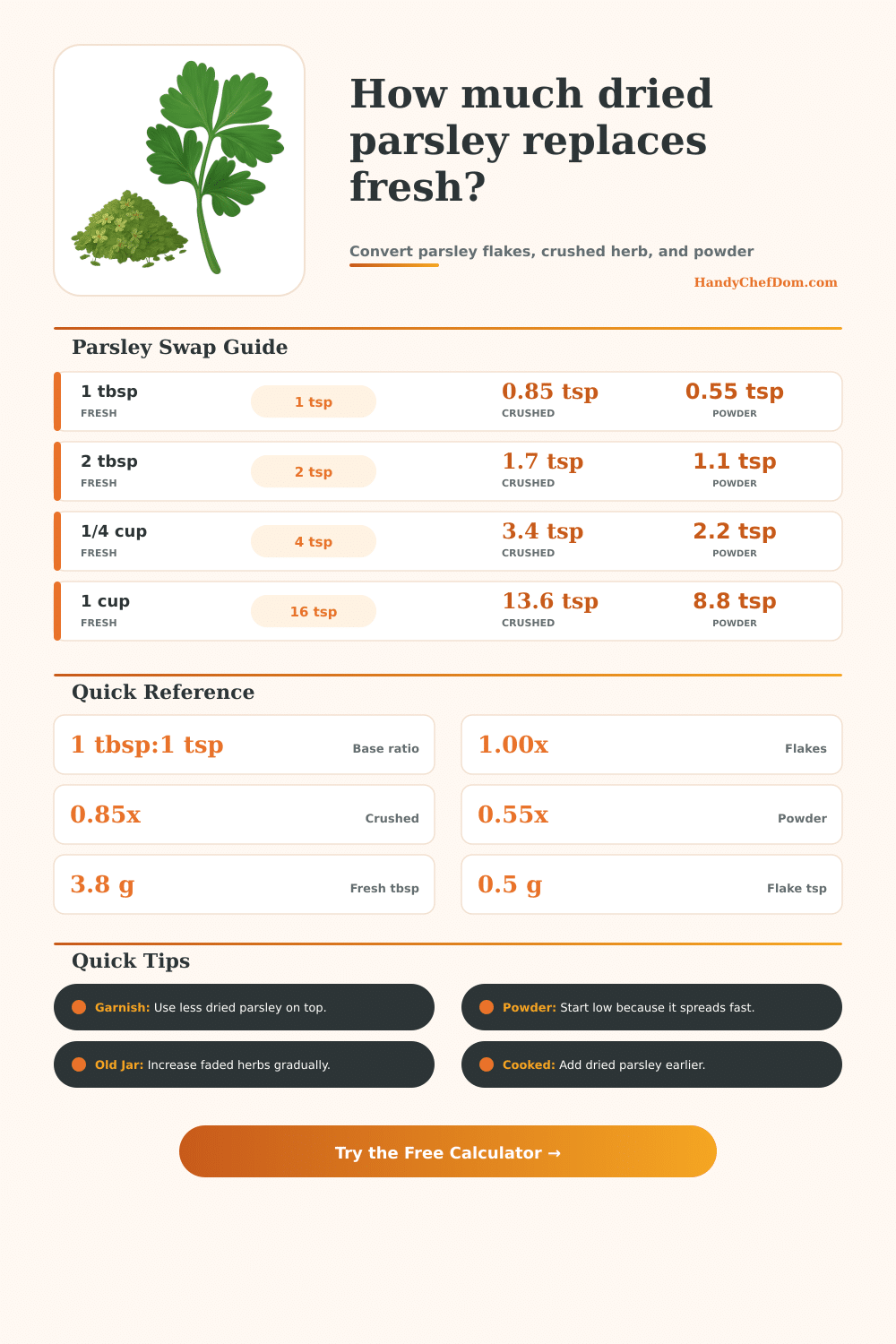
The common kitchen ratio is 1 tablespoon chopped fresh parsley for 1 teaspoon dried parsley flakes. This calculator adjusts that baseline for parsley form, recipe style, herb age, flavor target, and scaled batches.
| Fresh parsley amount | Dried flakes | Crushed dried | Fine powder |
|---|---|---|---|
| 1 teaspoon fresh chopped | 0.33 teaspoon | 0.28 teaspoon | 0.18 teaspoon |
| 1 tablespoon fresh chopped | 1 teaspoon | 0.85 teaspoon | 0.55 teaspoon |
| 2 tablespoons fresh chopped | 2 teaspoons | 1.7 teaspoons | 1.1 teaspoons |
| 1/4 cup fresh chopped | 4 teaspoons | 3.4 teaspoons | 2.2 teaspoons |
| 1/2 cup fresh chopped | 8 teaspoons | 6.8 teaspoons | 4.4 teaspoons |
| 1 cup fresh chopped | 16 teaspoons | 13.6 teaspoons | 8.8 teaspoons |
| Parsley form | Approx grams per teaspoon | Volume strength | Best measuring habit |
|---|---|---|---|
| Dried parsley flakes | 0.50 g | 1.00x baseline | Scoop level teaspoons for most recipe swaps. |
| Crushed dried parsley | 0.58 g | 0.85x spoon volume | Use slightly less because the leaf is compacted. |
| Fine parsley powder | 0.82 g | 0.55x spoon volume | Start low, stir well, then adjust after tasting. |
| Fresh chopped parsley | 3.80 g per tablespoon | Fresh baseline | Measure after chopping for the closest match. |
| Fresh parsley sprigs | 0.75 g each | About 0.2 tbsp | Strip leaves before converting to dried parsley. |
| Small fresh bunch | 60 g each | About 16 tbsp | Useful for scaling meal prep and catering pans. |
| Recipe use | Adjustment | Why it changes | Typical parsley style |
|---|---|---|---|
| Finished garnish | 0.75x | Dried parsley is visible and can taste dusty on top. | Flakes, lightly crushed |
| End-of-cook stir-in | 0.90x | Short hydration keeps the herb bright but not sharp. | Flakes or crushed |
| Cooked into sauce | 1.00x | Moisture gives dried parsley time to bloom. | Flakes, crushed, powder |
| Long simmer or baked filling | 1.15x | Extended cooking softens parsley aroma. | Crushed or powder |
| Cold salad or dressing | 0.85x | Dried pieces hydrate slowly in cold mixtures. | Fine flakes |
| Rice, potato, or grain dish | 1.10x | Starchy bases mute delicate herb flavor. | Flakes or crushed |
| Parsley form | Flavor release | Appearance | Best use |
|---|---|---|---|
| Fresh chopped parsley | Bright and grassy | Green leaf flecks | Fresh garnish, salads, finishing bowls |
| Dried parsley flakes | Mild and familiar | Leafy flakes | Soups, sauces, potatoes, casseroles |
| Crushed dried parsley | Faster and fuller | Smaller flecks | Dressings, rubs, rice mixes, herb butter |
| Fine parsley powder | Quick and concentrated | Blends into mixture | Seasoning blends, fillings, smooth sauces |
| Older dried parsley | Soft and muted | Duller green | Cooked dishes where extra volume is acceptable |
| Very fresh dried parsley | Clean and strong | Brighter green | Use the lower end for garnish and finishing |
Parsley can be either fresh or dried. Each of these parsley products contains different ingredient and exhibit different behavior within the cooking process. Fresh parsley contains more water then dried parsley, and has a stronger flavor.
Because of the difference in water content, however, cooks must use more dried parsley in recipe to provide the same flavor as if fresh parsley was used. The calculator that is provided with this article allow cooks to convert the measurement of fresh parsley to dried parsley. The calculator utilizes various variable to calculate the amount of dried parsley that is necessary for recipes with varying property.
How to Convert Fresh Parsley to Dried Parsley
For instance, the type of recipe can affect the amount of dried parsley that should be used. For example, long simmered sauces allow for the dried parsley to rehydrate, but sauces that are served hot but not simmered can prevent the rehydration of the dried parsley, and reduce the flavor that the dried parsley can contribute to a sauce. The same concept apply to whether the parsley is being used as a garnish or as an ingredient in the recipe that is being prepared.
For example, if the parsley is to be a garnish, it will not be exposed to the same level of moisture as the remainder of the recipe, and less dried parsley will be needed. In contrast, parsley that is to be use as an ingredient will release its flavor into the remainder of the recipe, and dried parsley will be needed. In addition to the type of recipe, other variables in the calculator relates to the flavor of the dried parsley that is to be used.
For instance, one of the variable is the age of the dried parsley. With time, dried parsley can lose its flavor; the aroma of dried parsley can fade after the jar of dried parsley is opened. For instance, if the jar has been opened for a long time, more dried parsley will be needed to provide the same flavor as if the dried parsley was fresh out of the jar.
Similarly, if the dried parsley is very old, its flavor will be weak, and more parsley will be needed to provide the flavor that would be provided by parsley that was more recent stored in the jar. Such an ingredient can be accounted for in the intensity setting on the calculator. The intensity setting also allow cooks to select whether the flavor of dried parsley should be one of the primary flavor in the recipe, or one of the background flavor.
Other variables that must be accounted for include the physical form of the dried parsley. Variables related to the physical form of dried parsley may include whether the dried parsley is in the form of flake, crushed parsley, or ground powder. Flakes of dried parsley have a larger surface area than the other form, so the flakes will take longer to absorb the moisture in the recipe.
Crushed parsley has more weight than the flakes, and release its flavor faster than parsley in flake form. Finally, dried parsley in the form of powder will disperse quick into the dish. Therefore, care must be taken with the physical form of the parsley; the physical form can be selected in the calculator.
Other variables relate to the storage of the dried parsley. For instance, if the cook stores the dried parsley away from heat, and if the lid of the jar of dried parsley is always tightly close, the drying of the parsley will be slower. Over time, however, the flavor will fade.
Thus, amount of dried parsley that is required in a recipe will change according to how long the parsley has been stored in the pantry or other storage area in the kitchen. Finally, dried parsley can be measured with the calculator to determine the amount of dried parsley that should be used in a recipe. However, it is essential to always taste the dish while cooking.
It is much more easy to add dried parsley to a recipe than to remove it from a recipe that has already been prepared. Thus, you should of used the calculator to determine the amount of dried parsley that is needed, and then use the taste of the recipe to determine whether that amount of parsley is the correct amount for that specific recipe.