🌿 Dried Oregano To Fresh Calculator
Convert fresh oregano into dried oregano leaves, rubbed oregano, or oregano powder with adjustments for sauces, soups, marinades, pizza, cooking time, herb age, intensity, and batch scaling.
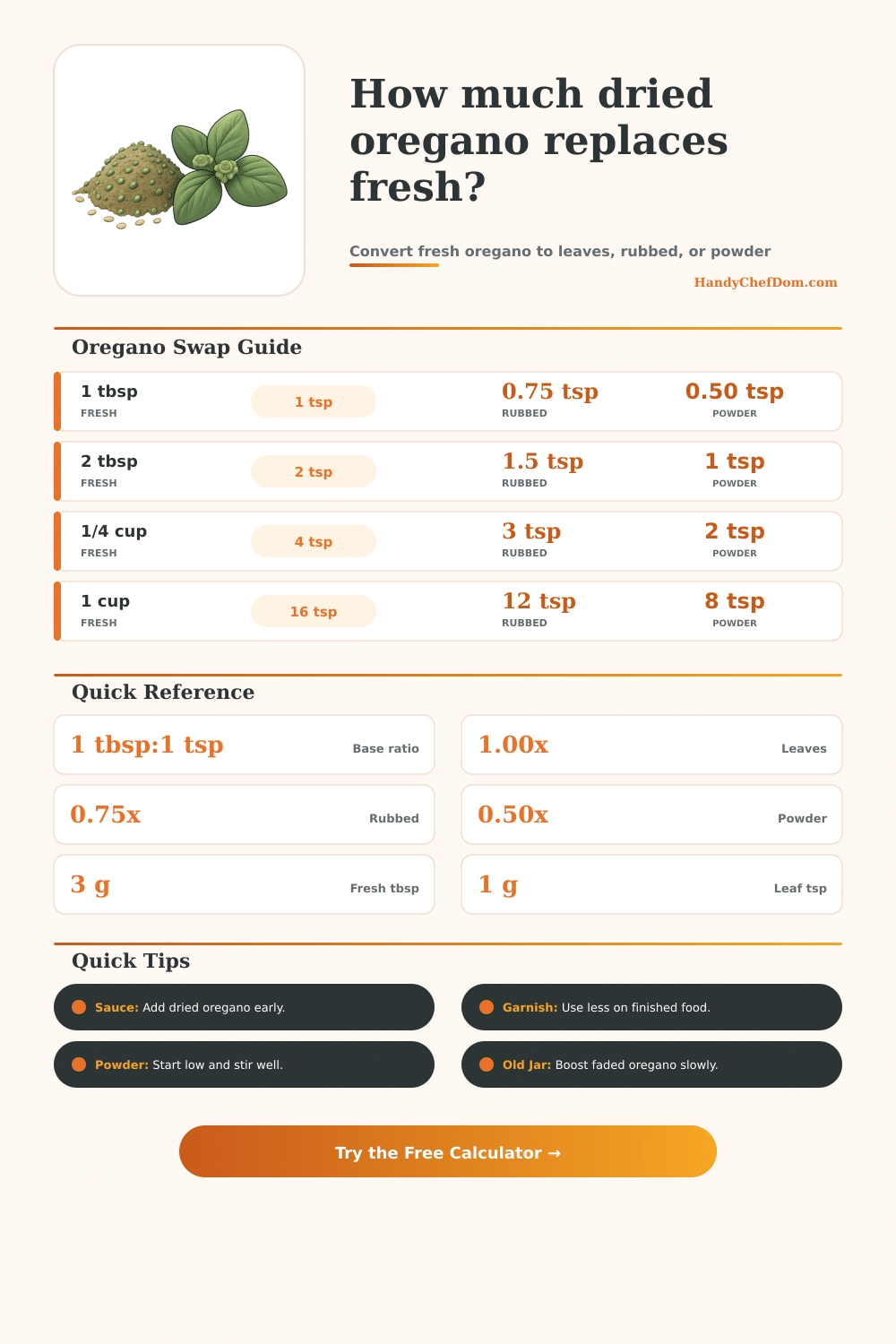
The standard oregano substitution is 1 tablespoon chopped fresh oregano equals 1 teaspoon dried oregano leaves. Rubbed oregano and fine powder are stronger by spoon volume, so the calculator reduces them before applying recipe, time, potency, and batch adjustments.
| Fresh oregano amount | Dried oregano leaves | Rubbed oregano | Fine oregano powder |
|---|---|---|---|
| 1 teaspoon chopped fresh oregano | 0.33 teaspoon | 0.25 teaspoon | 0.17 teaspoon |
| 1 tablespoon chopped fresh oregano | 1 teaspoon | 0.75 teaspoon | 0.50 teaspoon |
| 2 tablespoons chopped fresh oregano | 2 teaspoons | 1.5 teaspoons | 1 teaspoon |
| 1/4 cup chopped fresh oregano | 4 teaspoons | 3 teaspoons | 2 teaspoons |
| 1/2 cup chopped fresh oregano | 8 teaspoons | 6 teaspoons | 4 teaspoons |
| 1 cup chopped fresh oregano | 16 teaspoons | 12 teaspoons | 8 teaspoons |
| Oregano form | Approx grams per teaspoon | Volume strength | Measuring habit |
|---|---|---|---|
| Dried oregano leaves or flakes | 1.00 g | 1.00x baseline | Level the spoon for the classic fresh-to-dried herb swap. |
| Rubbed oregano | 0.80 g | 0.75x spoon volume | Use slightly less because rubbed leaves release flavor faster. |
| Fine oregano powder | 1.30 g | 0.50x spoon volume | Start low and blend well to avoid bitter pockets. |
| Fresh chopped oregano | 3.00 g per tablespoon | Fresh baseline | Measure after stripping woody stems and chopping leaves. |
| Leafy fresh oregano sprig | 1.00 g each | About 0.33 tbsp | Sprigs vary, so chopped tablespoons are more reliable. |
| Loose oregano bunch | 72 g each | About 24 tbsp | Useful for large sauce, marinade, or catering batches. |
| Recipe type | Adjustment | Why it changes | Best dried form |
|---|---|---|---|
| Tomato sauce or marinara | 1.00x | Moist heat hydrates oregano and carries its savory edge. | Dried leaves or rubbed oregano |
| Pizza, flatbread, or focaccia | 0.85x | Dry oregano on the surface tastes stronger than oregano cooked in sauce. | Dried leaves |
| Marinade, rub, or dressing | 0.95x | Oil and acid draw flavor out without needing a full simmer. | Rubbed oregano |
| Soup, stew, chili, or beans | 1.08x | Broth and long volume dilute the herb note slightly. | Rubbed oregano or leaves |
| Salad, garnish, or uncooked finish | 0.70x | Dried oregano is sharper when it is not hydrated by heat. | Light dried leaves |
| Roasted meat or vegetables | 1.05x | Dry oven heat softens some aroma while browning concentrates flavor. | Rubbed oregano |
| Herb | Fresh to dried ratio | Flavor pattern | Substitution caution |
|---|---|---|---|
| Oregano | 3:1 by volume | Sharp, resinous, savory | Rubbed and powdered oregano can dominate quickly. |
| Basil | 3:1 by volume | Sweet, peppery, aromatic | Dried basil is weaker for fresh garnishes. |
| Thyme | 3:1 by volume | Earthy, steady, woody | Small leaves pack densely in a teaspoon. |
| Marjoram | 3:1 by volume | Mild, floral, oregano-like | Use gently when replacing assertive oregano. |
| Rosemary | 3:1 by volume | Piney, resinous, strong | Crush dried needles before measuring. |
| Parsley | 3:1 by volume | Grassy, mild, green | Dried parsley contributes less flavor than color. |
When using oregano in the kitchen, there is a decision to make between using fresh oregano or dried oregano. Fresh oregano and dried oregano are not teh same. Fresh oregano contain water, while dried oregano does not contain any water.
Because dried oregano does not contain any water, the flavor is more concentrated than fresh oregano. Due to dried oregano being more concentrated than fresh oregano, you will require less dried oregano to extract the same flavor as fresh oregano. The standard conversion between dried and fresh oregano is a three-to-one ratio.
How Much Oregano to Use
This means that one part of dried oregano should be used for every three part of fresh oregano. The cooking method will affect the flavor of the oregano, therefore affecting the amount of oregano that will be required for the recipe. For instance, oregano can be added to a sauce that will simmer for a long period of time.
In this situation, the dried oregano will rehydrate and release its flavor slow into the sauce. However, if you add the oregano to food like pizza, the oregano will sit on the food and contribute to its flavor. Because the cooking method will influence the way in which the oregano release its flavor, the amount of oregano will have to be altered based off the cooking method for the recipe.
Another factor that will influence the flavor of the oregano is the age of the dried oregano. Dried oregano that has been sitting in the pantry for a year will not have as strong of a flavor as dried oregano that were opened most recently. In recipes that use older dried oregano, more of the dried herb will be required to extract the flavor that is desired.
Thus, the age of the oregano will have to be considered when calculating the correct amount of oregano for a recipe. The physical form of the oregano will affect the rate at which the oregano release its flavor into the body of the dish. Dried oregano leaves will release flavor slow.
However, crumbled oregano will release its flavor at a faster rate because it have more surface area to release its flavor. Oregano powder will release its flavor at the most fastest rate because it has the most surface area of the other forms of oregano. Each physical form of oregano will have a different amount of surface area.
Therefore, each form will have a different amount of volume required to extract the same amount of flavor. The size of the batch of the food will influence the amount of oregano that are needed. If a batch of food is prepared in larger quantities, the amount of oregano does not necessarily have to be increased at the same rate as the other ingredients.
The liquid in the food will reduce in quantity during the cooking process, which will alter the amount of oregano that is present in the food. Thus, a batch multiplier can be used for oregano to ensure that the amount of oregano is the same as the batch of food that is prepared. Finally, the timing of adding the oregano to the food will have an effect on whether or not the amount of oregano can be changed.
If the dried oregano is added to the food early in the cooking process, the food can be tasted and more dried oregano can be added if the flavor of the oregano is too weak. However, if you add the oregano as a garnish on the food at the end of the cooking process, the amount of oregano cannot be altered after it has been added to the food. Therefore, the timing of the addition of oregano should of been considered prior to the cooking process begins.
Using a conversion tool will allow for the determination of the correct volume of oregano to be used in the cooking process in order to focus on the flavor of the food being prepared.