🫘 Dry Lentils Per Cup Cooked Calculator
Estimate how many dry lentils you need for a target cooked amount, with dry cups, grams, expected cooked yield, servings, leftover buffer, and secondary water guidance.
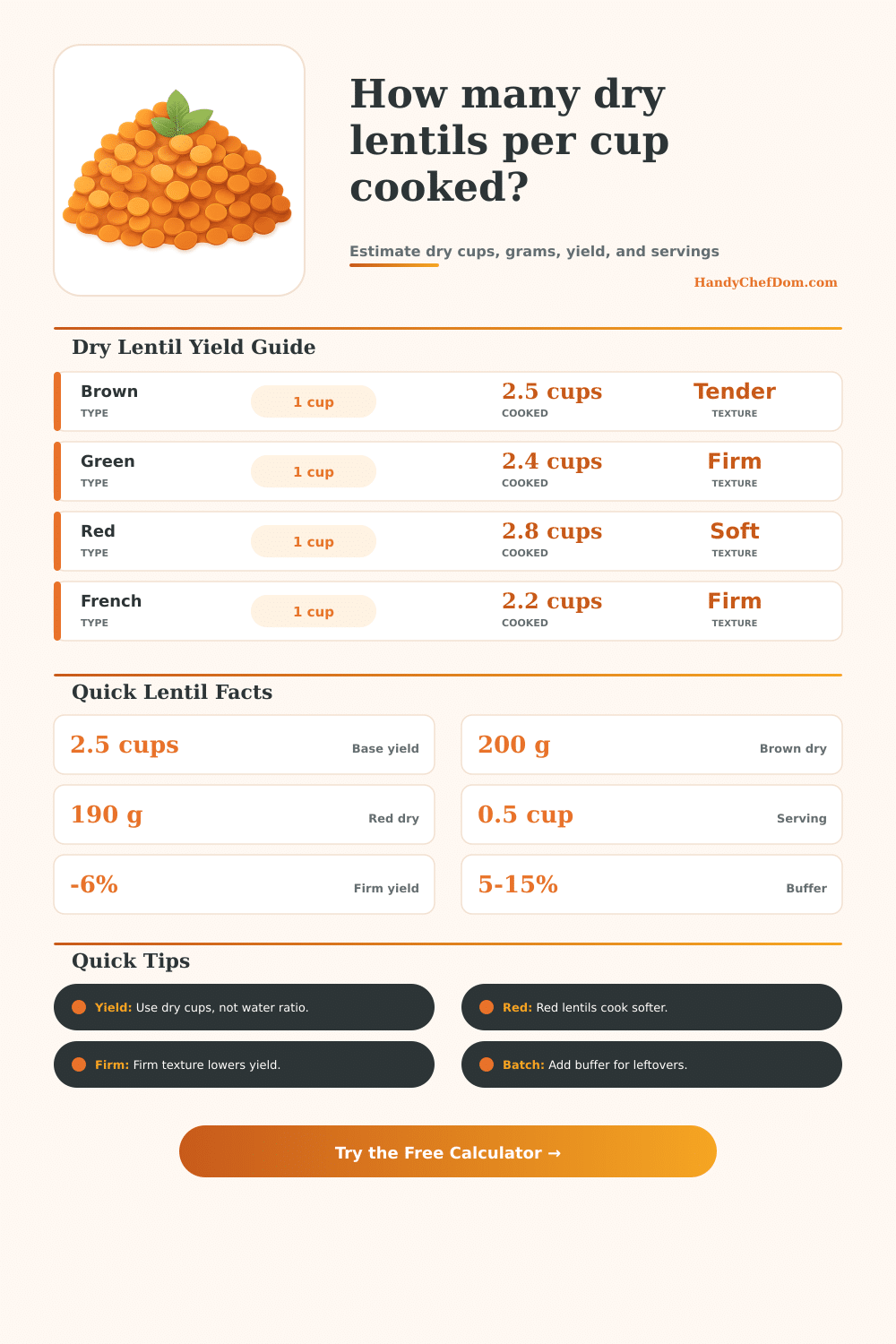
This is a dry-lentils-needed calculator, not a water-to-lentils calculator. It starts from the common kitchen reference that 1 cup dry lentils yields about 2.5 cups cooked, then adjusts by lentil type and texture.
Best everyday baseline when you need a cooked cup target for sides, soups, and meal prep.
Red lentils break down more easily, so the cooked volume can look higher and softer.
Firm lentils hold shape, so they often need a bit more dry volume for the same cooked cups.
Beluga lentils stay compact and are useful when the final dish needs distinct grains.
| Lentil type | Cooked cups from 1 dry cup | Best texture | Yield planning note |
|---|---|---|---|
| Brown lentils | About 2.5 cups cooked | Tender but intact | Default baseline for the calculator and most meal prep portions. |
| Green lentils | About 2.4 cups cooked | Tender to firm | Hold shape better than brown lentils, so yield is slightly lower. |
| Red lentils | About 2.8 cups cooked | Soft or creamy | Split red lentils soften and spread, especially for dal or soup. |
| French green lentils | About 2.2 cups cooked | Firm | Small dense lentils need more dry cups for the same cooked volume. |
| Black beluga lentils | About 2.3 cups cooked | Firm and distinct | Compact cooked shape makes them reliable for salads and bowls. |
| Yellow split lentils | About 2.7 cups cooked | Soft | Similar to red lentils when cooked until loose and creamy. |
| Dry lentil type | Approx grams per dry cup | Approx ounces per dry cup | When to weigh instead |
|---|---|---|---|
| Brown lentils | 200 grams | 7.1 ounces | Use grams for repeatable meal prep and large batches. |
| Green lentils | 195 grams | 6.9 ounces | Useful for firm bowls where a small difference shows. |
| Red lentils | 190 grams | 6.7 ounces | Weigh when the cooked texture will be very soft. |
| French green lentils | 205 grams | 7.2 ounces | Small lentils pack densely in the cup. |
| Black beluga lentils | 200 grams | 7.1 ounces | Best for salad batches where uniform texture matters. |
| Yellow split lentils | 192 grams | 6.8 ounces | Good for dal-style planning with a soft finish. |
| Serving style | Cooked lentils per person | Dry lentils per person | Best use |
|---|---|---|---|
| Salad topper | 1/4 cup cooked | About 0.10 dry cup | Use when lentils are one ingredient among greens and grains. |
| Soup add-in | 1/3 cup cooked | About 0.13 dry cup | Good for brothy soup where lentils share the bowl. |
| Side dish | 1/2 cup cooked | About 0.20 dry cup | Common portion next to rice, vegetables, or protein. |
| Main bowl | 1 cup cooked | About 0.40 dry cup | Use for hearty bowls, dal, or lentil-heavy plates. |
| Type | Yield direction | Texture tendency | Water note in this calculator |
|---|---|---|---|
| Brown | Average cooked expansion | Tender, flexible, everyday | Secondary water starts near 2.5 cups per dry cup. |
| Green | Slightly lower than brown | Firm when watched closely | Water can stay moderate if you drain after simmering. |
| Red | Higher apparent yield | Soft, creamy, breaks down | Extra water may be useful, but yield is the main calculation. |
| French or black | Lower, compact yield | Firm, separate, salad friendly | Use enough water to cover well, then drain for precise texture. |
Lentils is a food item that changes in volume when the lentils are cook, and the lentils change in volume because the lentils absorb liquid while being cooked. The dry volume of lentils are not the same as the volume that the lentils will be cooked. In order to determine how many dry lentils will be needed to prepare, you must first determine the number of cooked lentils that is desired.
The number of cooked lentils that will be prepared will depend upon the type of lentils that is to be use in the preparation of the dish; different types of lentils will expand at different rate when cooked. Brown lentils are one type of lentil that typically expands at a mediumly rate. Red lentils are another type of lentil that often break down more easy than brown lentils when cooked, causing the cooked red lentils to appear to occupy more space within the prepared dish.
How Lentils Change Size When Cooked
Finally, French and black lentils are two additional type of lentils; however, French and black lentils tend to remain compact when cooked, suggesting that more dry lentils will need to be use in the preparation of a dish that contain French lentils or black lentils. Finally, the texture of the lentils will also influence the amount of space that the lentils will occupy in the prepared dish. The volume of lentils can change if the lentils are rinsed or soaked prior to cooking.
If the lentils is rinsed, the dust on the lentils can be removed, but the volume of the lentils will not change as a result of rinsing. However, soaking the lentils in water for an extended period of time will allow the lentils to absorb the water prior to cook, which will increase the volume of the lentils that will be cooked. Another factor that will affect the volume of lentils that will be cooked is the method that is use to cook the lentils.
Because a pressure cooker will retain the moisture of the lentils, but because water will evaporate during an open simmer, the volume of lentils that will be cooked during each of these processes may be different. Furthermore, another consideration regarding the volume of lentils that will be cooked is the manner in which the lentils are to be served. For instance, an individual may feel that a smaller portion of lentils is sufficient when the lentils are to be served as a part of a meal that also includes vegetables, but may feel that the same portion of lentils is not enough if the lentils are to be served in a soup.
Thus, the decision of how the lentils are to be served will allow an individual to decide how many dry lentils should be cooked. Furthermore, an individual may also decide in advance to prepare additional lentils then can be served to determine how many dry lentils to begin cooking in order to provide enough lentils for each individual that may desire additional servings of lentils. Finally, the age of the lentils and the equipment that will be used to cook the lentils may also impact the process.
For instance, if the lentils are relatively old, it may be necessary to add additional water to the lentils and to cook the lentils for a longerer period of time compared to if the lentils are fresh. Additionally, the shape and size of the cooking pot and the lid may impact the amount of water that evaporate from the lentils while they are being cooked. Thus, the calculated amount of dry lentils can be utilized to begin cooking the lentils, but the amount of dry lentils may be adjusted according to the lentils and equipment that is use in the kitchen.
Thus, if the volume of lentils that are to be cooked is thought about first, it will be possible to accuratelyly plan the number of dry lentils that should be utilize in the recipe.