🥚 Egg Carb Calculator
Estimate total carbs, net carbs, protein, fat, and batch scaling for whole eggs, whites, yolks, cooking methods, dairy, cheese, and vegetable mix-ins.
Choose egg count, egg size, whether you are using whole eggs, whites, yolks, or a split mix, then add dairy, cheese, vegetables, servings, and target batch scaling.
Approximate values use large egg equivalents; size changes scale the egg portion in the calculator.
| Egg item | Total carbs | Fiber | Net carbs | Protein | Fat |
|---|---|---|---|---|---|
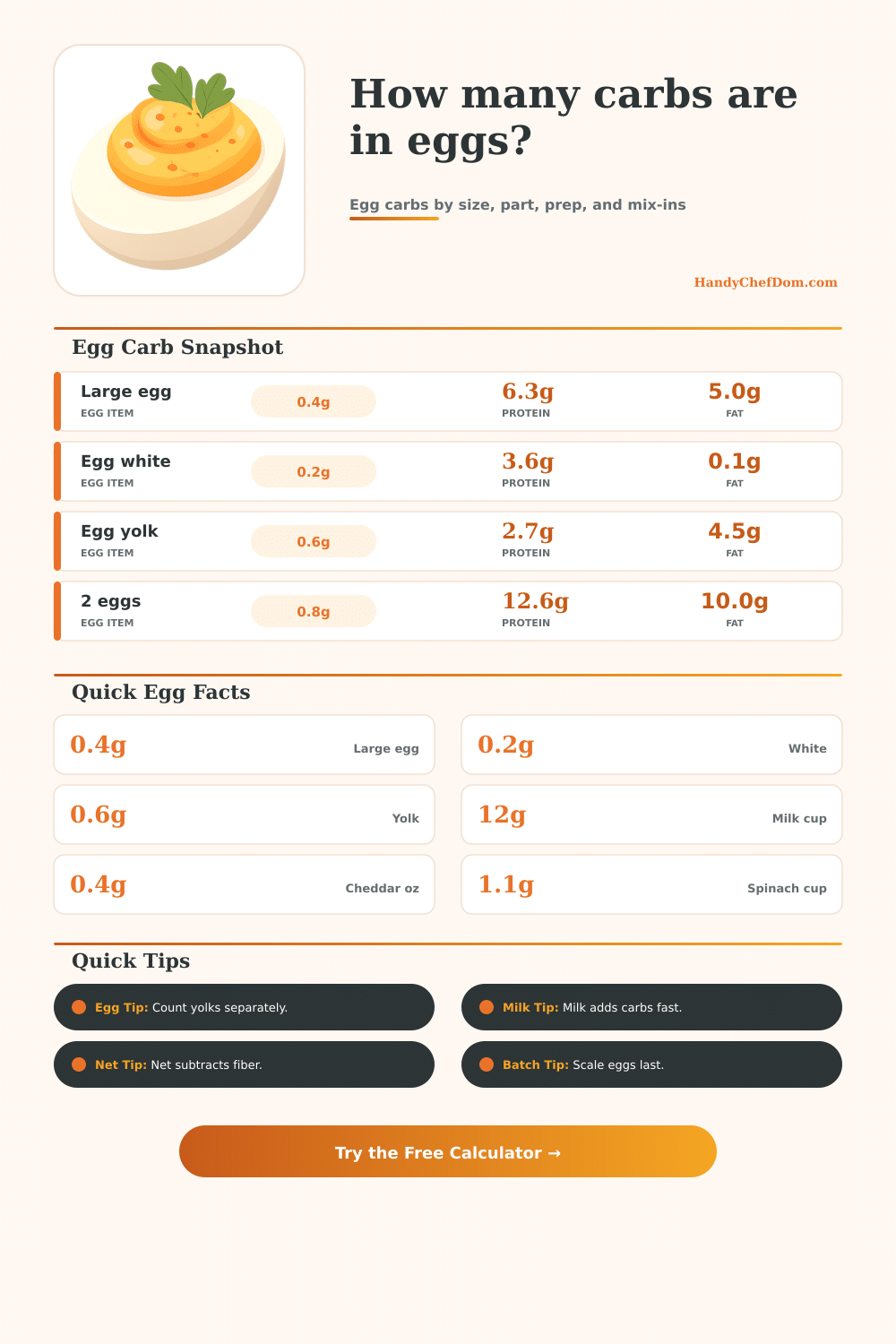
| 1 large whole egg | 0.4 g | 0.0 g | 0.4 g | 6.3 g | 5.0 g |
| 1 large egg white | 0.2 g | 0.0 g | 0.2 g | 3.6 g | 0.1 g |
| 1 large egg yolk | 0.6 g | 0.0 g | 0.6 g | 2.7 g | 4.5 g |
| 2 large whole eggs | 0.8 g | 0.0 g | 0.8 g | 12.6 g | 10.0 g |
| 3 large whole eggs | 1.2 g | 0.0 g | 1.2 g | 18.9 g | 15.0 g |
| Cooking method | Carb effect | Finished yield | Best use |
|---|---|---|---|
| Boiled or poached | No carb change | 100% | Simple snacks, salads, deviled eggs |
| Scrambled | Add-ins matter most | 96% | Milk, cream, cheese, and soft vegetables |
| Omelet | Fillings drive carbs | 95% | Cheese, spinach, mushrooms, peppers |
| Fried eggs | Fat adds no carbs | 98% | Butter or oil changes fat context only |
| Baked egg dish | Dairy can add carbs | 93% | Frittatas, casseroles, meal prep slices |
| Muffin tin egg cups | Veg mix-ins add fiber | 92% | Portioned breakfast batches |
| Add-in | Reference amount | Total carbs | Fiber | Protein | Fat |
|---|---|---|---|---|---|
| Whole milk | 1 cup | 12.0 g | 0.0 g | 8.0 g | 8.0 g |
| Heavy cream | 1 cup | 6.6 g | 0.0 g | 5.0 g | 88.0 g |
| Unsweetened almond milk | 1 cup | 1.4 g | 0.7 g | 1.0 g | 2.5 g |
| Cheddar cheese | 1 ounce | 0.4 g | 0.0 g | 7.0 g | 9.4 g |
| Spinach | 1 cup raw | 1.1 g | 0.7 g | 0.9 g | 0.1 g |
| Bell pepper | 1 cup chopped | 9.0 g | 3.1 g | 1.5 g | 0.3 g |
| Serving plan | Typical eggs | Egg-only net carbs | Protein context | Batch note |
|---|---|---|---|---|
| Snack for 1 | 1 to 2 eggs | 0.4 to 0.8 g | 6 to 13 g | Good for boiled eggs or quick scrambles |
| Breakfast for 2 | 4 eggs | 1.6 g | 25 g | Add dairy separately for a softer scramble |
| Meal prep for 4 | 8 eggs | 3.2 g | 50 g | Use target servings to scale egg cups |
| Frittata for 6 | 10 to 12 eggs | 4.0 to 4.8 g | 63 to 76 g | Vegetables and milk often exceed egg carbs |
| Tray for 12 | 12 eggs | 4.8 g | 76 g | Deviled eggs often use yolks and fillings |
They are eggs. You’re likely convinced they’re the carb-free champ of brekkie. For a long time you had reason to believe so. But then you tossed some mushroom into the skillet to change the texture and splashed on a bit of milk to make things fluffy, and your ideal low-carb number begin to wobble. Sometimes it’s not even about the egg itself. A lot of times it’s about what goes in the pan around it.
Once you plug in your exact combination of yolks, whites, veggies, and dairy into the calculator above, it’ll do the arithmetic for you, no more guessing as to how those little extras compare to your protein base. But here’s the thing: Eggs aren’t one-size fits all, yet most folks assume they are. A small egg weigh less than a jumbo egg; it has slightly fewer carbs but much more fat. For simplicity’s sake, most nutrition labels base their numbers on “large” eggs, which means your numbers will differ from the label if you’re using farm-fresh giants or smaller birds. The calculator accounts for size, so you’ll be measuring the stuff in your bowl instead of some assumed average. It makes a difference if you’re carefuly monitoring macros.
How to Count Carbs in Eggs Correctly
But there’s another piece: cooking method. Mostly that shows up as addition of fats and yield. An egg, boiled, isn’t altered chemically inside itself at all. Fried up, sure, it’s got some fat but no carbs. Scrambled? That’s when things get interesting, since we can add cream or milk that dissolves right into the protein network. That’s where you might see unexpected rise in carbohydrate. Whole milk alone will contribute more carbs then two large eggs, combined. Seems backwards, I know; who thinks of milk as anything but a minor player here? But dairy tends to exceed those eggs on volume front in terms of sugary goodness. The tool gives you space to plug in exact quantities of dairy (milk type, cream, even oat milk alternatives) to break it down.
For those aiming to get most protein while minimizing carbohydrate intake, egg whites are your friend. They contain negligible carbohydrates and almost no fat. Most nutrition is in the yolk, which also has most of the flavor and slightly more sugar. By separating them out, you gain some control over the overall profile. Do you want more volume and a fluffier omelet? Add some additional whites. Want it rich, not so much? Use a couple fewer yolks. This type of precision is possible thanks to tool’s split-input feature. It understands that even though you may want to use two yolks for richness, you’re also going to use six whites for added protein. This is a popular meal prep trick to increase protein without increasing unnecessary calories or fat.
The same goes for veggies. Onions and bell peppers adds natural sugars; spinach doesn’t really have an effect, aside from adding more fiber and wilting down. If you get too carried away with onions or peppers, it’s not hard to double the carb content of your egg dish (one cup of chopped peppers will do that). Use the food calculator and see what happens when you add a handful of veggies. The amount varies depending on whether you’re liberal with the veggies, and it also takes into account the mix-ins. Raw veggies are high in sugar but it’s not always obvious until they’ve been concentrated and cooked down.
Most home cooks falter when they start trying to scale up recipes. For example, maybe a scrambled egg recipe works well for two eggs. You might try to make it for four and forget to change the amount of cheese and milk to match. Either way there’s too much something, or not enough of something else. When you’re batching things up with the batch scaling feature, you can see how everything scales together, so that no matter if it’s one snack or a dozen egg cups for the week, the flavor stays intact.
The point is that eggs are a blank slate. Eggs are protein and structure; everything else relies on whatever else you put on top. If you know where you’re getting carbs from, you can tinker without compromising flavor. If you understand the trade-off, you can enjoy your creamy scramble. This isn’t so much about restriction as it is about understanding. When you realize how your vegetables, cheeses, and milks pairs with the primary protein, you won’t be guessing anymore… You’ll plan accordingly. And the numbers aren’t limits, they’re leverage. Down to the gram, you get to choose exactly what you fuel up for breakfast. You should of checked the math first.