☕ Coffee Roasting Weight Loss Calculator
Calculate roast yield, moisture loss percentage, and green bean input for any roast level
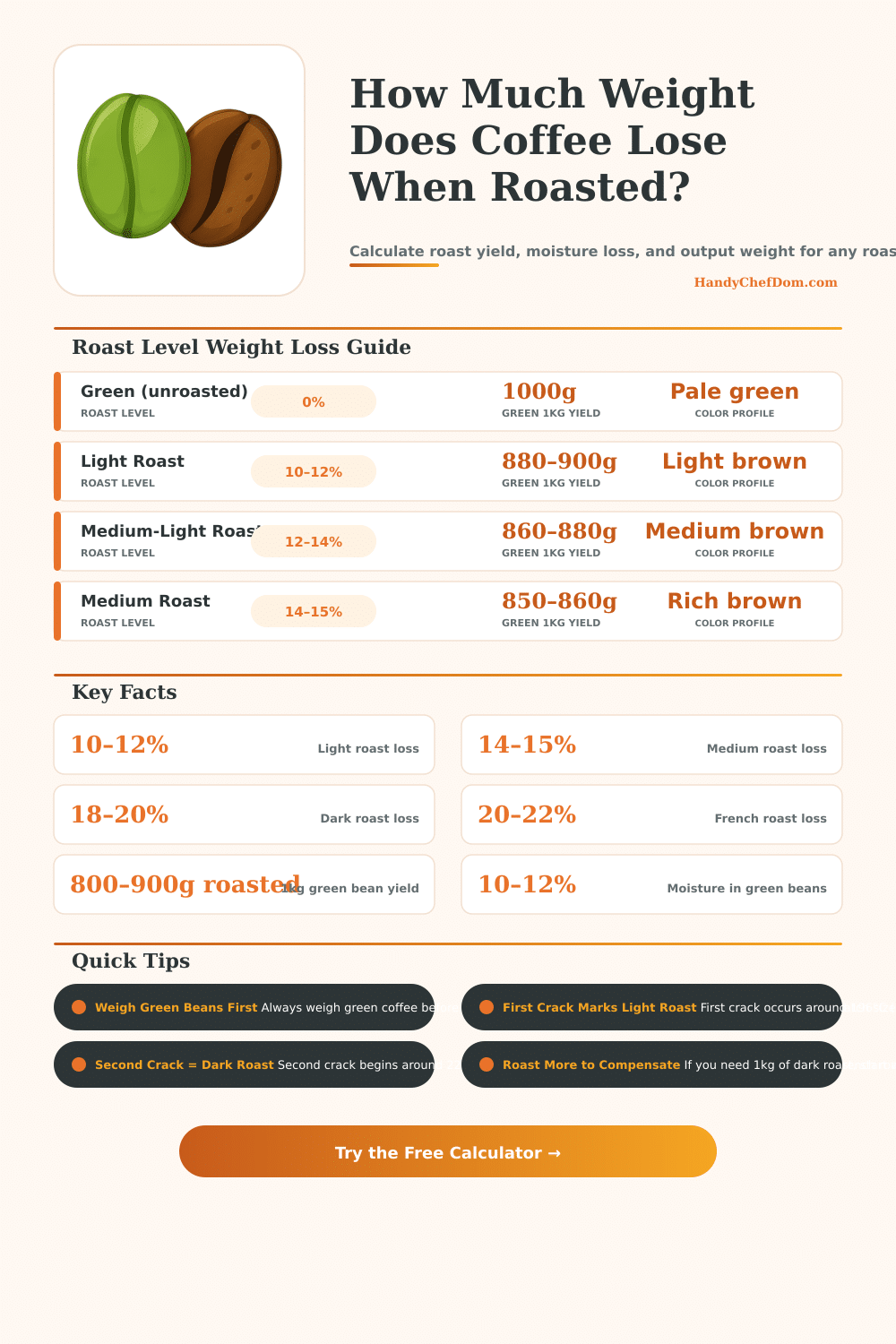
| Roast Level | Loss % | Yield from 1kg | Green Needed for 1kg |
|---|---|---|---|
| Light Roast | 10–12% | 880–900g | 1,111–1,136g |
| Medium-Light | 12–14% | 860–880g | 1,136–1,163g |
| Medium Roast | 14–15% | 850–860g | 1,163–1,176g |
| Medium-Dark | 15–17% | 830–850g | 1,176–1,205g |
| Dark Roast | 18–20% | 800–820g | 1,220–1,250g |
| French Roast | 20–22% | 780–800g | 1,250–1,282g |
| Italian Roast | 22–25% | 750–780g | 1,282–1,333g |
| Stage | Temperature | Roast Level | Loss Range |
|---|---|---|---|
| Drying phase | 100–160°C | Green / Yellow | 0–5% |
| Browning phase | 160–196°C | Light tan | 5–9% |
| First crack begins | 196°C (385°F) | Light roast | 10–12% |
| Post first crack | 200–215°C | Medium roast | 13–16% |
| Second crack begins | 224°C (435°F) | Dark roast | 17–20% |
| Post second crack | 230–245°C | French / Italian | 20–25% |
You look at coffee (that black), bitter drink that became everyday habit for millions of folks. One prepares it by Coffee Roasting and grinding coffee beans, and the result is something very bitter with smell that most people love or handle because of the caffeine boost. Talking about that, that stimulating effect comes from the caffeine itself.
It works everywhere. If caffeine is not for you, there are caffeine-free versions and also many replacements for coffee lovers who want to quit it entirely.
Basic Facts About Coffee
The coffee plant itself is a tropical evergreen bush that started in Africa believe it or not. Of the types, arabica and robusta lead the market. Robusta stores more caffeine and commonly has a rubbery, too bitter taste compared to the softer profile of arabica.
Coffee ranks between the thirty most drunk drinks in the world, right up with water and tea, and from a business view, it is very profitable on a global level.
Here where it gets weird: the standard serving for coffee in United States is indeed six ounces, not eight. Most people do not know that, because we think of a cup as eight ounces, right? But the makers of coffee commonly consider one cup as five ounces.
So, when you see a machine marked “12 cups“, that is not near twelve standard eight-ounce servings. Coffee shops, on the other hand, live in their own wrold, they serve you from eight ounces up to 32 or even 44 ounces, depending on the size that you order.
Coffee is not a replacement for food, although it can serve as that. The caffeine helps to stay alert, which explains why so many folks grab cups most recently after waking. Adding more grounds to the filter could seem like a weigh to more caffeine, but indeed it does not work like that.
Really you only pull out more flavor and bitterness, the caffeine amount stays almost the same.
Study after study showed that regular, moderate coffee drinking can be good for health. Folks that drink coffee commonly have lower risks of diabetes, stress, heart disease and some kinds of cancers and dementia, according to watched data. The benefits are biggest when you do not mix it with cream and sugar.
Even so, in 2018, one American state decided to require warning labels about cancer on coffee anyhow.
Methods for making coffee show up everywhere. French press is liked for home use, while pour over cones work well for single servings. Electric drip machines are more efficient with grounds and usually give better taste than the stovetop versions.
Turkish coffee brings a whole other mode, it is dense and strong, which gives both the caffeine push and rich taste. Around the world, drinkers ofcoffee have their own tastes and ways.