Espresso Shots Caffeine Calculator
Estimate caffeine from espresso shot style, volume, bean roast, extraction strength, decaf blend, body weight, and drinking window.
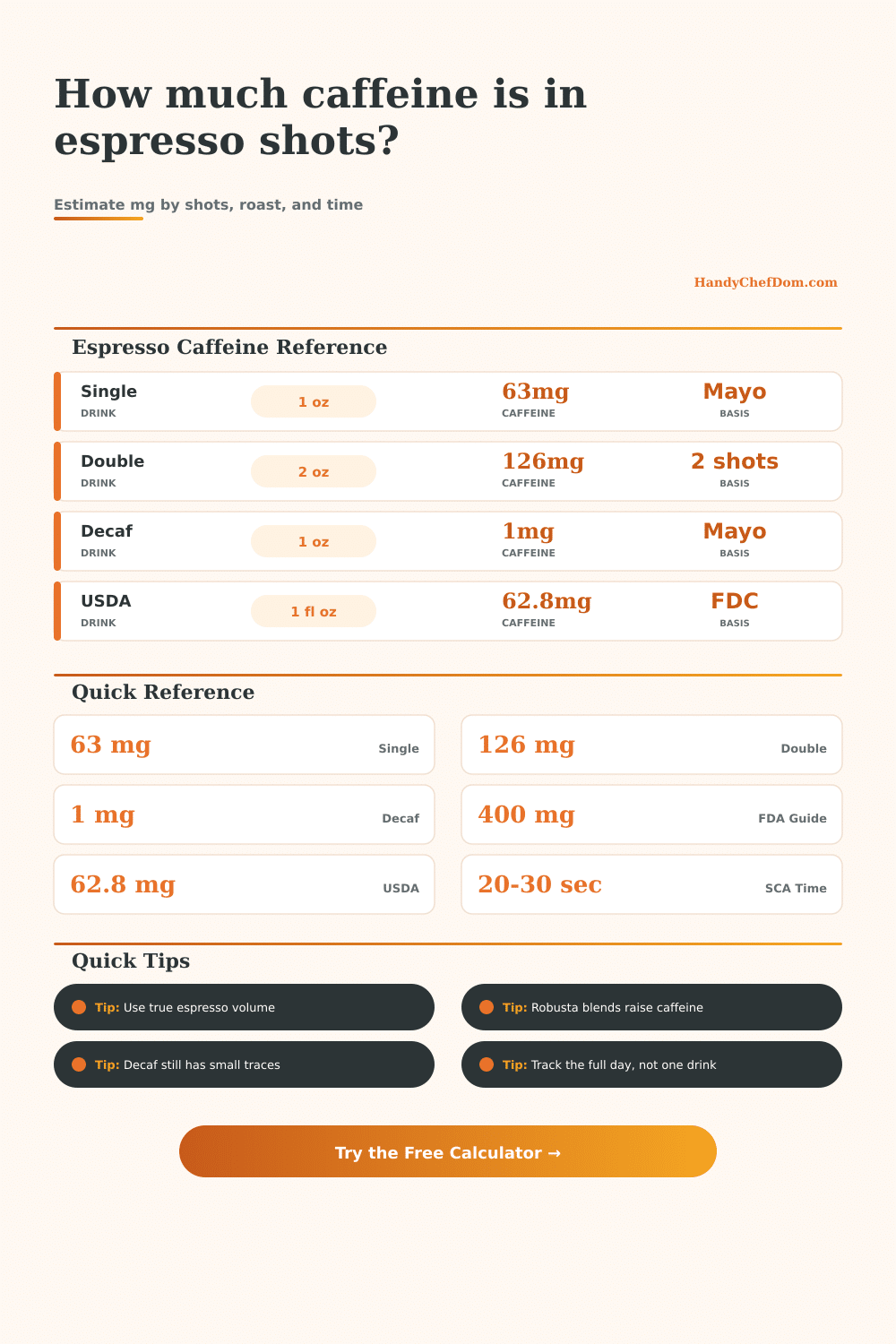
| Espresso Drink | Typical Volume | Baseline Caffeine | Decaf Equivalent | Best Use |
|---|---|---|---|---|
| Single espresso | 1 fl oz / 30 ml | 63 mg | 1 mg | Standard one-shot estimate |
| Double espresso | 2 fl oz / 60 ml | 126 mg | 2 mg | Most milk drink bases |
| Triple espresso | 3 fl oz / 90 ml | 189 mg | 3 mg | Large latte or strong order |
| Ristretto pair | 1.5 fl oz / 44 ml | 110 mg | 2 mg | Shorter, concentrated pulls |
| Lungo single | 2 fl oz / 60 ml | 75 mg | 2 mg | Longer pull from one dose |
| Custom espresso | User entered | 62.8 mg/fl oz | 1 mg/fl oz | Measured shop or home volume |
| Factor | Setting | Multiplier | Why It Changes | Calculator Use |
|---|---|---|---|---|
| Bean profile | Light roast Arabica | 1.06 | Slightly higher per volume estimate | Brighter light roast shots |
| Bean profile | Medium Arabica | 1.00 | Baseline against 63 mg shot | Default espresso estimate |
| Bean profile | Dark roast Arabica | 0.94 | Slightly lower per volume estimate | Dark roast home shots |
| Bean profile | Classic espresso blend | 1.08 | Often includes higher-dose blends | Cafe-style milk drinks |
| Bean profile | 50% Robusta blend | 1.45 | Robusta commonly carries more caffeine | High-caffeine blends |
| Extraction | Under-extracted | 0.88 | Lower dissolved caffeine estimate | Sour or fast-pulled shots |
| Extraction | Balanced | 1.00 | Matches normal espresso baseline | Standard recipe |
| Extraction | High-yield | 1.14 | More liquid and solubles extracted | Longer or dialed-up pulls |
| Scenario | Shots | Volume | Caffeine | % FDA Guide | mg/kg at 160 lb | Window Rate |
|---|
| Reference | Caffeine Amount | Applies To | Calculator Meaning |
|---|---|---|---|
| Mayo Clinic espresso | 63 mg per 1 oz | Typical espresso | Main shot baseline |
| Mayo Clinic decaf espresso | 1 mg per 1 oz | Typical decaf espresso | Decaf replacement baseline |
| USDA FoodData Central | 62.8 mg per fl oz | Restaurant-prepared espresso | Cross-check for baseline |
| FDA adult guide | 400 mg per day | Most healthy adults | Percent of daily guidepost |
| FDA rapid high dose warning | About 1200 mg | Rapid intake risk context | Not a target or recommendation |
| SCA-style espresso range | 20-30 sec pull | Barista recipe context | Extraction setting guide |
So you go through your morning routine expecting to feel clear-minded, only to find yourself jittery because there’s no way for you to be sure what’s in that cup. A double shot latte seems reasonable, so you order it, but then when you walk out of cafe you’re anxious. The problem isn’t that it was bad coffee. The problem is that you can’t account for that hidden variable: the caffeine content.
Most of us view espresso as a fixed amount of energy, but it act less like an energy source and more like a chemical reaction that changes every time you change something at the espresso machine. All that means there’s no need for guesswork; does that light, fruity bean have as much (or less) kick than the dark, oily one right beside it? No worries: The calculator up top will do all the math for you, based off the exact roasting profile and volume you entered.
Why Coffee Caffeine Levels Change
Caffeine molecules themselves don’t degrade over time, but they’re not equally spread out among each type of bean. Generally speaking, Robusta beans contains more caffeine than Arabica, which is why some espresso mixtures can feel so much heavier on the system, despite appearing to be of equal volume. You’re actualy receiving a far higher dose per ounce than what the average person would assume.
The other wrinkle that throws off most casual coffee drinker is roast level. It’s a common misconception that more bitter/dark tasting coffees has higher levels of caffeine because they are “darker” roasts. Usually the reverse is true. As a coffee bean is roasted longer, it will lose some of its structure (including caffeine). So in theory, a very dark roast may provide slightly less caffeine per volume then a lighter roast (given an equal dose).
This is where density matter. Because dark roasted beans are less dense and will expand more, you’ll fit fewer beans into your portafilter by weight. If you’re dosing based on weight instead of volume, then that darker blend may end up providing a lighter shot. By allowing you to choose which type of bean you’re working with and what style of extraction you want, the tool takes all these subtle changes into account.
Overestimating/underestimating how much decaf espresso I’ve had is another thing. Decaf doesn’t mean zero. Most of the time, there is just enough left behind (usually about a milligram per ounce) that it won’t make a difference for most people. However, it could of matter for someone who is really sensitive to it or trying to avoid any caffeine whatsoever.
Trying to mix regular with decaf to get half caf? Math gets complicated to do in your brain. Enter the calculator. Just put in what percent of decaf you’re using, and it will combine the baselines so you know exactly how much you’re getting.
While the number of milligrams matters, so does timing. Taking 200 mg of caffeine in one sitting will affect your body more then taking the same dose spread out across four hours. To address this, the app also allows you to specify a window during which you drank your coffee. That way, the app can tell you how quickly you’re exposing yourself to stimulants. This is especially true if you’re a home brewer or barista pulling several shot throughout a work day or morning routine.
Caffeine perception is also partly influenced by body weight. What’s moderate on me may feel like an overload on someone else. The output includes a milligrams-per-kilogram metric to give you some personal perspective on what you’re drinking compared to health recommendations. This is meant to build awareness, not to cause fear. Yes, you want to know where you are in relation to those four-hundred-milligram-a-day guideposts that we see floated around by health organizations all the time.
In short, monitoring your coffee doesn’t require precise counting; it requires knowing your limits. Coffee makers, roasters, and cafés is all different, and they vary greatly from one to another. It’s just important to have a starting point to at least guess what you’re putting into your body instead of guessing based off label terms. Begin with the fundamentals, pay attention to how you feel, and tweak as needed. With a bit more care poured into that cup, that daily ritual can still be something special.