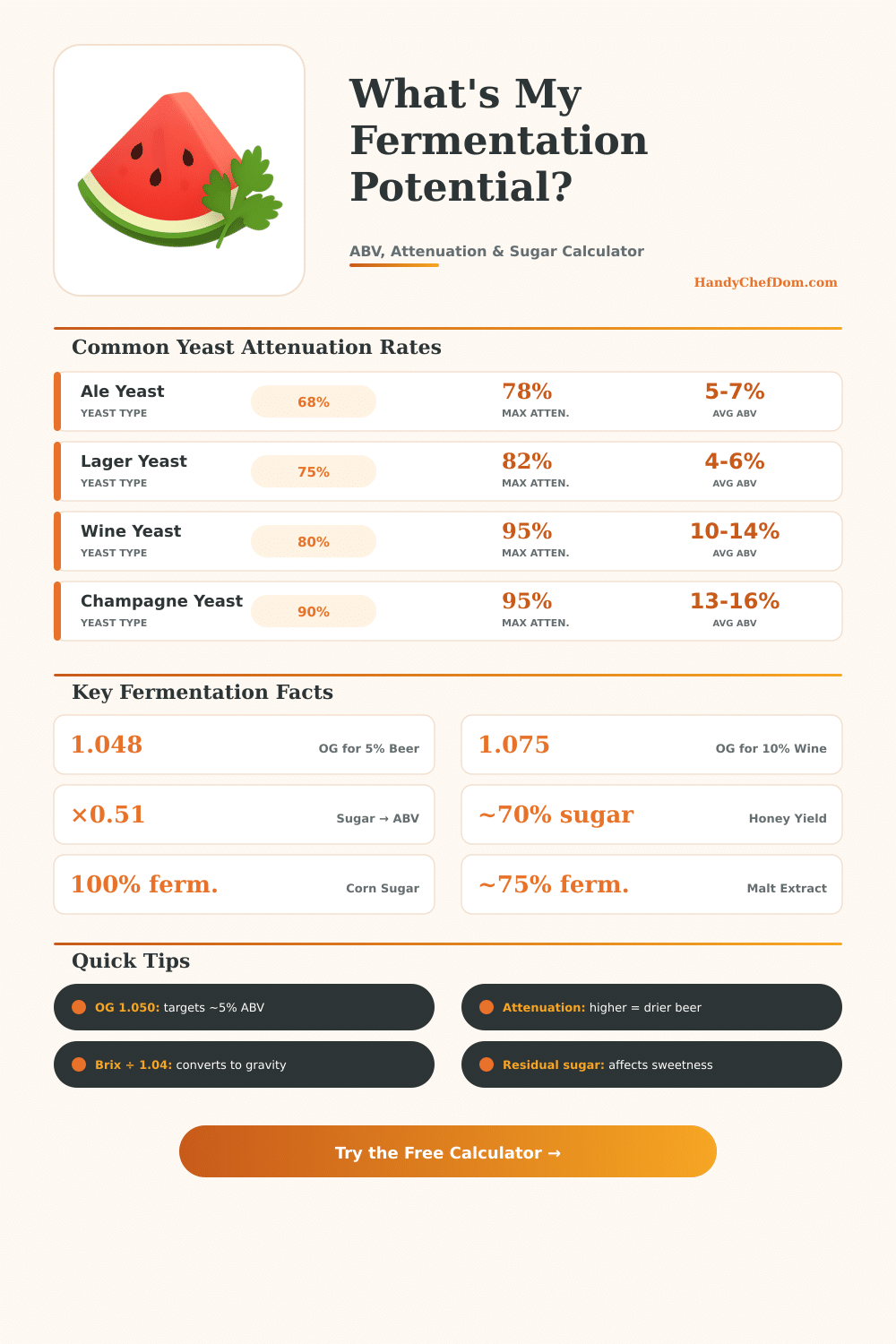
🍻 Fermentation Potential Calculator
Calculate estimated ABV, attenuation, residual sugar & apparent extract from gravity readings
| SG | °Plato | °Brix | Sugar (g/L) |
|---|---|---|---|
| 1.020 | 5.1°P | 5.2 | 51 |
| 1.030 | 7.6°P | 7.8 | 77 |
| 1.040 | 10.0°P | 10.3 | 103 |
| 1.050 | 12.4°P | 12.7 | 128 |
| 1.060 | 14.7°P | 15.2 | 153 |
| 1.070 | 17.1°P | 17.6 | 179 |
| 1.080 | 19.3°P | 20.0 | 204 |
| 1.090 | 21.6°P | 22.4 | 230 |
| 1.100 | 23.8°P | 24.8 | 255 |
| 1.120 | 28.1°P | 29.5 | 306 |
| Style | OG Range | FG Range | ABV % |
|---|---|---|---|
| American Lager | 1.040–1.050 | 1.004–1.010 | 3.2–4.0 |
| Pale Ale | 1.045–1.060 | 1.010–1.015 | 4.5–6.2 |
| IPA | 1.056–1.075 | 1.010–1.018 | 5.5–7.5 |
| Stout | 1.050–1.075 | 1.010–1.022 | 4.0–7.0 |
| Belgian Tripel | 1.075–1.085 | 1.008–1.014 | 7.5–9.5 |
| Dry Cider | 1.045–1.065 | 0.999–1.006 | 5.5–7.0 |
| Dry Wine | 1.080–1.095 | 0.990–1.000 | 10.0–13.0 |
| Sweet Wine | 1.090–1.110 | 1.010–1.025 | 10.0–14.0 |
| Mead (Dry) | 1.080–1.120 | 0.996–1.010 | 10.0–15.0 |
| Barleywine | 1.080–1.120 | 1.016–1.030 | 8.0–12.0 |
| Yeast Strain | Type | Attenuation | Alcohol Tolerance | Flocculation |
|---|---|---|---|---|
| Safale US-05 | American Ale | 72–80% | 11% ABV | Medium |
| Safale S-04 | English Ale | 73–77% | 9% ABV | High |
| Nottingham | English Ale | 74–82% | 14% ABV | High |
| WY1056 | American Ale | 73–77% | 11% ABV | Low |
| WY3787 | Belgian HG | 74–78% | 12% ABV | Medium |
| WY2124 | Bohemian Lager | 73–77% | 9% ABV | Medium |
| Lalvin 71B | Wine | ~90% | 14% ABV | Medium |
| EC-1118 | Champagne | ~92% | 18% ABV | Low |
| Lalvin D47 | Wine (White) | ~90% | 15% ABV | Medium |
| Lalvin RC212 | Wine (Red) | ~84% | 16% ABV | Medium |
Fermentation is a chemical process, in that molecules like glucose break down without need of oxygen. It belongs to anaerobic metabolic processes, so oxygen must not participate. In this process organic substances, for instance sugars, break into parts, and their electrons move to other organic parts.
Like this one receives ATP for energy, together with organic products like carbon dioxide and ethanol.
What Is Fermentation and How It Works
Two main kinds exist. Alcoholic Fermentation changes pyruvate into carbon dioxide and ethanol. Lactic acid Fermentation converts pyruvate to lactic acid.
Both start from pyruvate, that appears during glycolysis. Basically, Fermentation helps to regenerate NAD+, so that glycolysis can last. That means to produce energy without oxygen what is useful in various cases.
This method already exists for at least 10 000 years. Old populations used microbial cultures to preserve foods, prepare alcoholic drinks and improve the value of foods, from yoghurt to tempeh. One applied Fermentation to create wines, mead, cheeses and beers a lot before any knew the science behind it.
Microorganisms, like bacteria and yeasts, break foods during Fermentation, what gives fresh flavors and precious parts. Fermented foods use separate kinds of fungi or bacteria, that avoids dangerous by-products. If food simply decomposes, no one controls what grows, and it can make folk sick.
Hence Fermentation is intentional and controlled mode, in which fit conditions alter the raw state of food into something nice and delicious.
Compared to salting, Fermentation touches a more broad set of foods, including breads, soy sauce and cheeses. The intention is to modify the taste, the makeup and the duration of use. Sauerkraut and kimchi receive their bitter flavor from the Fermentation itself.
Fermented foods also are seen as a source of prebiotics and probiotics.
In industry Fermentation also plays a role. Substances like acetic acid, citric acid and ethanol all produce by means of Fermentation. Progress in biotechnology now mean scientists control germs very closely.
One calls that precise Fermentation, what helps too create ingredients for foods, proteins, vitamin and fibers.
The gut microbiome truly ferments fiber from foods to create useful acids like butyric acid and propionic acid. Some of those gut germs generate gases, what explains where the bloating comes from because of fiber. Fermenting separate foods can make foods more accessible for the body, for instance fermenting milk reduces the content of phytic acid.
Fermentation requires sugar. If sugar ends, the Fermentation halts. Also the salt level matters, because bacteria, that does the work, works best at a certain saltlevel.
Less salt boosts the process, while more salt slows it.