Sous Vide Time and Temperature Calculator
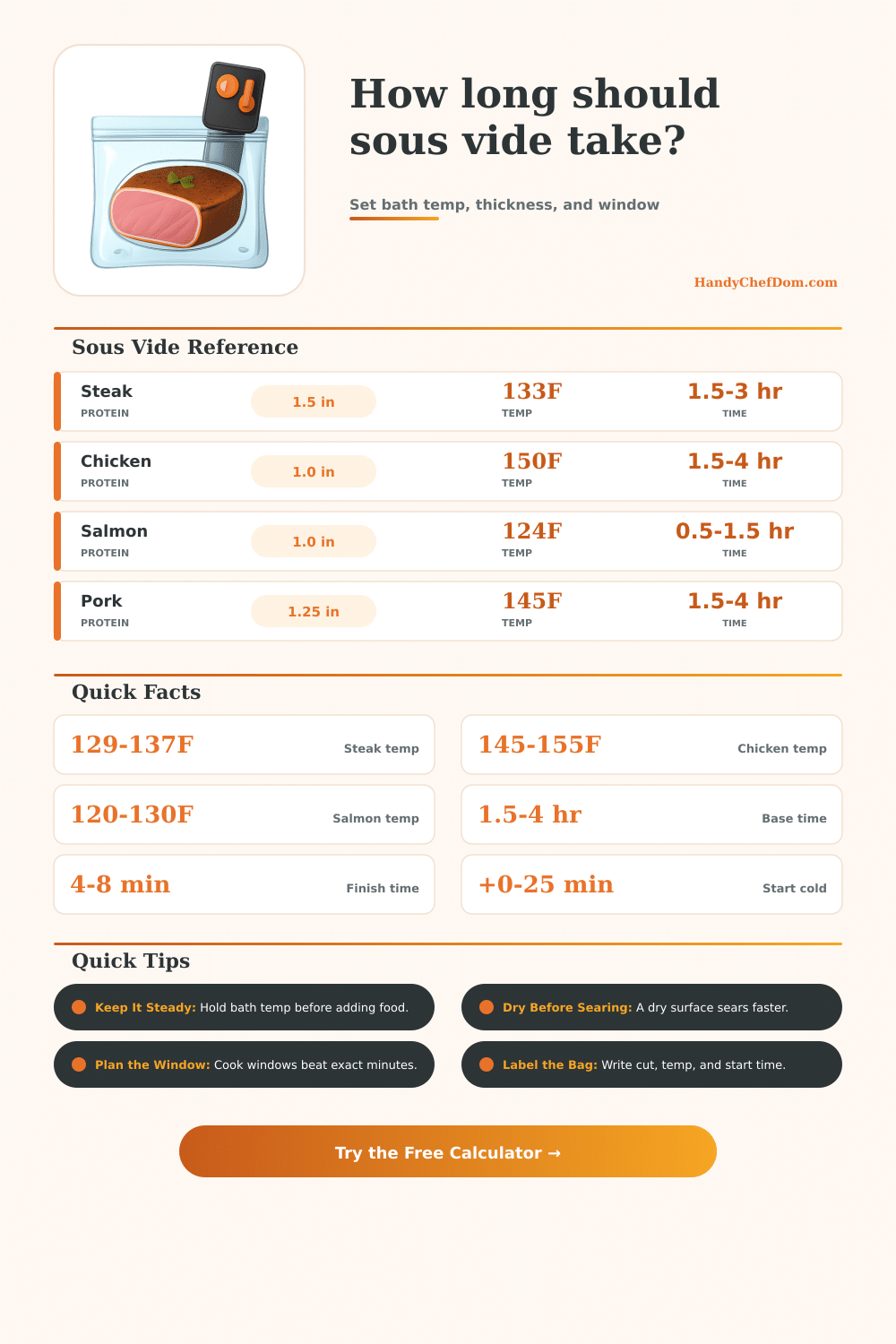
Dial in bath temperature, thickness, and cook window for steak, chicken, salmon, pork, and more with a sous vide calculator.
Choose the protein, thickness, and start temperature. The calculator turns those into a bath target, minimum time, and a practical serving window.
| Protein | Tender | Balanced | Firm |
|---|---|---|---|
| Ribeye | 129F | 133F | 137F |
| Chicken | 145F | 150F | 155F |
| Salmon | 120F | 124F | 130F |
| Pork chop | 140F | 145F | 150F |
| Thickness | Steak | Chicken | Fish |
|---|---|---|---|
| 0.75 in | 1-1.5 hr | 1.5-2 hr | 0.5-1 hr |
| 1.0 in | 1.5-2 hr | 1.5-2.5 hr | 0.5-1.25 hr |
| 1.5 in | 2-3 hr | 2.5-4 hr | 1-1.5 hr |
| 2.0 in | 3-4 hr | 3-5 hr | 1.25-2 hr |
| Start Temp | Adj / in | Use | Note |
|---|---|---|---|
| Fridge | 0 min | Default | Standard |
| Chilled | -6 min | Fast prep | Slightly faster |
| Room | -12 min | Fresh prep | Shorter wait |
| Frozen | +28 min | Freezer | Needs extra time |
| Finish | Add-on | Texture | Note |
|---|---|---|---|
| Hot sear | 6 min | Crusty | Most common |
| Torch | 4 min | Even | Gentle color |
| No sear | 0 min | Soft | Serve as is |
| Butter baste | 8 min | Rich | Deep flavor |
Sous vide cooking is a method of cooking food by placing the food in a vacuum bag and placing that bag in a temperature-controlled water bath. Many people uses sous vide cooking because of the precise control of the temperature and texture of the food. The process involve slowly adding heat to the food from all sides by allowing the water to penetrate the food.
The thickness of the food is the most important factor in determining how long the food will cook in the water bath. The thicker the food, the more longer the food will cook. Thin food will cook to the desired temperature more fast than thick food.
How to Use Sous Vide
The temperature of the food will determine it’s texture when it is cooked. You should select the temperature based on the type of food being cooked. For example, steak should be cooked to 130 degrees Fahrenheit to ensure it are tender.
Chicken should be cooked to between 145 and 155 degrees because chicken require higher temperatures to ensure it is safe to eat. Salmon, being a fish, should be cooked to 120 degrees because fish is delicate and require lower temperatures to maintain its silky texture. The texture of the food will decide the temperature at which the food should be cooked.
The time that the food is cooked depends on the thickness of the food being cooked and it’s starting temperature. Food that is thin will take less than an hour to cook. Food that is thick and larger than two inches in thickness may take four hours or more to cook.
If the food that is to be cooked starts at a cold temperature, such as food that is taken from the refrigerator, more time will be required to allow the food to reach the temperature of the cooking water. If multiple portion of food are to be cooked at once, the cooking water may drop in temperature when you add the food to the water. More time will be needed to allow the water to reach cooking temperature again.
The strength of the circulation of water in the bath will impact how quickly the food will be cooked. If the water circulation is strong, the food will cook more quick. If the circulation of water is weak, it will take longer for the food to cook.
An excessive amount of food should not be added to the bath at once because it will prevent the circulation of water around each portions of food. If the water is not circulating around the food, the food may not cook even. After the cooking process in the bath, the food can be cooked again in another pan to create a crust on the food.
For instance, a steak can be cooked in a pan to create a crust on it. Prior to cooking the steak in the pan, the cook should dry the steak with a towel to prevent it from steaming in the pan. A torch can also be used to sear the food.
This method is gentler then cooking in a pan. Some food, like vegetable, dont require a second cooking process because there texture is complete after being cooked in the bath. There are some mistake that can be made when using sous vide cooking techniques.
One mistake is adding too much food to the vacuum bags. The food will not cook even because of the trapped air in the bag. Another mistake is ignoring the pasteurization process required for food safety.
Sous vide cooking allow food to be pasteurized at lower temperatures. The food should be kept at these low temperatures for long enough to allow the food to be pasteurized. Lastly, the temperature of the water bath must be measured with a thermometer.
The temperature circulators for sous vide baths may not maintain the target temperature for the food. Sous vide cooking techniques can be used for food items other than meat. Vegetables can be cooked at 183 degrees to make them tender.
Eggs can be cooked in a sous vide bath to make custards. Eggs are an easy food to cook in a sous vide bath because the shell of the eggs provide some insulation for the eggs while they cook. Sous vide cooking methods can be used to prepare proteins, vegetables, and desserts.
By using the sous vide cooking method, there is a minimum time that the food will cook in the water bath to ensure that it reaches the necessary temperature for safety through pasteurization. However, there is a larger window of time during which the food can be cooked. This time allows cooks to prepare meal in advance and hold the food until they are ready to eat the food.
The cooks can manage their time by preparing meals in advance by using the sous vide cooking method.