Freezer Load Calculator for Food Storage
Check how much food fits, how fast a fresh batch can freeze, and how much headroom remains in a chest or upright freezer.
📌Load Presets
Each preset loads a real food mix, a practical freezer type, and a batch window so the math stays close to actual kitchen storage decisions.
⚙Load Inputs
Freezer load snapshot
Enter a food mix and compare space, capacity, and batch pace against the freezer's practical limit.
📑Reference Tables
| Food | Lb/cu ft | Best pack | Why it fits |
|---|---|---|---|
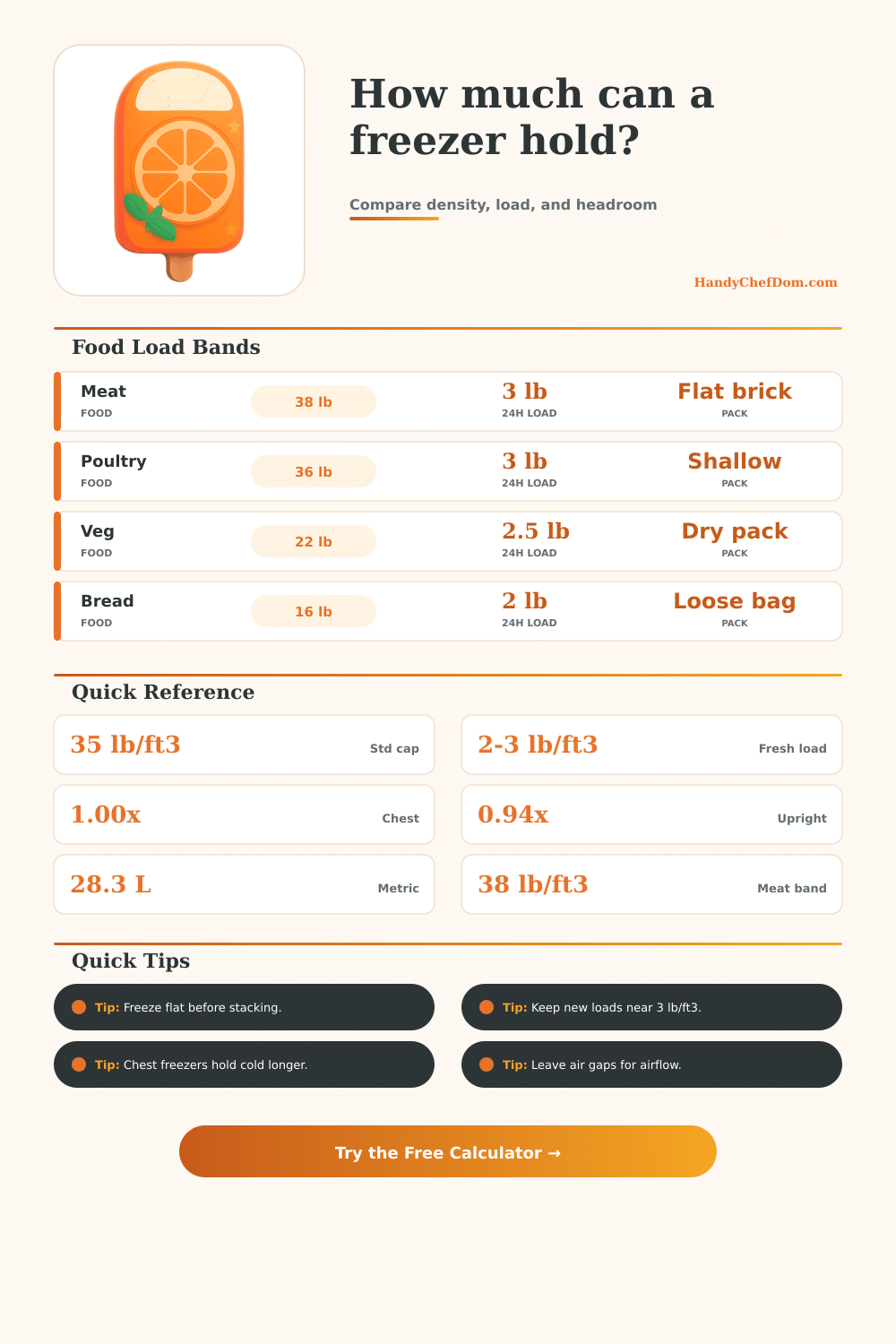
| Meat cuts | 38 | Flat brick | Dense, stacks well |
| Poultry | 36 | Shallow tray | Needs head space |
| Fish | 34 | Vacuum pack | Thin packs freeze fast |
| Vegetables | 22 | Dry pack | Lots of air between pieces |
| Fruit | 28 | Syrup bag | Depends on syrup or dry |
| Casseroles | 24 | Baking pan | Flat top helps stacking |
| Bread/dough | 16 | Loose bag | Soft packs waste room |
| Soup/stew | 30 | Narrow tub | Liquid needs expansion room |
| Freezer type | Storage factor | 24h factor | Practical read |
|---|---|---|---|
| Chest | 1.00 | 1.00 | Best stacking |
| Upright | 0.94 | 0.95 | Shelves steal room |
| Frost-free | 0.90 | 0.90 | Air movement trims space |
| Fridge-freezer | 0.85 | 0.85 | Smallest true freezer side |
| Usable size | Frozen lb | 24h load | Fit note |
|---|---|---|---|
| 5 cu ft | 175 | 12.5 | Light family stash |
| 8 cu ft | 280 | 20 | Shared side freezer |
| 12 cu ft | 420 | 30 | Bulk food zone |
| 20 cu ft | 700 | 50 | Big chest load |
| Load sample | Weight | Space | Read |
|---|---|---|---|
| Meat bricks | 60 lb | 1.6 cu ft | Tight but normal |
| Veg bins | 40 lb | 1.8 cu ft | Big air share |
| Soup tubs | 30 lb | 1.0 cu ft | Leave headspace |
| Bread bags | 16 lb | 1.0 cu ft | Soft and bulky |
📊Load Profile
💡Tips
Freezer management require an understanding of the relationship between the density of the foods to be stored, the shape of the package in which the food is to be stored, and the type of freezer in which the food are to be stored. Many people attempts to load there freezers with a large amount of food at once. However, if too many food is loaded into the freezer at once, the center of the food will remain at refrigerator temperature while the outer layer of the food will have had time to freeze.
If the center of the food remains at refrigerator temperatures, bacteria can grows within that food; therefore, you should take care to avoid this situation by either loading the food in smaller batches, or by chilling the food in the refrigerator before you place it into the freezer. The density of the food to be stored in the freezer can vary. For instance, meat is a dense food; vacuum sealed meat can weigh 38 pounds per cubic foot.
How to Store Food in Your Freezer
Meat contain no air pockets, therefore, it allow for more weight to be stored in a specific volume of the freezer. In contrast, vegetables are less dense than meat. Vacuum-sealed vegetables can weighs approximately 22 pounds per cubic foot.
Vegetables contains air pockets between the vegetables, which take up space within the freezer compartment. Furthermore, because vegetables contain air pockets, cold air are able to penetrate the vegetables more quick than dense meats. In addition to the type of food to be stored, the type of freezer that is used can impact the amount of food that can be stored.
For instance, chest freezers has more raw capacity to store food than upright freezers. Freezers have raw capacity because chest freezers do not have shelves to take up space within the freezer. Furthermore, upright freezers may have less usable space within the freezer due to the built-in shelves within those freezers.
Additionally, frost-free freezers may have less usable space within the appliance than non-frost free models. In frost-free freezers, an additional amount of space must be provided for the food to circulate through the appliance. In any case, it is recommended to leave some empty space within the freezer; leaving some space within the appliance allows for a more steady temperature to be maintained within the appliance, in the case that the power to the refrigerator fails, or if the lid of the refrigerator isnt close completely.
Another factor to consider in the management of a freezer is the rate at which the freezer can freeze new food. Typical freezers can freeze approximately two to three pounds of food per cubic foot every 24 hours. Freezers cannot freeze food at a faster rate; if an amount of food is placed into the freezer that the freezer cannot freeze in a 24 hour period, the temperature within the freezer will rise.
Therefore, you should take care to only load the freezer with food that the freezer can handle in a 24 hour period; large amounts of food should be split into several days. Finally, the size of the food parcel to be frozen will also impact the rate at which the food freezes. Food parcels that is large will take longer to freeze than small parcels of the same food; large parcels of food may take 48 hours to reach the desired frozen state.
In addition to the considerations regarding the food to be stored, the type of packaging in which the food is to be stored will also impact the way in which the food is stored in the freezer. For instance, vacuum-sealed packaging can allow for more food to be stored due to the ability of the packages to be stacked. Food that is in loose bags will take up more space within the freezer; the air pocket within those packages will take up space.
Flat packages are best used when as much of the food as possible needs to be stored; trays can be used for food like poultry, to allow cold air to circulate through the food. Finally, food like casseroles should not be stored in glass container within the freezer; aluminum pans allow for better distribution of cold air to the food. Last, it is important to understand that a freezer that contains food is often more energy-efficient than an empty freezer.
The filled refrigerator holds the cold better than an empty refrigerator. In this case, however, you should avoid an overloaded freezer. An overloaded refrigerator will make the compressor within the appliance work harder to maintain an efficient freezer temperature.
A compressor that constantly works hard will place strain on the appliance, and lead to increased energy cost. Therefore, 85% full is an ideal percentage of food to fill a freezer. By managing the density of the foods to be stored, by following the freezing rates for the food, and by using the appropriate packaging for the food products, it is possible to efficiently store a lot of food in a home freezer.