Kitchen Calorie Burn Calculator
Estimate real kitchen calorie burn from prep pace, stove heat, carrying load, and break-adjusted active minutes.
Formula: Calories = MET x 3.5 x body kg / 200 x active minutes, then adjusted by pace, heat, load, and station-trip factors.
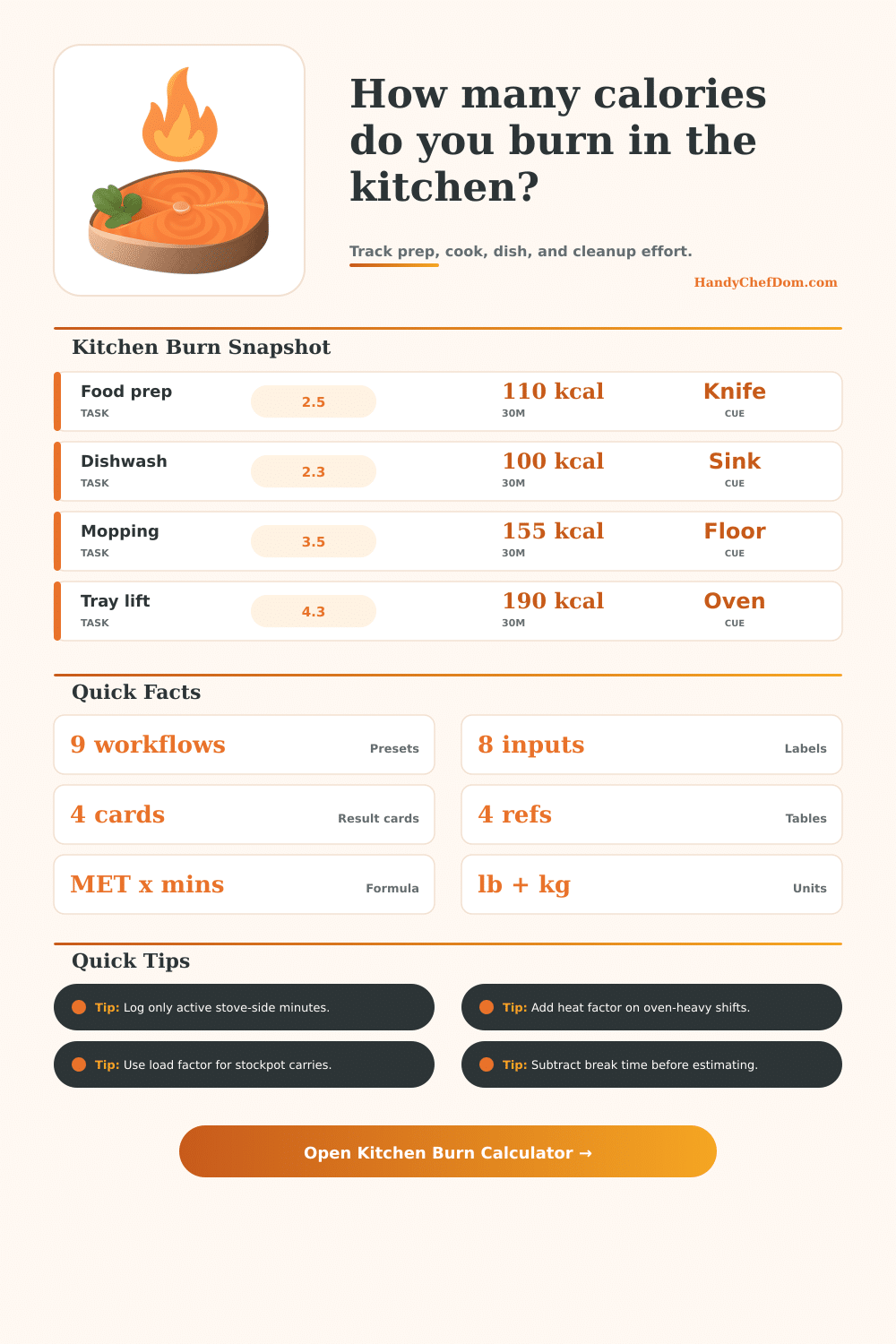
| Task | MET | Focus | Typical block |
|---|---|---|---|
| Food prep | 2.5 | Knife + bench | 30-90 min |
| Stove cook | 3.0 | Stir + plate | 20-75 min |
| Baking trays | 2.8 | Rack handling | 30-120 min |
| Dishwashing | 2.3 | Scrub + rinse | 15-60 min |
| Counter scrub | 2.7 | Wipe + polish | 10-40 min |
| Mop sweep | 3.5 | Floor passes | 15-50 min |
| Market unload | 3.8 | Bag lifting | 10-35 min |
| Hot tray carry | 4.3 | Pan transport | 10-30 min |
| Task MET | 130 lb | 160 lb | 190 lb |
|---|---|---|---|
| 2.3 Dish | 102 kcal | 125 kcal | 149 kcal |
| 2.5 Prep | 111 kcal | 137 kcal | 162 kcal |
| 3.0 Stove | 134 kcal | 164 kcal | 194 kcal |
| 3.5 Mop | 155 kcal | 191 kcal | 225 kcal |
| 4.3 Tray | 191 kcal | 234 kcal | 279 kcal |
| Input | Level | Factor | When useful |
|---|---|---|---|
| Pace | Steady | 1.00x | Normal prep |
| Pace | Rush | 1.10x | Service peaks |
| Pace | Nonstop | 1.18x | Back-to-back |
| Heat | Cool | 1.00x | Cold prep |
| Heat | Warm | 1.04x | Warm line |
| Heat | Hot | 1.08x | Oven station |
| Load | Light | 1.05x | Bowls, pans |
| Load | Heavy | 1.15x | Full trays |
| Input | Level | Factor | Use case |
|---|---|---|---|
| Trips | 0 per 10 | 1.00x | Single station |
| Trips | 10 per 10 | 1.03x | Short shuttles |
| Trips | 20 per 10 | 1.06x | Expo shuttle |
| Trips | 30 per 10 | 1.09x | Wide kitchen |
| Floor | Rubber mat | 1.00x | Grip support |
| Floor | Tile | 1.03x | Hard surface |
| Floor | Mixed | 1.02x | Station hops |
Kitchen work are a physical exertion as it requires a number of calories due to the nature of the movements and tasks perform in the kitchen. Although many people may not realize it, the tasks required of kitchen staff does actualy count as a physical activity that is as demanding than a workout, especially in the requirement to perform lifting and standing for long period of time. In addition, people feel tired after performing kitchen tasks due to the long period of time that they must perform micro-movements in the kitchen, as well as potentially due to a hot environment in which they perform there tasks.
The intensity of kitchen tasks are not constant, but instead may change according to the specific tasks that are performed at any given time. For instance, one task that may be performed in the kitchen may be dicing onion, which requires relatively low intensity to perform, but another task may be plating appetizer, which may require more higher levels of intensity. Because of these varying levels of intensity, it is difficult to estimate the number of calories that may be burned during kitchen tasks.
Calories Burned in the Kitchen
Instead, the calculator account for these varying intensities by utilizing MET (metabolic) value, which represent the amount of oxygen that is consumed during a task versus while standing still. Thus, the calculator can convert the feeling of tiredness after performing kitchen tasks into a number that represents the calories that were burned. Because the kitchen is a hot environment, heat is another factor that increase the calories that are burned.
Heat causes an increase in the heart rate of the individual, as does the effort that the body requires to cool itself while standing in the kitchen. The extra energy that is burned as a result of this effort can therefore be accounted for in the calculation of the calories that are burned while standing in the kitchen. Another factor is the weight of the objects that are moved in the kitchen.
For instance, lifting a heavy cast iron skillet requires more effort from the muscular system than lifting a plastic bowl. Furthermore, the effort that those muscles requires is greater in moving the heavy skillet with better muscular stability than with a light plastic bowl. Thus, the number of calories that are burned by an individual who lift heavy trays differs from those who remain standing in one place on a kitchen bench.
The type of floor that is utilized in the kitchen, as well as the movement that is performed in the kitchen, also impact the number of calories that are burned. For instance, standing on a hard tile floor requires more muscular effort to maintain ones stability in standing than standing on a rubber mat. Additionally, the more steps that are performed in the kitchen, such as from the refrigerator to the stove, the more calorie are burned.
While it may seem unlikely that anyone will account for the time spent moving between stations in the kitchen, such transit time is another component of the total energy expenditure of an individual who stands in the kitchen. Finally, it is impossible for any individual to stand in the kitchen and perform tasks at maximum capacity for the entire time that they stand. For instance, when standing in the kitchen, individuals must take break to stand for other tasks, such as waiting for water to boil or for the timer to finish.
Thus, it is necessary to make an adjustment for these periods of idling in the kitchen to account for the fact that fewer calories will be burned during these breaks. Should such periods of idling not be accounted for, the estimation of calories that will be burned is likely to be too high for the individual. To determine the number of calories that are burned while standing in the kitchen, it is possible to divide the standing time into separate time block.
For instance, individuals may have a period of time during which they perform prep task, another period in which they perform service tasks, and a third period during which they perform kitchen cleanup tasks. Each of these periods may have different levels of intensity to the tasks that are performed. Thus, each of these tasks may have different MET value.
The combination of each of these MET values will provide an individual with an idea of the total toll that there standing in the kitchen has taken upon their body. Thus, kitchen work may involve the preparation and service of food, but also the expenditure of energy.