🍮 Gelatin for Jello Shots Calculator
Estimate gelatin packets and grams for portioned gelatin dessert cups by liquid volume, cup size, firmness, sugar load, juice load, batch count, and chill time.
Use the total liquid that will go into the gelatin base. The calculator converts cups, cup count, packet size, sugar load, juice acidity, non-gelling liquid share, and chill time into a practical set-ratio target.
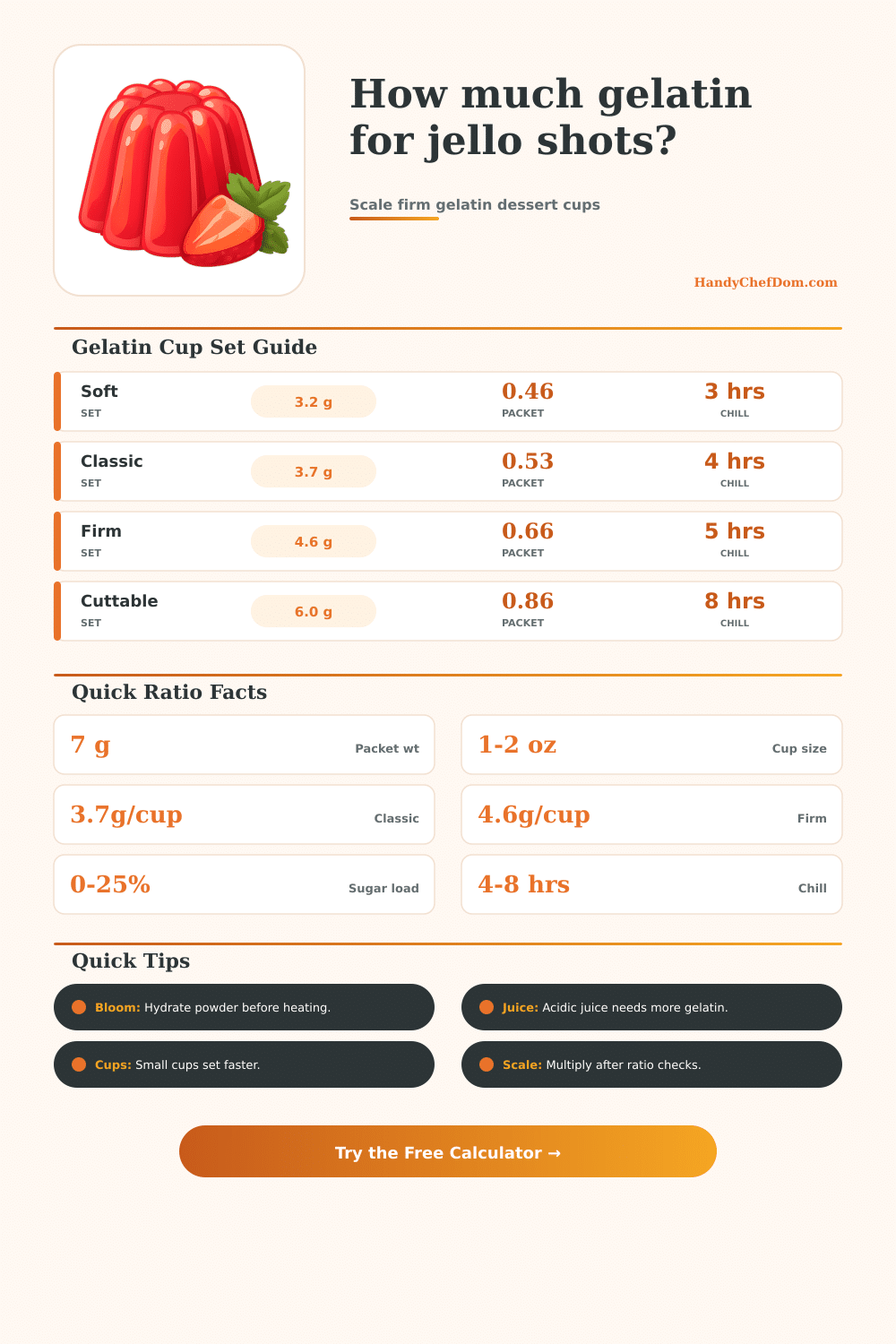
| Target Set | Base Gelatin Rate | Packets Per 4 Cups | Best Dessert Format |
|---|---|---|---|
| Soft spoonable dessert cup | 3.2 g per cup | 1.83 packets | Small cups that stay chilled in containers |
| Classic portion cup set | 3.7 g per cup | 2.11 packets | Standard gelatin dessert cups with a clean wobble |
| Firm unmoldable cup set | 4.6 g per cup | 2.63 packets | Portions that need extra structure from the cup |
| Extra-firm transport set | 5.2 g per cup | 2.97 packets | Sturdier small cups with high sugar or juice load |
| Cuttable cube or tray set | 6.0 g per cup | 3.43 packets | Tray cubes or lifted portions after a long chill |
| Total Liquid | 1 oz Cups at 90% | 2 oz Cups at 90% | Classic Gelatin Target |
|---|---|---|---|
| 2 cups / 16 fl oz | 17 cups | 8 cups | 7.4 g / 1.06 packets |
| 3 cups / 24 fl oz | 26 cups | 13 cups | 11.1 g / 1.59 packets |
| 4 cups / 32 fl oz | 35 cups | 17 cups | 14.8 g / 2.11 packets |
| 6 cups / 48 fl oz | 53 cups | 26 cups | 22.2 g / 3.17 packets |
| 8 cups / 64 fl oz | 71 cups | 35 cups | 29.6 g / 4.23 packets |
| 12 cups / 96 fl oz | 106 cups | 53 cups | 44.4 g / 6.34 packets |
| Formula Factor | Typical Range | Set Effect | Calculator Treatment |
|---|---|---|---|
| Added sugar or syrup | 0 to 0.35 cup per liquid cup | High sugar can soften the gel network | Adds up to a moderate gelatin boost |
| Mild juice or puree | 10% to 50% of liquid | Adds flavor liquid and mild acidity | Small to medium boost based on share |
| Citrus or lemonade | 10% to 60% of liquid | Acidic liquid needs more structure | Higher juice multiplier and chill cue |
| Tropical fruit liquid | 5% to 40% of liquid | Some fruits weaken gelatin strongly | Largest fruit multiplier in the formula |
| Non-gelling liquid share | 0% to 50% of liquid | Weakens the finished set | Raises gelatin target as the share rises |
| Short chill time | Under target chill window | Set has less time to become firm | Adds a chill-time correction factor |
| Gelatin Format | Strength Factor | Packet Math | Kitchen Note |
|---|---|---|---|
| Standard unflavored powder | 1.00x | Use label packet grams | Most predictable for ratio scaling |
| Flavored gelatin mix base | 0.95x | Use equivalent gelatin grams | Already includes sugar and flavor solids |
| Lower-bloom powder | 1.12x | More grams per cup | Helpful if prior batches set too softly |
| High-bloom dessert gelatin | 0.92x | Fewer grams per cup | Stronger gel at the same gram weight |
| Silver gelatin sheets | 1.05x | Weigh sheets for accuracy | Hydration varies by sheet size |
| Gold gelatin sheets | 0.98x | Weigh sheets for accuracy | Close to standard powder in this tool |
There are certain small decisions that affect the entire batch. One of them was getting gelatin correct on the jello shots. Add not enough and your cup will shimmy about until it becomes a puddle, too much and they become rubbery and don’t taste as good as we want. We’re aiming for a small easy-to-scoop portion size that maintains structure yet doesn’t feel like a science project.
Beyond the box size of your packets, other factors influence amount of gelatin you will use. How much liquid you’re using (and what type) affect things. Cup size and how full you fill them matter because that changes the number of servings. The same applies to contents of that liquid: the more sugar or acid you add to the jelly, the softer it will be. Increase the ratio to match your desired firmness. Liquids that don’t set at all, like spirit cocktails, has a similar impact, and the calculator includes the percentage when building target.
How to Get the Right Gelatin Amount
The tool’s firmness options reflect actual kitchen compromises: If the cups will be in the fridge up to service, go for a softer set. For slightly more wiggle room, like if you’re dealing with juicier recipes or transporting them, use a firmer version. And because shorter chill times mean more work… Meaning you need more gelatin to get it right by the time your guests arrive, that chill time input is also important. The calculator doesn’t make you guess how much higher, that number takes all of this into account.
Most of us think about total volume and neglect impact of cup size. A smaller cup will cool and set quicker than a large one. A large cup require additional time to get all that center firmed back up. When alcohol or purees are in the mix, the set will behave different than what you expect, and the tool incorporates this variation into its final suggestion.
That page has some reference tables for making these adjustments. They will give you an idea about what your final cup yield will be based off a given amount of liquid input, which will also help you plan out batches. You’ll get an idea about how to adjust things and still end up with something workable, once you wrap your head around why those adjustments work. More importantly, it teaches you what variables to pay attention to.
After scaling up the entire batch, things like packet size and type of gelatin don’t really matter as much as many would think. On the other hand, factors such as non-gelling liquids and acid level of your juices is much more important than indicated by the box label. It makes all the necessary adjustments and does the math for you while letting you focus on the actual parts that will make a difference.