🍞 Gluten Flour to Add to Bread Calculator
Convert lower-protein flour into bread-ready flour by calculating vital wheat gluten, adjusted water, final protein, and per-loaf additions.
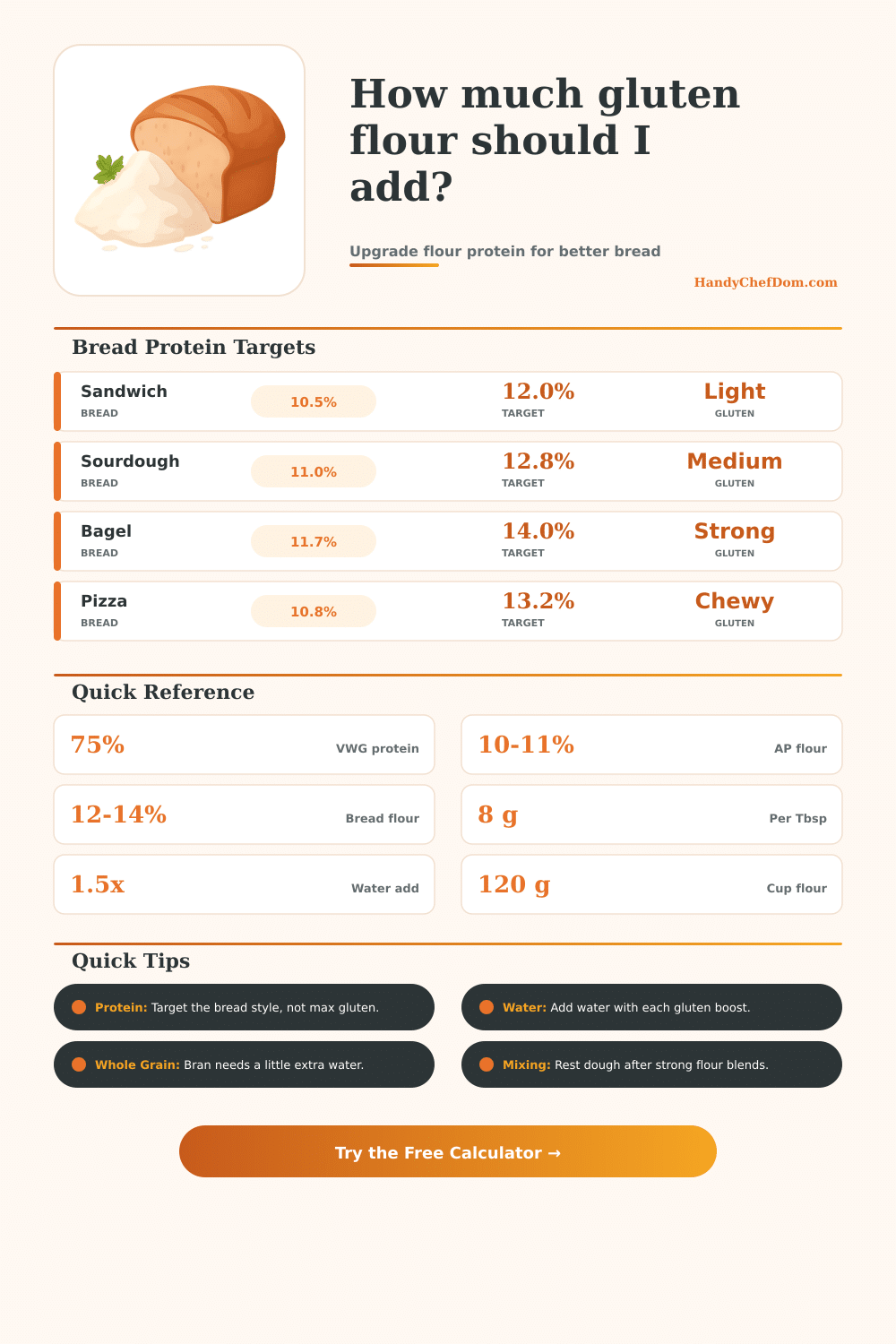
Use the protein equation gluten = flour weight x (target protein - current protein) / (vital gluten protein - target protein). The calculator treats vital wheat gluten as added flour and then estimates the extra water it needs.
| Bread Style | Typical Target | Dough Feel | Best Use |
|---|---|---|---|
| Soft sandwich loaf | 11.8% to 12.4% | Elastic but sliceable | Pan loaves, toast bread |
| Lean sourdough boule | 12.2% to 13.2% | Strong and extensible | Open scoring, long fermentation |
| Neapolitan-style pizza | 12.5% to 13.5% | Stretchy and chewy | High heat pizza dough |
| Bagels and pretzels | 13.5% to 14.5% | Very elastic | Dense chew and shaping strength |
| Enriched brioche | 12.0% to 13.0% | Strong but tender | Butter, eggs, sugar dough |
| Whole wheat bread | 12.8% to 14.0% | Strong with more water | Bran-heavy pan or hearth loaves |
| Starting Flour | Protein Range | g Per Cup | Calculator Note |
|---|---|---|---|
| Cake or pastry flour | 7.5% to 9.0% | 114 g | Needs a large gluten correction |
| Soft Southern all-purpose | 8.5% to 9.8% | 118 g | Good for tender bread, not bagels |
| Standard all-purpose | 10.0% to 11.2% | 120 g | Most common bread-flour upgrade |
| European-style flour | 11.0% to 11.8% | 125 g | Often needs a small boost only |
| Whole wheat flour | 13.0% to 14.0% | 113 g | Protein is high but bran weakens dough |
| Spelt flour blend | 11.0% to 13.0% | 110 g | Use moderate gluten and gentle mixing |
| Example Flour Batch | Start Protein | Target Protein | Approx Gluten Add |
|---|---|---|---|
| 500 g all-purpose flour | 10.5% | 12.5% | 16 g vital wheat gluten |
| 500 g soft flour | 9.0% | 12.5% | 28 g vital wheat gluten |
| 750 g pizza dough flour | 11.0% | 13.2% | 27 g vital wheat gluten |
| 1000 g bagel flour blend | 11.7% | 14.0% | 38 g vital wheat gluten |
| 600 g whole wheat dough | 13.0% | 13.6% | 6 g vital wheat gluten |
| 400 g brioche dough flour | 10.8% | 12.4% | 10 g vital wheat gluten |
| Hydration Situation | Adjustment Rule | Why It Matters | Example |
|---|---|---|---|
| Vital gluten addition | 12 g to 18 g water per 10 g gluten | Gluten hydrates heavily | 16 g gluten adds about 24 g water |
| Whole grain above 20% | Add about 0.12 hydration point per grain point | Bran and germ absorb water | 50% whole grain adds about 3.6% |
| Dry seeds or bran | Add about 0.25 g water per gram | Dry add-ins steal dough water | 30 g seeds add about 8 g water |
| Chewy dough target | Use higher protein but do not over-hydrate | Firm dough keeps shape | Bagel dough may stay near 55% |
| Open crumb dough | Pair gluten boost with rest time | Hydration develops extensibility | Ciabatta can pass 75% |
| Enriched dough | Small protein boost is often enough | Fat softens gluten structure | Brioche may target 12.5% |
If you use low-protein flour instead of the type you intended to bake, you may find your dough is slack and crumb is pale. This is especially true for breads like sourdough boules, which you want to have an open crumb, or bagels, which should be chewy. How do you fix it? With vital wheat gluten.
And how much? Also, how much more water will you have to add to the dough to compensate for added protein? Now all you have to do is feed in three data points and let the calculator do the rest. Tell it how much flour you’ll be using (in pounds or ounces), what’s listed on the label as the protein content (%), and what percent you’d like your finished bread to be (which can be differenter).
How to Fix Low-Protein Flour Bread
Then the tool spits out an estimate of how many grams of vital wheat gluten is required. And based off that, it tells you how much water (in milliliters) to include along with the gluten. Whether you’re mixing a batch by the cup or scaling up to make multiple loaves, this approach makes sense. The computer will change the figures to keep ratios intact.
It is not just about protein. It’s not just about protein. Bran in whole grain flours severs the gluten network and soaks up water. That’s why the calculator requests the percent whole grain in the flour blend. If you are making a dough containing three percent white, one percent rye and one percent wheat (for example), it will require slightly more water then an otherwise identical all-white recipe to reach the desired finished protein level. And it will require a slight increase in gluten as well.
Additional ingredients like seeds, dried fruit and bran pulled into the dough after mixing further dehydrate it. This demand are included in the calculation, no unexpected loss of hydration here. There’s also another subtle force: the desired strength of the final bread. For example, a pretzel dough needs to be chewy, so it can tolerates a slightly higher effective protein than a tender sandwich loaf. That target number is adjusted by the calculator.
So if your flour is near-ish its adjusted value, the calculation will indicate skipping the gluten. You should of save that energy for longer mix time and fermentation instead. For example, this tells me whether I need to make a large or small adjustment to my current bag, depending on the type of bread I am making and starting flour. It also reminds me that wheat gluten, which is essential to bread-making, are about seventy-five percent protein, a highly concentrated dose. Little goes a long way.
It’s a very practical habit to get into with this tool: First weigh out your flour, then determine what type of bread you wish to make. The calculator displays how much water you’ll need as well as the protein gap. With those two in hand, everything else falls into place. When you begin with precise measurements, mixing, resting and shaping feel more controlled.