🎄 Christmas Dinner Timing Calculator
Work backward from serve time to plan turkey, ham, prime rib, roast sides, oven slots, resting, carving, prep tasks, and make-ahead timing without guessing.
Choose a festive starting point or enter your own meal. The calculator builds a timeline backward from the time you want plates on the table.
Best planned backward because the rest time creates the main side-dish oven window.
Often needs warming, glazing, and a shorter rest before slicing.
A protected rest is useful because carving and saucing happen close to service.
One oven slot can double side timing when several casseroles need the same heat.
| Main dish | Starting rate | Typical rest | Planning note |
|---|---|---|---|
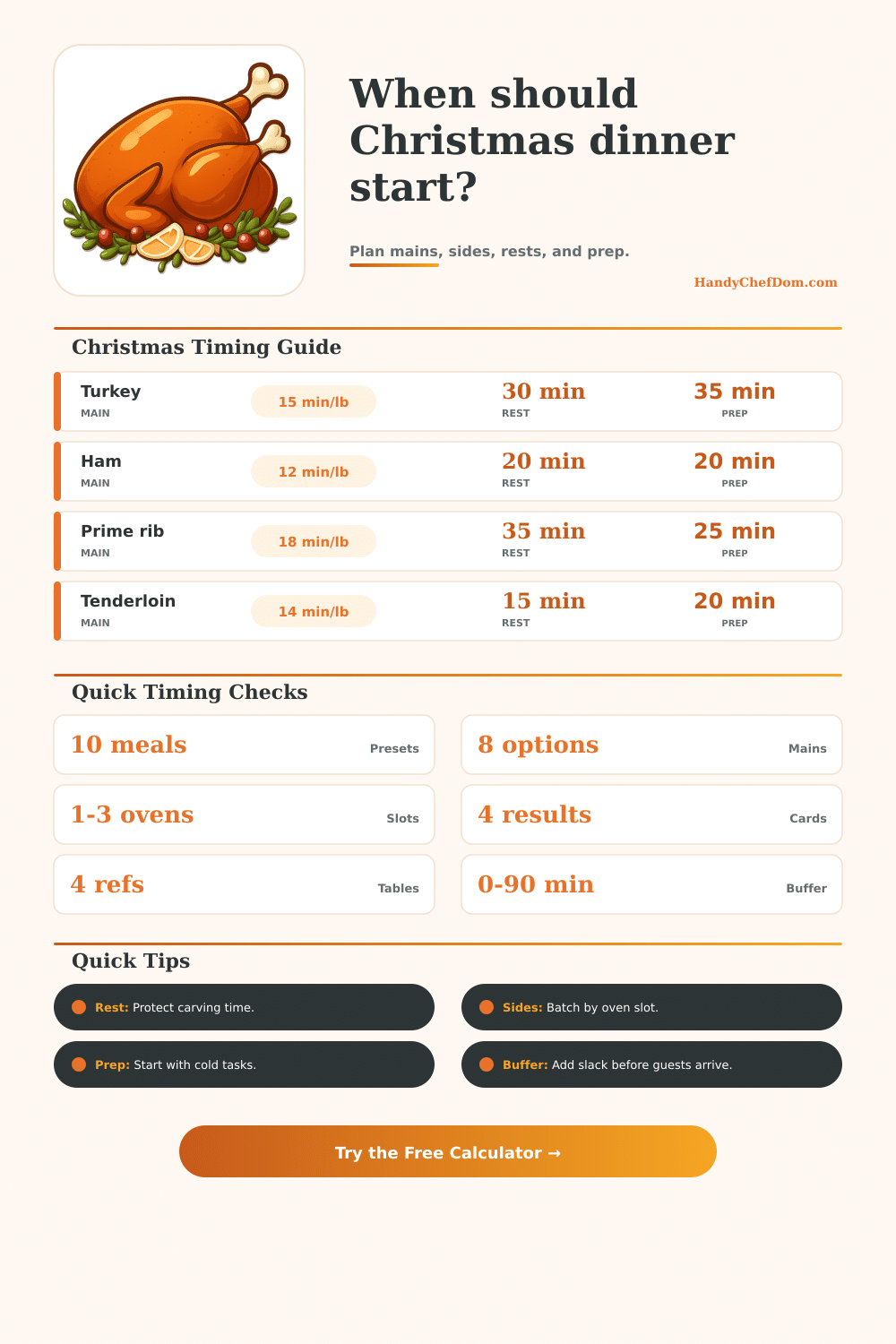
| Whole turkey | 13 to 16 min per lb | 30 to 45 min | Largest schedule driver for traditional Christmas dinners. |
| Turkey breast | 16 to 20 min per lb | 20 to 30 min | Shorter total time but less flexible if overcooked. |
| Spiral ham | 10 to 14 min per lb | 15 to 25 min | Glaze near the end and reserve slicing time. |
| Prime rib roast | 15 to 20 min per lb | 30 to 45 min | Rest window is valuable for sides and gravy. |
| Beef tenderloin | 12 to 16 min per lb | 12 to 20 min | Fast main, so prep and sides matter more. |
| Pork loin roast | 18 to 24 min per lb | 15 to 25 min | Often pairs well with make-ahead casseroles. |
| Side style | Oven time | Prep time | Slot strategy |
|---|---|---|---|
| Mixed Christmas sides | 40 min each batch | 12 min each side | Use for stuffing, veg, potatoes, and rolls together. |
| Dense casseroles | 50 min each batch | 15 min each side | Plan fewer batches or reheat partly ahead. |
| Roasted vegetables | 35 min each batch | 10 min each side | Finish close to service for texture. |
| Potatoes and gratins | 55 min each batch | 16 min each side | Heavy dishes need the longest oven slot. |
| Rolls and quick sides | 22 min each batch | 8 min each side | Put these in after heavier sides are holding. |
| When | Task group | Good candidates | Timing impact |
|---|---|---|---|
| Two days before | Shopping and equipment | Roasting pan, foil, platters, labels | Removes same-day decision drag. |
| Day before morning | Cold prep | Chopped aromatics, cranberry, dessert bases | Saves 30 to 75 minutes on dinner day. |
| Day before evening | Side assembly | Stuffing, gratins, casseroles, sauces | Turns cooking day into reheating and finishing. |
| Morning of | Main setup | Dry main, season, pan vegetables, butter | Makes oven start time easier to hit. |
| Final hour | Finishing tasks | Gravy, rolls, carving, garnish, serving dishes | Needs a clear order and counter space. |
| Meal size | Suggested buffer | Prep lead | Best oven plan |
|---|---|---|---|
| 4 to 6 guests | 15 to 20 min | 60 to 90 min | One side batch is usually enough. |
| 8 to 12 guests | 20 to 30 min | 90 to 140 min | Use the main rest for sides. |
| 14 to 20 guests | 30 to 45 min | 2 to 3 hr | Split hot sides into early and final batches. |
| Buffet service | 35 to 60 min | 2 to 4 hr | Hold sturdy foods and finish delicate foods last. |
| Two mains | 30 to 50 min | 2 to 4 hr | Cook the longer main first, warm the shorter main later. |
When planning a Christmas dinner, time management is the most importence consideration for the holiday dinner. The timing of the Christmas dinner is more important than the specific foods that is prepared for the holiday dinner. You must plan the food for the Christmas dinner with an awareness that you must work backwards from the moment that everyone should be sitting down to eat.
Both problem can occur due to the schedule of the Christmas dinner; the main course may cook too early relative to the other courses (or may be too hot to carve once it is finished cooking), but these problems isnt due to the recipe for the Christmas dinner. The main course is the most important variable in the planning of the Christmas dinner because the main course will determine when the oven will be available to cook other food. Each type of main dish will take a different amount of time to cook and require a different amount of resting time after cooking.
Plan the Time for Your Christmas Dinner
For instance, a large turkey will require a long cooking time and a long resting time, but a spiral ham will warm up quick and take less resting time. Similarly, a prime rib will both take longer to cook and require a long resting time, which will provide more time for the other Christmas dinner side dishes to be cooked in an oven. Thus, the choice of main dish is a decision about the food that will be served at the Christmas dinner, but it is also a decision about the amount of time that will be available in the oven for the other course.
The other side dishes can complicate the time management of the Christmas dinner because the side dishes will not all require the same amount of time to cook. For instance, a dense casserole will require more time in the oven than rolls. Thus, you must ensure that there is enough time to cook each of these side dish, as well as to utilize the resting time of the main dish to cook those side dishes.
By cooking the side dishes during the resting time of the main dish, the side dishes will be hot and ready to be served at the Christmas dinner. Beyond the main and side dishes, there is one more factor to consider when planning the Christmas dinner: the preparation of the food. Each step in preparing the Christmas dinner will take up some of the time that is available for the cooking of the dishes.
Thus, more preparation will occur if there is more guests for the Christmas dinner, or if there are more side dishes that must be prepared. However, the preparation of the Christmas dinner can be reduced if some of the preparation can be made on the day before the Christmas dinner. One more consideration for the Christmas dinner is the behavior of the oven while the Christmas dinner is cooking.
When preparing the Christmas dinner, the oven may become crowded with warm foods. In these case, the oven will lose heat if the doors are opened to cook the other foods. In this case, you can add an extra amount of time (a buffer) to the Christmas dinner schedule to account for these different variables.
These different reasons for adding a buffer to the Christmas dinner may include the need to account for the potential late arrival of some guests for the Christmas dinner, the potential need to cook certain side dishes that may require more time to cook than estimated, and the time required to carve the meats when people are in the kitchen. The specific time at which the Christmas dinner will be served will dictate the entire schedule of the Christmas dinner. If the serve time is early, then you must start the oven earlier to allow for the main dish to cook, as well as to perform more preparation of the food before the Christmas dinner occurs.
However, if the serve time is later, it is possible that there will be more time to prepare the Christmas dinner on the day of the Christmas dinner. Thus, the serve time can have a dramatic effect on how the Christmas dinner will be prepared. A planning tool can help to visualize each of these variables and how they may relate to each other.
For instance, changing the weight of the main dish will change when the oven must be started. Alternatively, changing the number of side dishes will change the amount of preparation that will have to occur in the kitchen. Each of these changes can be seen beside one another to determine how they may impact the Christmas dinner.
For instance, if one chooses a different type of main dish that takes less time to cook, the remaining time can be used to cook the side dishes on the same day, or more preparation of the side dishes can occur prior to the Christmas dinner. Thus, using such a planning tool allow cooks to sequence the Christmas dinner into a series of steps that will ensure that the final step occurs when the guests is ready to eat.