🦃 Injectable Marinade per Turkey Calculator
Estimate turkey injection marinade volume from turkey weight, whole or parts selection, injection rate per pound, needle pattern, reserve percentage, marinade density, salt strength, flavor intensity, and injection timing.
Enter the edible turkey weight you plan to inject. The calculator scales the injection target, adds reserve for syringe and needle loss, estimates site count from the needle pattern, and converts volume into cups, milliliters, and marinade mass.
| Turkey Form | Starting Rate | Typical Pattern | Planning Note |
|---|---|---|---|
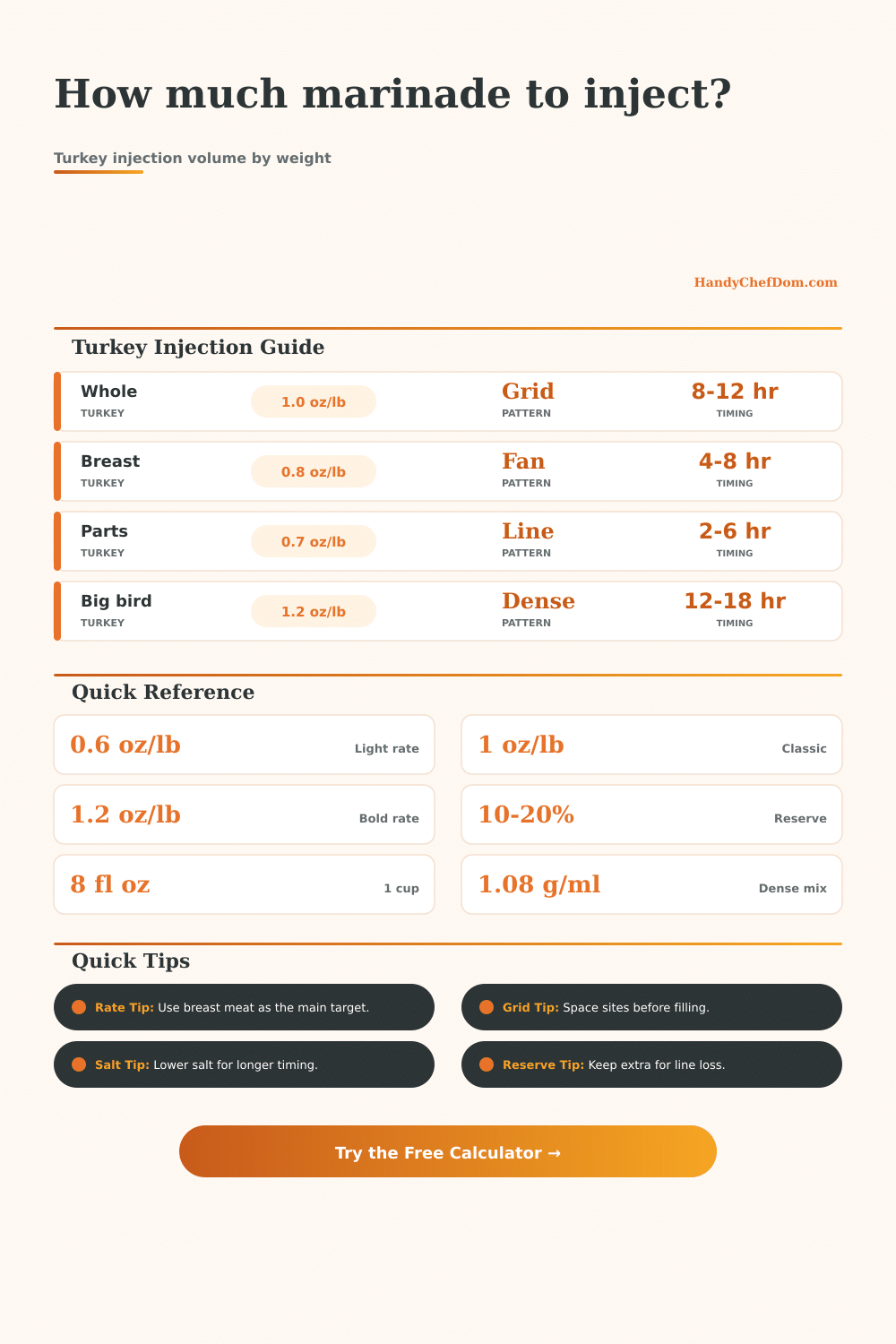
| Whole turkey | 0.9 to 1.1 fl oz per lb | Standard grid | Divide volume between breast and dark meat |
| Turkey breast | 0.7 to 0.9 fl oz per lb | Fan pattern | Use smaller fills across lean sections |
| Mixed parts | 0.6 to 0.8 fl oz per lb | Line pattern | Scale by piece size and exposed muscle |
| Legs and thighs | 0.7 to 0.95 fl oz per lb | Deep muscle | Dark meat accepts slightly more liquid |
| Boneless roast | 0.8 to 1.0 fl oz per lb | Even grid | Keep spacing close for uniform slices |
| Spatchcock turkey | 0.85 to 1.05 fl oz per lb | Shallow grid | More surface access means faster coverage |
| Needle Pattern | Spacing Guide | Site Multiplier | Best Match |
|---|---|---|---|
| Light spacing | About 2 inches | 0.75x | Mild flavor or small turkey |
| Standard grid | About 1.5 inches | 1.00x | Whole turkey baseline |
| Dense grid | About 1 inch | 1.35x | Bold marinade coverage |
| Breast fan | Angled passes | 1.15x | Turkey breast halves |
| Parts line | Along each piece | 0.85x | Wings, legs, thighs, sections |
| Deep muscle | Fewer deeper sites | 0.95x | Large thighs and drumsticks |
| Timing Window | Volume Effect | Salt Choice | Flavor Result |
|---|---|---|---|
| 0 to 2 hours | Add 8 percent | Balanced or savory | More surface-level flavor |
| 2 to 6 hours | Add 3 percent | Balanced | Good all-purpose spread |
| 6 to 12 hours | Baseline | Balanced | Even holiday flavor |
| 12 to 18 hours | Reduce 4 percent | Low or balanced | Deeper but gentler seasoning |
| 18 to 24 hours | Reduce 8 percent | Low salt | Longest flavor rest |
| Marinade Style | Density Range | Salt Strength | Intensity Fit |
|---|---|---|---|
| Light stock base | 1.00 to 1.03 g/mL | 1.2 to 1.8 percent | Gentle or classic |
| Herb and citrus | 1.01 to 1.05 g/mL | 1.4 to 2.0 percent | Citrus-herb |
| Butter-rich mix | 1.03 to 1.09 g/mL | 1.6 to 2.2 percent | Classic or rich |
| Cajun savory mix | 1.04 to 1.10 g/mL | 2.0 to 3.0 percent | Bold or hot |
| Low-salt long rest | 1.00 to 1.04 g/mL | 1.0 to 1.4 percent | Long timing |
The point is this: Think of marinade as less of a surface treatment and more of a way to get a liquid solution into a muscle fiber that doesn’t want to expand. You’re attempting to cram some moisture and flavor into a structure designed to remain dry.
Plug your bird’s weight and target injection rate into the calculator above. Let it do the math. No need for conversions or coefficients. There is no guesswork. Just enter your parameters and it turns what was a vague desire for juice into an exact volume of liquid. It’ll give you specific salt concentration. And it’ll tell you exactly where that liquid ought to be injected. What if there are no numbers? Then you might as well just stab around and hope for the best.
How to Use the Injection Calculator
The other key input is the rate in ounces per pound being injected. For a whole bird, that’s about an ounce per pound. So if I tell you the rate, then you know how far out the meat get pushed before you pop it into the oven. Too much and the skin rips. Too much and all those delicious juices leak out and leave you with something closer to a soggy mush different than a juicy roasted bird.
Since some cuts, like dark meat thighs, hold more liquid than others, like lean white meat breasts, you has another way to adjust that base volume. The tool knows how sturdy the particular cut of meat is. And what do you want to buffer? What percentage do you want as your reserve? That’s where you account for the losses you’ll encounter at the needle, at the bottom of the syringe, and when you spill some on the table. That’s the buffer; that’s why you’re always left with more. It’s a little thing, but it counts.
All of this depends on timing. Injecting 12 hours ahead of time is different than injecting right before cooking. The calculator accounts for resting time with the bird. It adjusts based off that. Salt isn’t just for flavor. It’s a tenderizer as well. It changes structure of proteins. Too much and it can makes the meat mushy if given a long rest. Too little but still marinating overnight is fine. That’s where the chart helps. It is on the page. It shows you what percentage of salt is best at what point in time. It shows how those timing windows shift. If you inject heavily one way or another, it can go bad on you if left too long. This tool allows you to find that balance between the two, between that chemical reaction and the schedule.
Needle pattern is how you physically execute your plan. For a delicate herb butter, a light fan pattern makes sense, whereas a bold cajun mix calls for a denser grid. Your preferred spacing translates into an estimated number of injection sites. The calculator doesn’t leave one spot dry while flooding another. That’s crucial to ensuring even cooking. No point should of receive all the flavor; you want it permeating each and every slice.
Marinade density also matters. Simple stock isn’t as heavy as butter-laden mixes. The tool turns that volume into mass. Now you precisely know how much of what goes into the mix. It closes the gap between recipe card and how injection actualy works.
But folks, remember: Injection IS invasive. When roasting, some liquid will bleed out of the meat. It is normal. You are not trying to hold onto every drop. Just enough stays behind so the heat pulling on those fibers keeps them moist as they pull apart. The calculator’s estimate for the remaining marinade provides a realistic expectation of what you’ll have at the end. It takes the romance out of cooking. Input data ensures proper execution. Use it when the pressure is on and you can trust the numbers more than your gut feeling. Control isn’t chaotic; it’s mastery. Control is knowing precisely how much liquid is being added. It’s understanding where the salt goes and how much of it travels with that liquid.
Treat the turkey as a system instead of a canvas and everything work out better. No more worries about dryness, because you’ve accounted for it. The bird takes care of the rest. Remember: Start with a plan. Respect the meat’s limitations. Follow the math; let it be your guide.