🍯 Molasses to Make Brown Sugar Calculator
Blend white sugar into light, medium, or dark brown sugar with molasses amounts, humidity adjustment, batch scaling, and mixing loss included.
Enter either cups or grams of white sugar, choose the brown sugar style, then adjust for molasses strength, recipe use, humidity, and expected mixing loss.
| Target Sugar | Molasses Per Cup | Molasses Grams | Best Use |
|---|---|---|---|
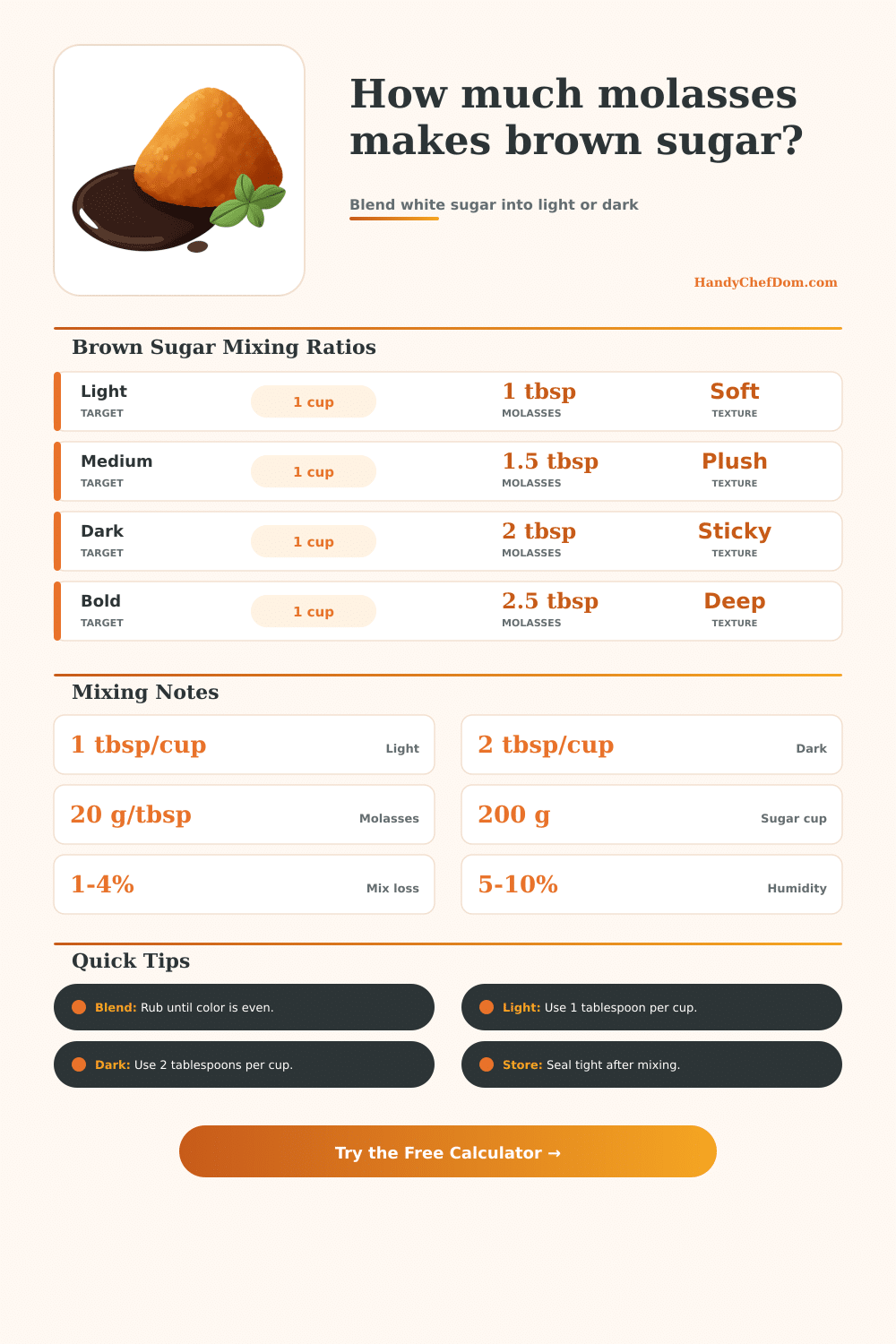
| Light brown | 1 tbsp | 20 g | Cookies, bars, everyday baking |
| Medium brown | 1.5 tbsp | 30 g | Crumb cake, muffins, snack cakes |
| Dark brown | 2 tbsp | 40 g | Ginger cookies, sauces, glazes |
| Extra dark | 2.5 tbsp | 50 g | Spice dough and deep molasses flavor |
| Custom mild | 0.5 tbsp | 10 g | Color tint without much flavor |
| Custom bold | 3 tbsp | 60 g | Small specialty batches |
| White Sugar Base | Light Molasses | Dark Molasses | Finished Weight |
|---|---|---|---|
| 1 cup / 200 g | 1 tbsp / 20 g | 2 tbsp / 40 g | 220-240 g |
| 2 cups / 400 g | 2 tbsp / 40 g | 4 tbsp / 80 g | 440-480 g |
| 3 cups / 600 g | 3 tbsp / 60 g | 6 tbsp / 120 g | 660-720 g |
| 4 cups / 800 g | 4 tbsp / 80 g | 8 tbsp / 160 g | 880-960 g |
| 6 cups / 1200 g | 6 tbsp / 120 g | 12 tbsp / 240 g | 1320-1440 g |
| 10 cups / 2000 g | 10 tbsp / 200 g | 20 tbsp / 400 g | 2200-2400 g |
| Molasses Type | Flavor Strength | Use Multiplier | Mixing Note |
|---|---|---|---|
| Mild baking molasses | Gentle | 1.10x | Use a touch more for color |
| Regular unsulphured | Balanced | 1.00x | Standard brown sugar match |
| Robust molasses | Strong | 0.90x | Reduce slightly for cookies |
| Blackstrap | Very strong | 0.65x | Use carefully; flavor is sharp |
| Sorghum syrup | Earthy | 1.15x | Good for rustic baking |
| Date molasses | Fruity | 1.20x | Works best in sauces |
| Condition | Adjustment | Texture Goal | Good For |
|---|---|---|---|
| Dry pantry | +5% molasses | Restore softness | Cookies and crumb topping |
| Normal kitchen | No change | Balanced pack | General baking |
| Humid kitchen | -4% molasses | Limit stickiness | Rub blends and jars |
| Very humid | -8% molasses | Prevent clumping | Dry rubs and toppings |
| Overnight rest | No extra | Even moisture | Large batches |
| Use now | Mix longer | Even color | Quick pantry fixes |
Brown sugar are a mixture of white sugar and molasses. The ratio of white sugar to molasses in the mixture will determine the colors and texture of the resulting brown sugar. Light brown sugar contains a smaller amount of molasses then dark brown sugar.
Light brown sugar will produce a more gentle flavor in your baked goods. Dark brown sugar contain a larger amount of molasses, giving it a deeper color and a strongerer flavor in the baked goods. The amount of molasses will impact how the brown sugar spread in cookies or how much moisture it will contain in a dry rub.
How to Make Brown Sugar
The amount of molasses that is add to the white sugar will determine the type of brown sugar that is created. If you add one tablespoon of molasses to one cup of white sugar, the result will be light brown sugar. If two tablespoon of molasses are added to one cup of white sugar, the result will be dark brown sugar.
You add more molasses if you would like the brown sugar to be soft. Less molasses should be added if you are creating a dry rub with the brown sugar. The humidity level in the kitchen will impact the moisture content of the brown sugar crystals.
In dry environments, the brown sugar may become too loose. In this case, the cook will need to add more molasses to the white sugar. In more humid environment, the brown sugar may absorb moisture from the air.
In this case, fewer molasses will need to be added to the white sugar. You can select a humidity level in the calculator so that the calculator adjusts the amount of molasses that is to be added according to the humidity levels in your kitchen. The type of molasses will also impact the flavor of the brown sugar that is created.
If unsulphured molasses is use, the flavor will be balanced. If robust molasses is used, the flavor will be strong. In this case, less of the robust molasses will be needed than unsulphured molasses.
Blackstrap molasses will create a very strong flavor to the brown sugar. This ingredient is often used in smaller portions. You can adjust the strength of the molasses in the calculator to ensure that the strong flavor of the molasses doesnt ruin the flavor of the brown sugar.
When making brown sugar, some loss of the white sugar and molasses will occur during the mixing process. Two or three percent can be added to the amount of white sugar and molasses that is to be used in the recipe to account for this mixing loss. This percentage can be accounted for in the calculator for the weight of the brown sugar to still meet the requirements of the recipe.
The size of the batch of brown sugar that is to be made will impact the resting time of the sugar. For large batches of brown sugar, more time need to pass in order to allow for the molasses to travel through the white sugar crystals. Small batches of brown sugar may be used immediately, but the brown sugar may appear streaky if its used in small batch.
Both batch size and resting time can be tracked in the calculator to help make an accurate batch of brown sugar. You can use reference tables to see the different weights of brown sugar that will be made from different types of white sugar and molasses. These table allow for the baker to decide what type of brown sugar he or she would like to make.
Light brown sugar is often useful for recipes that require the cookies to remain tender, such as candy cookies. Dark brown sugar can be useful in creating spice cake with deep crusts. The calculator will display the finished weight and finished volume of the brown sugar.
The calculator will calculate the weight and volume based off the type of brown sugar to be made, the humidity levels in the kitchen, the strength of the molasses to be used, the batch size, and the loss of sugar during mixing. By using the calculator, the baker can ensure that the brown sugar will be consistent and that each batch will contain the same amount of brown sugar.