🍳 Kitchen Exhaust Fan Size Calculator
Balance cooktop width, hood style, duct length, and elbows to land on a practical fan target that keeps kitchen air moving.
Linear inputs switch between inches and centimeters, while duct diameter stays on standard inch sizes used by most hood kits.
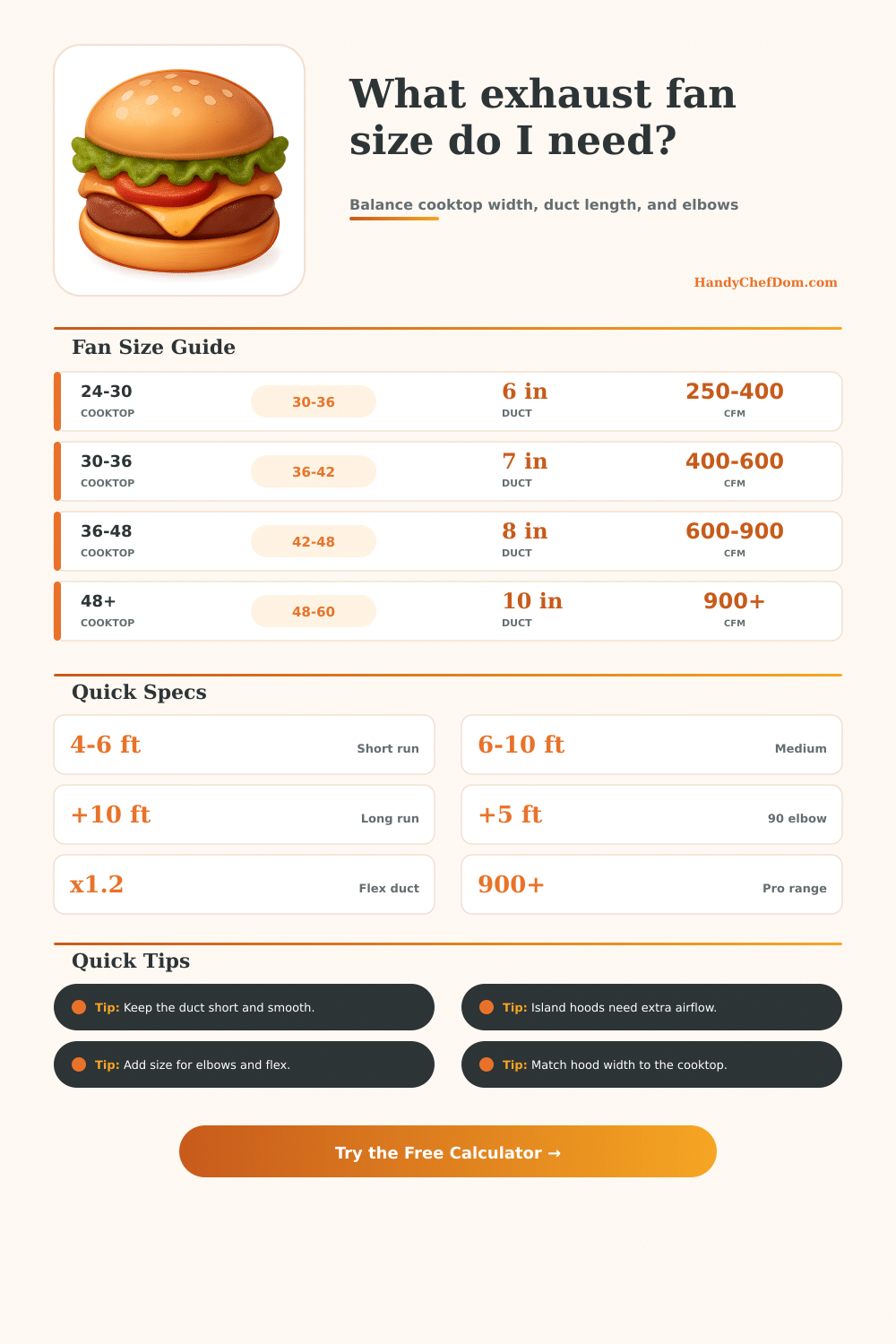
| Cooktop | Hood | Style | Target CFM |
|---|---|---|---|
| 24-30 in | 30-36 in | Light | 250-400 |
| 30-36 in | 36-42 in | Normal | 400-600 |
| 36-48 in | 42-48 in | Heavy | 600-900 |
| 48-60 in | 48-60 in | Wok | 900-1200 |
| Style | Factor | Best For | Note |
|---|---|---|---|
| Wall mounted | 1.00 | Most homes | Balanced default |
| Under-cabinet | 0.96 | Tight spaces | Low profile fit |
| Island hood | 1.16 | Open layouts | Adds exposure |
| Insert liner | 0.94 | Custom cabinetry | Hidden shell |
| Part | Load | Effect | Note |
|---|---|---|---|
| 90 elbow | 5 ft | Adds drag | Use fewer turns |
| Flex section | 18% | More loss | Keep it short |
| Roof cap | 8 ft | Extra load | Exit can add drag |
| Inline exit | 2 ft | Low load | Best for long runs |
| Fan Size | Duct | Use | Note |
|---|---|---|---|
| 250-400 CFM | 6 in | Small zone | Quiet cooking |
| 400-600 CFM | 7 in | Medium zone | Most kitchens |
| 600-900 CFM | 8 in | Large zone | Longer runs |
| 900+ CFM | 10 in | Pro zone | Heavy cooking |
A vent hood is a system that is use to remove smoke, steam, and grease from a kitchen. For these system to effectively perform their purpose of removing smoke and grease from the remainder of the house, the vent hood must be functioning correct. Many individuals choose a range hood based off the appearance of the range hood, or the number that is printed on the range hood itself.
However, using these methods of selection often leads to the purchase of a range hood that do not provide the necessary amount of airflow to effectively remove the smoke and steam that is created within the kitchen. In order to ensure that a range hood will effectively perform within the kitchen, an individual must understand the concept of CFM. CFM stands for “cubic feet per minute” and is a measurement of the amount of air that will be release from the range hood each minute.
How to Choose the Right Range Hood
When manufacturers makes range hoods, the CFM that is listed on the range hood itself is often inaccurate as to the true amount of air that will exit the range hood. The CFM is typically measured while the range hood is functioning within a vacuum. However, when the range hood is install into a system that includes metal piping, the performance of the range hood will decrease due to the resistance that the metal creates.
The more turns that the metal piping includes, the more resistance will be created, and the less amount of CFM that the range hood will create. Thus, an individual can utilize a calculator to determine the appropriate amount of CFM that the range hood should provide, based upon the amount of resistance that the metal piping that will be utilized will create. One of the factors that an individual must consider in purchasing a range hood is the width of the cooktop ranges that are to be utilized within the kitchen.
The width of the cooktop will determine the width of a plume of smoke and steam that will exit the cooktop. If the range hood is the same width as the cooktops, the range hood will not be able to contain the smoke and steam that is created by the cooktop. Thus, the width of the range hood should be wider than the cooktop ranges to ensure that smoke and steam is contained and are not allowed to escape from the kitchen.
The type of heat sources that will be used within the kitchen will impact the amount of airflow that is required from the range hood. For instance, induction burners will create steam but will not create ambient heat, indicating that induction burners will require less airflow than other type of burners. Gas ranges will create both heat and combustion byproducts, indicating that they will require more airflow than induction burners.
Professional wok burners create high-velocity heat, which pushes grease up and out of the cooktop, indicating that these type of burners will require the most amount of airflow. In addition to the type of burners that will be used within the kitchen, the type of ductwork that is to be utilized in the range hood will impact the amount of airflow that can exit the range hood. Air will experience resistance if it enters a ninety-degree elbow in the ductwork.
Additionally, each turn in the ductwork will have the same effect as increasing the length of the ductwork itself. Thus, ductwork with numerous turns will decrease the amount of CFM of the range hood that is manufactured. Smooth, rigid metal should be utilized for the ductwork to minimize the friction of the air within the ductwork.
Flexible ducting, which contains ribbed interior walls, will experience friction within the ductwork, reducing the amount of CFM that the range hood can release. The location of the range hood will impact the amount of power that is required of the range hood in order to function effective. Range hoods that are mounted onto the walls of the kitchen will utilize the back wall of the kitchen to direct the smoke and steam towards the range hood, indicating that the range hood will be more efficient in comparison to other range hoods.
Range hoods that are located in the middle of the kitchen (often referred to as island range hoods) are surrounded by open air. Therefore, these range hoods will be more susceptible to drafts that may emerge from the air conditioners or from individuals that pass by the range hood. As a result, the range hood will need to have a higher target of airflow to ensure that the smoke and steam are not pushed away from the range hood.
The height of the ceilings within the kitchen will impact the amount of suction that is required of the range hood. In kitchens that have high ceilings, the smoke and steam has more space in which to spread out and to cool prior to reaching the range hood. As a result, range hoods will have to work harder to remove the smoke and steam if the ceilings within the kitchen are high.
Thus, the range hood will have to provide a higher amount of suction power to effectively remove the smoke and steam from the remainder of the kitchen. The final goal of a range hood is to find a balance within the amount of power that the range hood has. Range hoods with too much power will remove too much of the warm air from the house during the winter months.
Additionally, the powerful range hoods can create a vacuum within the house that makes it difficult to close the doors to the house. Therefore, the range hood that is purchased should have an amount of power that is sufficient to remove smoke and steam from the kitchen, but not so much power that it create excessive noise. The balance can be found by considering each of the factors discussed above: the width of the cooktop ranges, the resistance of the ductwork, and the height of the ceiling.