🍞 Sourdough Hydration Calculator
Calculate true sourdough hydration from main flour, water, starter amount, starter hydration, salt, add-ins, target hydration, water or flour adjustments, and dough feel.
Enter main flour and main water separately. The calculator splits the sourdough starter into flour and water, estimates add-in water effects, then shows how much water or flour to change to hit your target hydration.
Main flour plus flour contained in the starter.
Main water plus water contained in the starter.
Starter flour as a share of total flour.
Dough weight after adding the bowl-loss buffer.
Dense, easy to knead, and shaped before a tight proof.
Soft enough for pan volume while staying easy to handle.
A forgiving range for shaping and scoring sourdough.
Tacky dough with enough water for a lighter crumb.
Slack and extensible, best with folds and gentle handling.
Wet, pan-supported dough that benefits from bassinage.
Bran absorbs water, so higher numbers can feel balanced.
Sticky rather than elastic, often easier in a pan.
| Sourdough style | Typical hydration | Dough feel | Best support | Adjustment cue |
|---|---|---|---|---|
| Firm bagel or pretzel dough | 50 to 58% | Firm and elastic | Hand kneading and tight shaping | Add water slowly if tearing |
| Sandwich or tin loaf | 60 to 68% | Soft but controlled | Loaf pan | Use flour adjustment for pan height |
| Beginner boule | 68 to 72% | Slightly tacky | Banneton | Hold back 3 to 5% water |
| Country boule or batard | 73 to 78% | Tacky and extensible | Banneton and folds | Add water by bassinage |
| Open crumb loaf | 79 to 85% | Slack and delicate | Strong flour and gentle folds | Avoid extra flour at shaping |
| Focaccia or ciabatta | 82 to 95% | Very wet | Pan, tray, or couche | Use oil on hands, not bench flour |
| Starter hydration | In 100 g starter | Effect on dough | When useful | Calculator note |
|---|---|---|---|---|
| 50% stiff starter | 66.7 g flour, 33.3 g water | Lowers final hydration | Panettone-style or firm dough | Add more main water for the same target |
| 60% stiff levain | 62.5 g flour, 37.5 g water | Builds strength | Bagels, pizza, and stiff dough | More flour is carried inside starter |
| 80% levain | 55.6 g flour, 44.4 g water | Moderate water contribution | Country loaves | Good middle ground |
| 100% liquid starter | 50 g flour, 50 g water | Neutral split | Most home sourdough formulas | Easy mental math |
| 125% liquid starter | 44.4 g flour, 55.6 g water | Raises final hydration | Fast mixing and mild levain | Reduce main water if needed |
| Flour blend | Comfort range | Absorption cue | Dough feel at 75% | Adjustment note |
|---|---|---|---|---|
| All-purpose flour | 62 to 74% | Lower absorption | Loose and tacky | Use smaller water increases |
| Bread flour | 68 to 80% | Balanced strength | Tacky and workable | Good default for freeform loaves |
| High-gluten flour | 70 to 84% | Strong absorption | Controlled and elastic | Can accept extra water |
| Whole wheat blend | 74 to 88% | Bran soaks water | Moderate, not overly wet | Rest before deciding it is dry |
| Rye blend | 76 to 95% | Pentosan-heavy | Sticky paste feel | Judge by structure, not elasticity |
| Spelt or einkorn | 60 to 75% | Weak gluten | Soft and spreadable | Reduce target or use pan support |
| Add-in | Water effect | Absorption effect | Formula impact | Handling cue |
|---|---|---|---|---|
| Dry seeds or grains | 0% free water | Absorbs about 30% | Makes dough feel drier | Soak or add reserve water |
| Soaked seeds | About 35% free water | Absorbs about 10% | Slightly raises hydration | Drain well before mixing |
| Olives or pickled vegetables | About 35% free water | Low absorption | Softens dough | Fold in after gluten develops |
| Cheese cubes | About 10% free water | Low absorption | Small hydration change | Use gentle folds |
| Cooked porridge | About 75% free water | Moderate absorption | Raises effective hydration | Expect a very soft crumb |
| Roasted vegetables | About 45% free water | Moderate absorption | Can loosen dough | Cool and drain before adding |
This calculator estimates formula hydration and handling feel. Flour age, milling style, starter maturity, mixing strength, and rest time can shift how wet the same percentage feels in your kitchen.
Hydration is a measurement of the amount of waters in a dough relative to the amount of flour in that same dough. The ratio of water to flour will significant impact the behavior of the dough during the baking process. If a person use too little water in the recipe, the dough will become a stiff mass that easy tears when attempting to shape the dough.
If a person uses too much water, the dough will become a slack puddle that cant hold the shape that is require of the dough. Due to the ability of a small change in the percentage of hydration to impact the texture of the dough, it is critical for a person to accurate calculate the total amount of water and flour that will be used in the recipe. Beyond the main flour and water for a recipe, there is other ingredients that should be accounted for in the calculation of the hydration of a batch of dough.
How Water Affects Dough and Using a Sourdough Calculator
Beyond the flour and water that are added direct to the dough, dough often contains sourdough starter that contains water and flour, as well. For instance, a 100 gram portion of sourdough starter that has 100% hydration contains 50 gram of flour and 50 grams of water. These amounts of flour and water must be include in the total calculations for that batch of dough.
In addition to the sourdough starter, many recipes also contains add-ins that will alter the hydration of the dough. For instance, dry seeds will absorb water from the dough and make the dough feel dryer, but soaking the seeds prior to adding them to the dough will add water and make the dough feel wetter. In order to account for each of these variable, a sourdough calculator is of great use in the baking kitchen.
The sourdough calculator will calculate the hydration of the starter, take into account any add-ins to the dough, and even allow the baker to select whether the baker should hold the weight of the flour to the weights of the other ingredient, or if the baker should hold the weight of the water to the weights of the other ingredients. This last selection is useful in the case of a baker that has a limited amount of flour, or who wishes to maintain a certain amount of volume of the baked bread. Different type of bread require different amount of hydration.
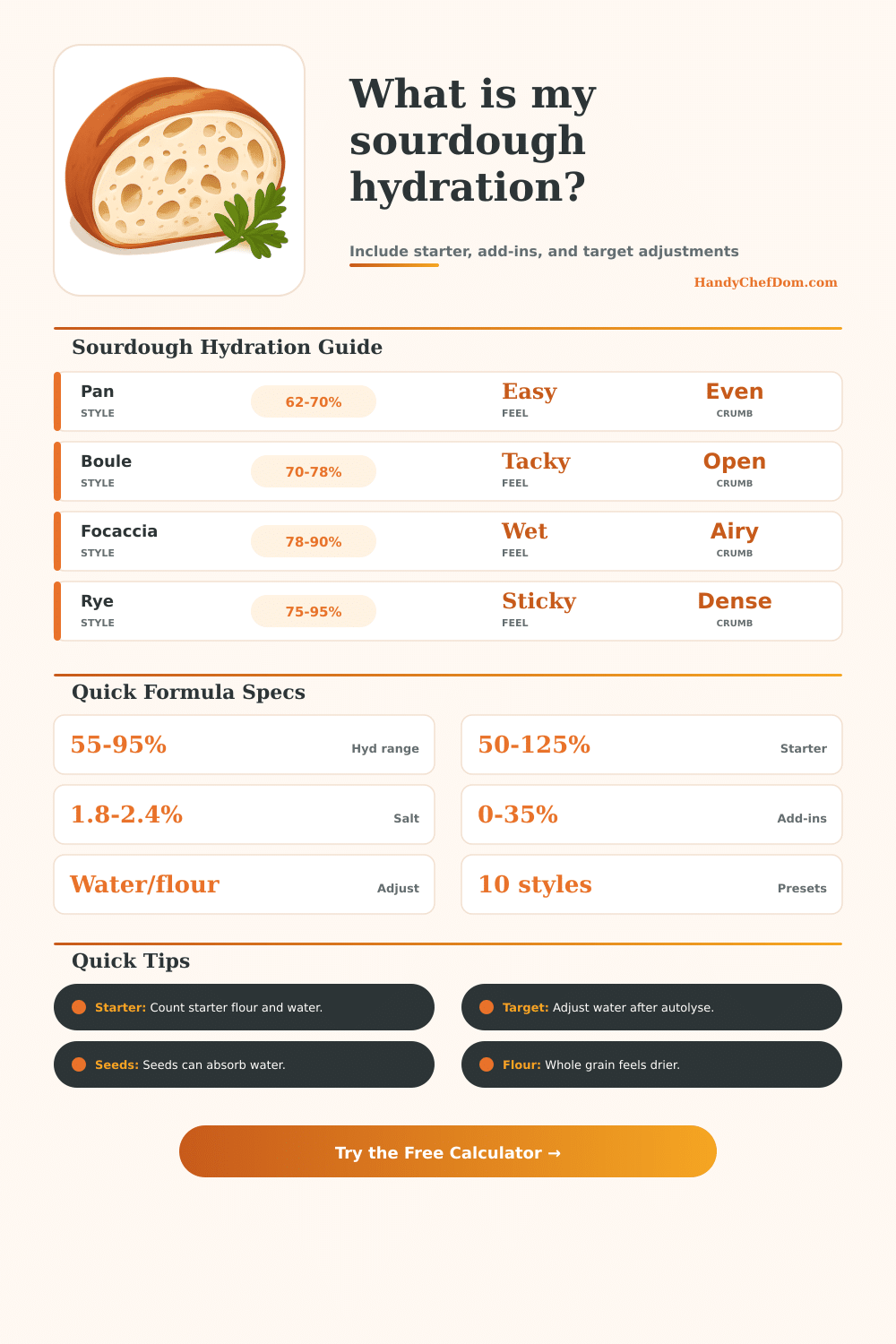
For instance, bagels contain firm dough that requires a hydration percentage of around 55%. Sandwich loaves require the dough to be softer, with a hydration percentage between 60% and 68%. Country loaves are often freestanding, so they require more hydration of between 73% and 78%.
Open-crumb loaves have high hydration percentage, usually higher than 80%. Due to the high percentage of hydration of open-crumb bread, strong flour should be use in its preparation. The type of flour that is used will impact the hydration percentage.
Flour that contains bread flour will contain a moderate protein content that will allow it to absorb water. Flour that contains whole wheat will contain more bran, which will absorb water from the flour and lead to the type of bread feeling dry. Rye flour contains pentosans that will create a sticky texture to the dough, instead of an elastic texture.
Each of these different flours will be represented by a flour-type selector within the sourdough calculator. Each of these flours will affect the hydration of the dough, so it is important to allow the dough to rest after adding it to the bowls to permit the flour to absorb all of the water from the dough; otherwise, error in the hydration percentage may be made. In addition to the type of flour that is used in the dough, the hydration of the sourdough starter will have an impact on the hydration of the baked bread.
A stiff sourdough starter will have a hydration percentage of around 60%; the ratio of flour to water is higher in the starter than water. A stiff starter will therefore lower the hydration of the bread that is baked. A liquid sourdough starter will have a hydration percentage of around 125%; it will contain more water than flour.
A liquid starter will increase the hydration of the bread that is baked. Therefore, if a person decides to change the type of sourdough starter that is used, the other variable will have to be changed accordingly. Baked goods that contain add-ins will alter the hydration of the dough in different ways.
For instance, dry seeds will absorb 30% of their weight in water; they will therefore make the dough feel tight. Vegetables, such as olives or roasted vegetables will release moisture into the dough; they will make the dough feel softer. Cheese does not absorb or release much water; it will have a neutral effect on the dough.
The sourdough calculator will calculate each of these ingredients, which will allow the baker to decide if soaking the seeds prior to baking is necessary. Bassinage is a technique in which a baker holds back some of the water for the dough, and adds that water later to the dough. Bassinage is used especially for doughs with high hydration rate.
The sourdough calculator will calculate the percentage of water that will be reserved in bassinage, and allow the baker to add that reserved water after the dough has rested for twenty minutes. Adding water during bassinage will allow the dough to maintain its shape, and prevent dry flour from adhering to the edge of the dough bowl. The level of salt that is used in the dough will also impact the dough.
Most recipes will use between 1.8% and 2.4% of the total amount of flour for salt. Salt will slow the fermentation of the dough, yet it will also allow the gluten to strengthen. Therefore, salt will make high-hydration dough feel firm.
The sourdough calculator will account for the salt within the total weight of the flour. Due to the various variable in the kitchen, a calculation of hydration percentages may not accurately reflect the dough that is created in the kitchen. For instance, the age of the flour may impact the amount of water that it will absorb.
The temperature of the kitchen may impact the rate at which the dough ferments. The protein content in each bag of bread flour may not be the same. The maturity of the sourdough starter can change.
Each of these variables may result in two bakers creating the same recipe yet creating two different types of doughs. The calculator is only a suggestion for dough hydration rates. Dough should be tasted and adjusted accordingly.
If the dough tears when being shape, there should be more water added during bassinage. If the dough slumps while being shaped, a lower percentage of hydration should be attempted in the future. By keeping notes on the variation in dough that are created during the baking process, a baker will become accustomed to the type of dough that each hydration rate create.