🫘 Fiber in Lentils Calculator
Estimate total fiber, fiber per serving, cooked yield, and daily fiber contribution for dry or cooked lentils in soups, salads, bowls, and meal prep.
Choose dry or cooked form, enter cups or grams, then tune yield and meal style. The calculator separates lentil fiber from broth, dressing, and plate add-ins.
| Lentil Type | Cooked Fiber | Cooked Cup Weight | Best Calculator Use |
|---|---|---|---|
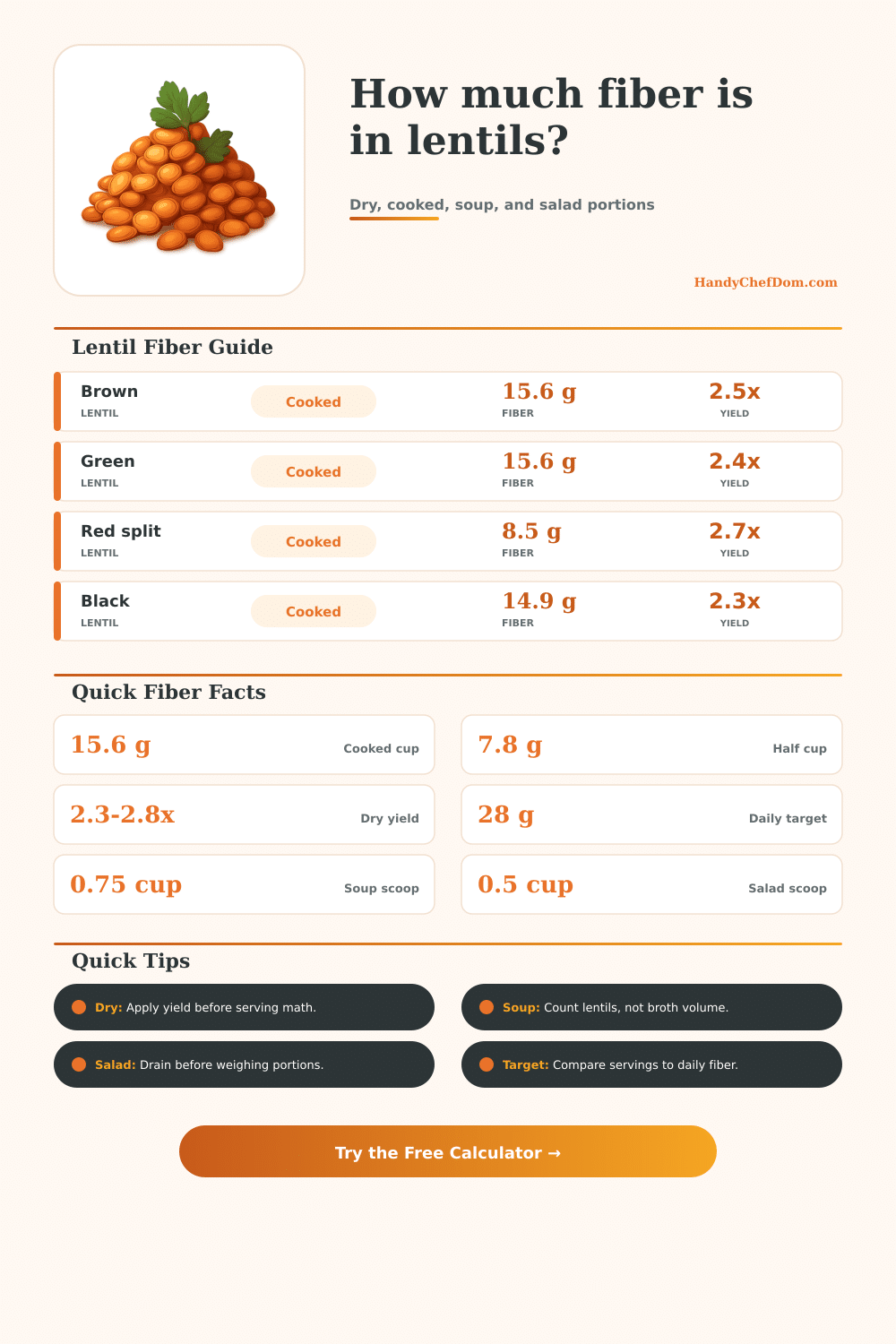
| Brown lentils | 7.9 g per 100 g | 198 g per cup | Soups, bowls, side portions |
| Green lentils | 7.9 g per 100 g | 198 g per cup | Salads and meal prep boxes |
| Red split lentils | 4.3 g per 100 g | 200 g per cup | Pureed soup and dal scoops |
| French green lentils | 8.0 g per 100 g | 205 g per cup | Firm bistro bowls and sides |
| Black beluga lentils | 7.5 g per 100 g | 198 g per cup | Dense grain bowls and salads |
| Yellow split lentils | 4.6 g per 100 g | 200 g per cup | Dal, mash, and stew portions |
| Canned lentils | 5.5 g per 100 g | 185 g per cup | Fast drained lunch portions |
| Sprouted lentils | 3.8 g per 100 g | 160 g per cup | Light bowls, salads, and snacks |
| Starting Form | Measure | Cooked Equivalent | Fiber Planning Note |
|---|---|---|---|
| Cooked lentils | 1 cup | 1 cup cooked | Use this for leftovers and drained batches |
| Cooked lentils | 100 g | 0.50 cup cooked | Best for scale-based meal prep |
| Dry brown or green | 1 cup | 2.4 to 2.6 cups cooked | Use yield setting for firmness |
| Dry red split | 1 cup | 2.6 to 2.8 cups cooked | Soft cups hold more water |
| Dry French or black | 1 cup | 2.2 to 2.4 cups cooked | Firm lentils expand a little less |
| Canned drained | 1 can drained | 1.5 to 1.8 cups cooked | Weigh after draining for cleaner fiber math |
| Meal Style | Typical Serving | Fiber Focus | Calculator Adjustment |
|---|---|---|---|
| Soup or stew | 0.75 cup lentils in broth | Fiber depends on lentil solids | Shows a larger practical scoop |
| Salad topper | 0.50 cup drained lentils | Compact serving with little liquid | Uses drained serving guidance |
| Grain bowl | 0.50 to 0.75 cup lentils | Good daily fiber contribution | Balanced bowl serving |
| Meal prep box | 0.75 cup per box | Easy repeatable fiber count | Even serving split |
| Mash or spread | 0.33 cup scoop | Smaller scoop, concentrated lentils | Smaller serving cue |
| Side dish | 0.50 cup cooked | Classic label-style portion | Uses half-cup comparison |
| Daily Target | Half Cup Brown | One Cup Brown | Serving Meaning |
|---|---|---|---|
| 25 g target | 31% | 62% | Common adult women benchmark |
| 28 g target | 28% | 56% | Nutrition label daily value |
| 31 g target | 25% | 50% | Lower adult men benchmark |
| 34 g target | 23% | 46% | Higher adult men benchmark |
| 38 g target | 21% | 41% | High-fiber planning benchmark |
| Family batch | Use per serving | Use total batch | Split by planned servings |
As a source of fibers, lentils are also an inexpensive food that can be stored in a pantry. To calculate the fiber contents in a serving of lentils, a person must determine two different factors: the type of lentil being measured and whether the lentils are dry or cooked. Dry lentils will expand when they is cooked; one cup of dry lentils can become more than two cups of cooked lentils.
The fiber is contained within the lentils, so no matter how much the lentils are cooked in broth, the fiber will remain contain within the lentils. Thus, the amount of fiber in a bowl of lentils will depend upon how many lentil are contained within that bowl. To use the calculator, a person must first select the type of lentil that is being measured.
How to Calculate Fiber in Lentils
Additionally, a person must also select whether the lentils are dry or cooked lentils. Furthermore, because different batches of lentils will absorb different amounts of water while being cooked, the person must also adjust the yield of the lentils. Lentils can also be selected for which type of meal are being prepared with the lentils; this change the serving size of the lentils that are to be prepared.
Different types of lentils contain different amount of fiber. For instance, red split lentils will break down during the cooking process and, therefore, contain less fiber than lentils that are not split. Lentils such as green lentils and brown lentils will maintain its shape during the cooking process and contain more fiber than lentils that break down during cooking.
Black beluga lentils are of medium fiber density, however, French green lentils tend to contain more fiber than other types of lentils. Thus, the type of lentil that a person chooses will change the amount of fiber that is shown within the calculator. With these calculators, a person can understand in what way a serving of lentils will help a person to reach there daily fiber goal.
Many individual desire to satisfy some portion of their daily fiber goal from lentils, but also from vegetables, fruit, and whole grains. The amount of fiber that lentils contain can be compared to the individual’s daily fiber goal, which may change with age and level of activity. One potential mistake that a person can make with this calculator is to assume that the fiber content is even throughout the cooking liquid.
The fiber is contained within the lentils, not within the liquid in which the lentils are cooked. Thus, taking a spoonful of the cooked lentil soup will contain less fiber than a spoonful of cooked lentils that have been drained of the cooking liquid. Draining canned lentils will cause the liquid to be removed from the lentils, which will help to provide an accurate measurement of the lentils.
The yield of the lentils will impact the amount of dry lentils that must be purchased. One cup of dry lentils can expand to become between two and a quarter cups and three cups of cooked lentils. Thus, if cooking lentils for a large number of individuals, the cook must adjust the yield of the lentils to ensure that there are enough lentils for each individual.
The calculator will perform these calculations automatic for the individual. A few variables in the cooking of lentils will not change the amount of fiber that the lentils contain. Soaking lentils overnight will change the texture of the lentils, but will not change the amount of fiber that the lentils contain.
Adding salt to the water in which the lentils are cooked will impact the softening of the lentils, but will not change the amount of fiber that the lentils contain. Finally, rinsing canned lentils will reduce the sodium content of the lentils, but will not remove the fiber from the lentils. By understanding the impact of the variety of lentils and the impact of the methods in which lentils are cooked, individuals can use lentils to help achieve their daily fiber goal.
By understanding how different types of lentils contain different amounts of fiber, individuals can swap the types of lentils that is used in a meal. By understanding the amount of fiber that different amounts of lentils contain, the individual can change the amount of lentils that are cooked. Thus, by using this calculator, individuals can gain an understanding of the amount of fiber that lentils contain and use that information to prepare their meals more effective.