🍋 Lime Juice in a Margarita Calculator
Plan lime juice, fresh limes, glass fill, sweetener, optional tequila and triple sec ratios, pitcher dilution, and ice melt for consistent bar prep.
This is a kitchen and bar-prep planning tool. Use the optional spirit fields to check recipe ratios, glass capacity, and pitcher dilution without promoting extra servings.
| Lime size | Juice yield | Metric yield | Planning note |
|---|---|---|---|
| Small lime | 0.75 oz | 22 ml | Use a larger buffer |
| Medium lime | 1.00 oz | 30 ml | Good default |
| Large lime | 1.25 oz | 37 ml | Useful for pitchers |
| Very juicy lime | 1.50 oz | 44 ml | Check with a jigger |
| Dry lime batch | 0.60 oz | 18 ml | Buy extra limes |
| Bottled lime check | 1.00 oz | 30 ml | Use for backup math |
| Style | Tequila | Lime | Triple sec or sweet |
|---|---|---|---|
| Classic rocks | 2.00 oz | 1.00 oz | 0.75 oz triple |
| Tart lime-forward | 2.00 oz | 1.25 oz | 0.50 oz triple |
| Sweeter balanced | 2.00 oz | 0.90 oz | 1.00 oz triple |
| Tommy style | 2.00 oz | 1.00 oz | 0.50 oz agave |
| Dry citrus style | 2.00 oz | 1.15 oz | 0.40 oz orange |
| Zero-proof citrus base | 0.00 oz | 1.10 oz | 0.60 oz orange |
| Prep style | Dilution water | Ice melt | Best use |
|---|---|---|---|
| Shake to order | 0% | 12 to 20% | Individual glasses |
| Pre-chilled pitcher | 8 to 12% | 4 to 8% | Table service |
| Frozen prep | 4 to 8% | 15 to 25% | Blender batches |
| Batch on rocks | 10 to 16% | 8 to 12% | Ice-filled cups |
| Carafe tasting | 6 to 10% | 0 to 5% | Small pours |
| Zero-proof base | 12 to 20% | 5 to 10% | Citrus spritz prep |
| Glass style | Total size | Target fill | Planning note |
|---|---|---|---|
| Coupe | 5 to 7 oz | 4 to 5 oz | Little ice room |
| Rocks glass | 8 to 10 oz | 6 to 8 oz | Good default |
| Margarita glass | 10 to 12 oz | 7 to 9 oz | Leaves rim space |
| Highball | 12 to 14 oz | 9 to 11 oz | More ice room |
| Mini tasting cup | 3 to 4 oz | 2 to 3 oz | Small event pour |
| Pitcher pour | 48 to 64 oz | 40 to 54 oz | Scale by servings |
That’s because making a good margarita requires just enough lime juice to give it that refreshingly tart bite without being so overpowering with acidity that it becomes harsh on the palate. Not enough and sweet overtakes; too much, and well…you get the picture.
You want to have an idea of how much lime juice you’re going to need for the number of guest you’ll be serving, and what size glassware will best fit that amount. Then there is ice and water which alter the end product. Keep that in mind.
How to Make Perfect Margaritas
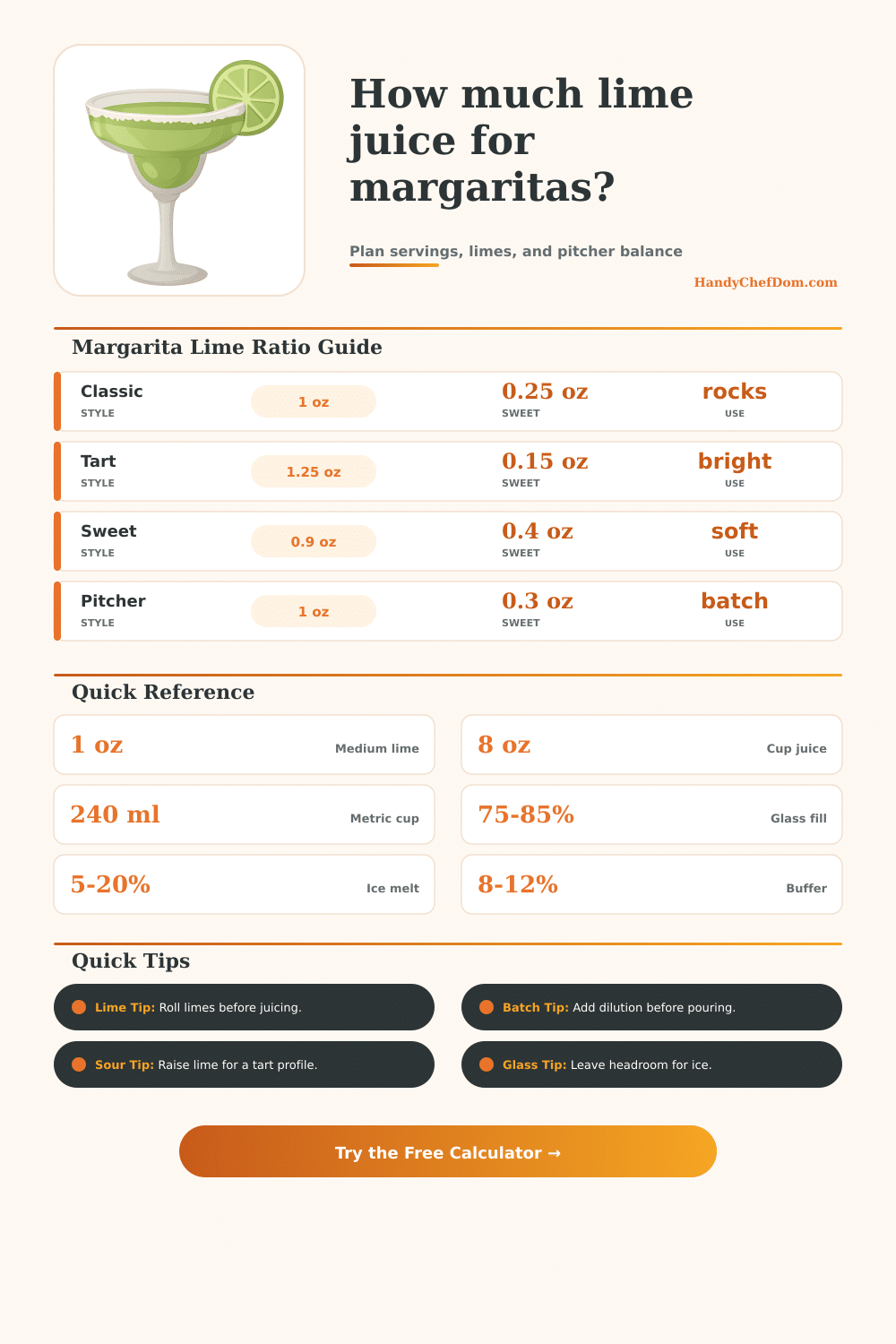
Limes are not all alike. Depending on their age and how large they are, a typical medium lime will yield approximately an ounce of juice. The more you roll them around on the countertop, the more they give up. Best to measure out one lime initially then multiply accordingly as necessary. This becomes particularly important if you’re mixing multiple drinks instead of just one such as in a pitcher.
So you type in what you want, how full you want it, and which glass it will be served from then the rest is up to calculator. Then tweak the sweetness and sourness until they balance each other. And if you want more juice than you have limes, increase lime yield field or set a higher buffer percent, and it calculates amount of extra fruit to purchase.
That’s variation plus garnish wheels covered. And here are reference tables breaking that down by style of glass without having to remember all the combinations.
An extra wrinkle is that the pitcher batches gets diluted as they melt in the glass, which alters how much is left at the end. If you shake every drink-to-order, the flavor won’t taste concentrated due to a little bit of water remaining after it’s poured; if you pre-chill your mix, then too much water make it flat on the citrus. Whether you’re shaking vs. Batching also plays into this: the calculator accounts for these variables so neither the pitcher overflows nor runs dry.
The other error is assuming all limes are created equal. You bought dry and you’ll see a clear decrease in yield, so no one gets the sour bite they expected. The other error: people forget to account for garnish wheels coming from the same fruit. That’s why it helps to pre-count those wheels so total number of limes remains realistic. This prevents a last minute run for more fruit.
That’s where it gets interesting: You get to see what happens when you change one variable and it ripples through all the other variables. If you want a more sour drink, for example, that means you’ll need more lime… Which in turn mean you’ll have to purchase a different number of whole limes. This will impact your pitcher yield relative to your glass size, and those relationships becomes difficult to hold in your mind beyond four or five servings.
Ultimately, it’s the best tasting drinks that taste equally good on their first glass as they do on their last. That’s because you pay attention to how much they are diluted, how much lime juice you get from them, and how full the glasses is. It results in a repeatable drink which beats guessing each time that you’ll land in the right place.