🍼 Breast Milk Refrigeration Time Calculator
Plan conservative storage timing for fresh, thawed, or leftover expressed milk by temperature, room time, container, fridge location, volume, and planned use.
This planner uses conservative CDC-style timing. It does not extend official storage windows for colder shelves or better containers; it only subtracts time already spent out and adds extra caution for warmer or less stable storage.
| Choice | Stable Timing | Planner Buffer | Best Use |
|---|---|---|---|
| Glass or hard plastic with tight lid | Best | 0 hr | Daily fridge storage |
| Breast milk storage bag | Good | 1 hr | Small 2 to 4 oz portions |
| Feeding bottle with nipple/collar | Shorter | 2 hr | Milk prepared for a near feeding |
| Disposable liner or non-storage bag | Not advised | Use now | Move to a milk-storage container |
| Back refrigerator shelf | Most stable | 0 hr | Longest fridge planning window |
| Refrigerator door | Least stable | 12 hr | Short holding only |
| Milk State | Room Temperature | Refrigerator | Freezer Transfer |
|---|---|---|---|
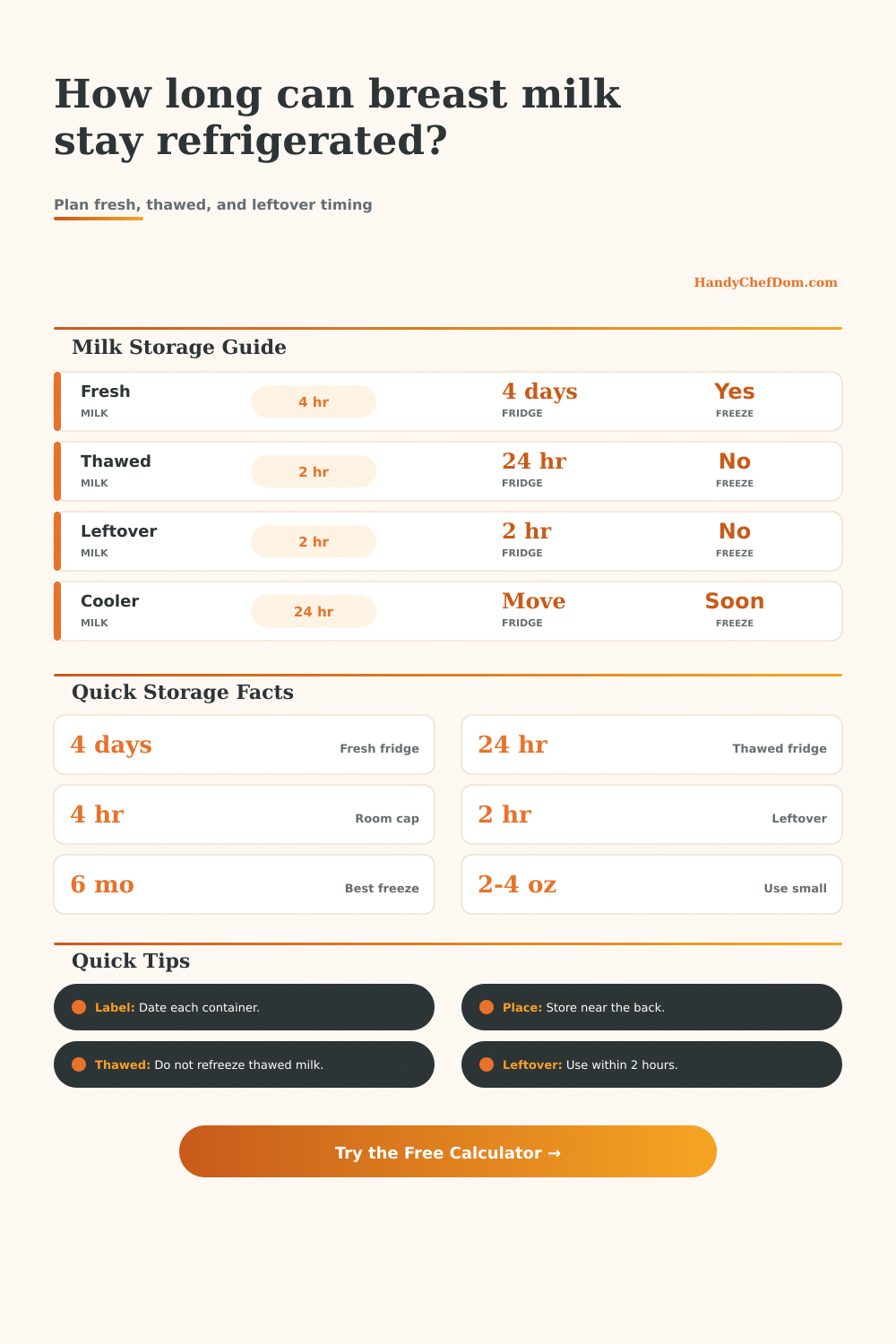
| Freshly expressed or pumped | Up to 4 hours | Up to 4 days | Allowed; sooner is better if not using within 4 days |
| Thawed, previously frozen | 1 to 2 hours | Up to 24 hours after completely thawed | Do not refreeze after thawing |
| Leftover from feeding | Use within 2 hours after feeding ends | Do not use fridge time to extend the 2-hour limit | Do not freeze leftovers |
| Insulated cooler with frozen ice packs | Keep cold and closed | Move to fridge or freezer within 24 hours | Transfer after cooler hold if still within limits |
| Storage Temperature | Planner Reading | Timing Effect | Action |
|---|---|---|---|
| 36 to 39 F | Cold refrigerator | No extension | Use normal CDC-style cap |
| 40 F | Upper fridge target | No extension | Keep sealed and use by cap |
| 41 to 44 F | Warm refrigerator | Subtract 12 hours from fresh milk planning | Use sooner and check appliance setting |
| 45 F or warmer | Too warm for fridge planning | Treat as room-temperature timing | Use immediately if still within state cap |
| 77 F or colder room | Room-temperature cap | Fresh milk up to 4 hours | Refrigerate or use within the room cap |
| 0 F freezer | Frozen storage | Six months best, twelve months acceptable | Freeze fresh milk before the fridge cap |
| Volume | Metric | Storage Reason | Planning Note |
|---|---|---|---|
| 1 to 2 oz | 30 to 60 ml | Top-off feeding | Low waste when appetite is uncertain |
| 2 to 4 oz | 60 to 120 ml | Common storage portion | Freezes and thaws more evenly |
| 4 to 6 oz | 120 to 180 ml | Full bottle plan | Use when planned timing is clear |
| 6 to 8 oz | 180 to 240 ml | Larger feeding | Split if you often have leftovers |
| 8 oz plus | 240 ml plus | Batch storage | Consider smaller containers before freezing |
| One-inch headspace | About 2.5 cm | Expansion room | Helpful for freezing fresh milk |
| Planned Use Gap | Status | What It Means | Typical Action |
|---|---|---|---|
| 12 hr or more before cap | Comfortable | Timing has room for normal home handling | Keep sealed near the back |
| 2 to 12 hr before cap | Close | Use plan is near the end of the window | Label clearly and use first |
| 0 to 2 hr before cap | Very close | Little timing cushion remains | Use sooner if possible |
| Past cap | Outside window | Planned use is beyond conservative guidance | Do not plan to use after this time |
| Unknown start time | Uncertain | The countdown cannot be trusted | Choose the more conservative action |
| Thawed and warmed | Short window | Two-hour use window applies | Do not return to long fridge storage |
This storage planner is for conservative home timing guidance based on common CDC-style storage windows. Follow your clinician, milk bank, hospital, childcare, or local public health instructions when they are stricter.
Breast pumping for the very first time is an anxious experience. There’s this milk in your hand, warm milk; and there are questions looming like they’re far too heavy for them to be. How long will it last? Where should I put it? Should I freeze it all right away? That’s what feels like the answer, but that’s not necessarily correct.
Milk expressed fresh tends to keep just fine in the fridge for a few days. Nutritional content remains the same; so do immune factors as compared with milk frozen from the start. But again, how do you know when it’s time? And what happens if the conditions of your kitchen aren’t perfect? And how can you figure out if that’s safe?
How to Store Breast Milk Safely
Just enter your fridge temperature into the calculator below. Choose your storage method and let the calculator do all the work for you. You don’t have to guess anymore about if your fridge will keep the milk cold enough.
Most folks think that a refrigerator maintains a constant cool temperature, like thirty-seven degrees, all the time. That’s not true. Sure the back of the shelf is cool, but when was the last time you reached for an item in the door without opening it? Each time you open the door, that bottle of milk warms up just a little bit… and that temperature swing makes a difference. When you store bottles in the door, they warm up a little bit each time you take them out. The calculator adjust for this by taking time away from your safe storage window. It makes you be conservative, and that’s what you should always want to be when it comes to baby food!
The timeline also depends on container choice. For refrigerator storage, the ideal bottle is one made of glass or a hard plastic material with a tight-fitting lid (one that doesn’t react with the milk). They seal well and does not interact with the milk. If you plan to freeze the milk right away, the freezer bags are handy…but unless you’re going to use them soon, they’re riskier for keeping in the fridge. If there’s even a tiny leak or your seal isn’t really tight, it ruins the entire contents of the bag. The planner takes all this into account and uses a smaller buffer zone for less reliable storage methods. That’s not because it’s some kind of dictatorial “you must follow my rules” way of thinking…just because we don’t want to feed you milk that’s sat in a rickety old bag for four days.
Now thawed milk; thawed milk is a whole different ball game. Milk that was previously frozen and now is thawed can’t be returned to the freezer. As soon as it’s completely liquid, it begins counting down. At most, it has about 24hrs in the refrigerator. If the milk was already sitting at room temperature prior to being refrigerated, then its lifespan decreases further. The milk calculator accounts for this room time.
For example, did your bottle hang out on the counter while you’re getting ready for the feed? That time factors into your equation. Can you make up for it later? No. This is where parents tend to get tripped up. “But I put it back in the fridge so the clock reset!” Nope. The bacteria that got started at room temp keeps going until the milk is used or tossed.
The hardest bucket to deal with is leftovers from a feeding. If your baby’s mouth touches the bottle, some amount of saliva from them mixes with the milk. That gets gross quickly. From when the feeding ends, you have two hours. At that point, into the trash it goes. No exceptions.
Pumping is a lot of work. And it just feels wrong to waste all that milk, so many parents want to save it for the next feeding. But risking feeding your baby spoiled milk isn’t worth the savings. The tool will tell you that leftover milk doesn’t really get any leeway; to it, the two-hour mark is a hard wall.
This is explained well in the reference table on the page. This explains what state of milk can be stored and for how long. For example: Fresh- Four days Thawed- One Day Leftovers, Two hours Milk from cooler- Depends on how cool those ice packs keep the cooler. Knowing this allows you to plan accordingly.
So if you know that your fresh milk isn’t going to get used up in four days, freeze it asap! Don’t think about freezing it at the end of the third day. The sooner you freeze it, the better it will be.
Another little part about storing milk is volume. You can handle two-ounce to four-ounce portion sizes better than larger ones. That means quicker thawing time. And, if the baby doesn’t eat all that much, there’s less wasted milk. Large batches are great for bulk storage, but they takes longer to heat up. If you frequently have leftover milk, then you know what I mean. You will have less waste and less mess, and you can keep it safe. It’s all about convenience versus caution.
On one hand, you want to provide your baby with the very best food possible. At the same time, you don’t want to stress out over opening up the fridge each time. How do you remove the guess work? This is where the tool comes in. Based off your specific circumstances, it provides a definite deadline. You know exactly what day to expect which feed(s). You’ll be able to plan ahead with confidence and trust your supply.
That’s how you make this a routine instead of an anxious experience. Of course the clock is ticking, but you won’t need to stare at it constantly. Check the plan. Trust the math. Keep the milk cool.