Margarita Batch Calculator
Scale tequila, lime, orange liqueur, and dilution for pitchers that stay lively from the first glass to the last.
📌Quick Presets
⚙Batch Controls
The calculator keeps volumes in a common core, then converts the display when you switch the unit mode.
Margarita batch snapshot
See the batch volume, tequila need, bottle count, and final strength in one clear view.
📑Margarita Reference Tables
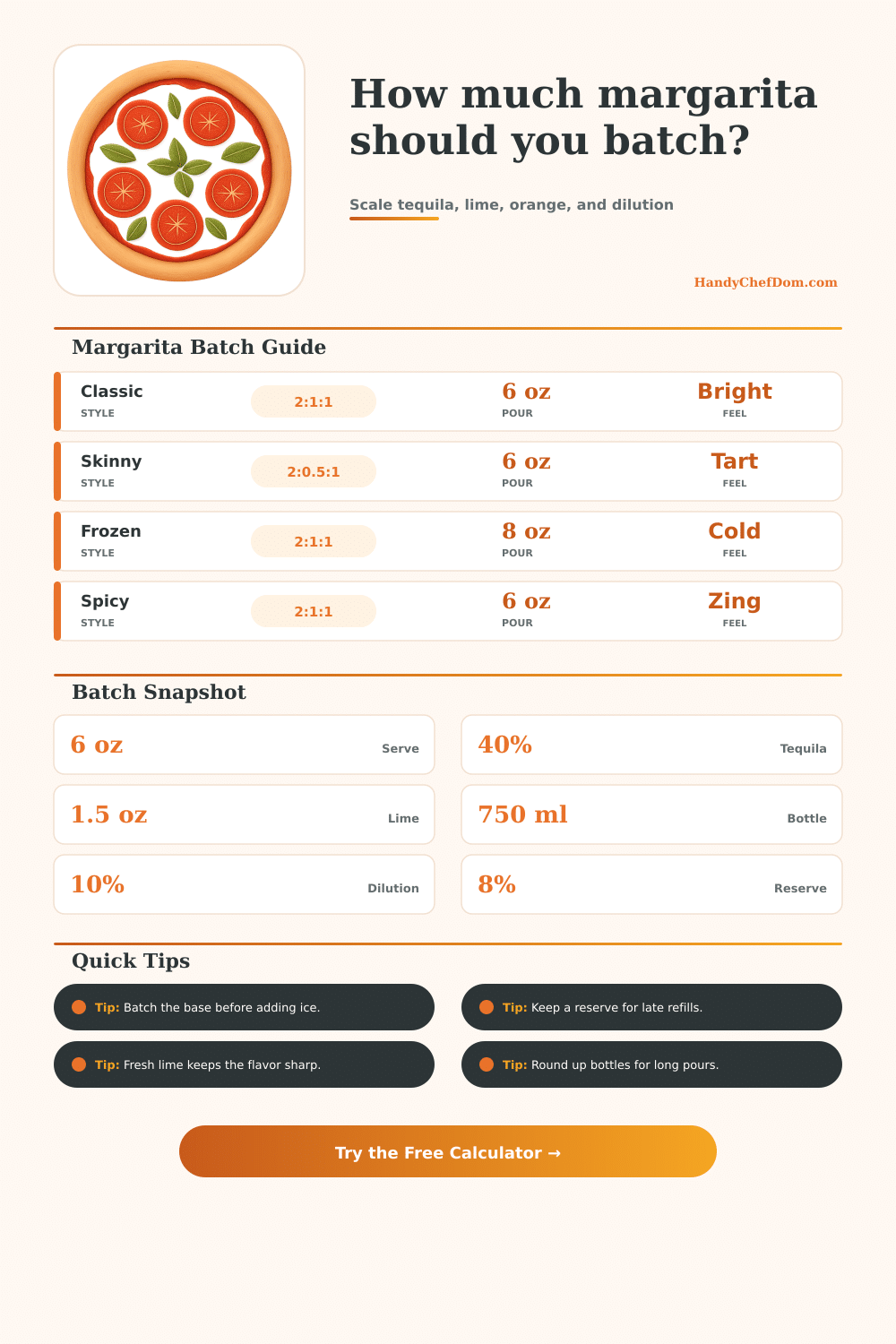
| Style | Ratio | Pour | Note |
|---|---|---|---|
| Classic | 2:1:1 | 6 oz | Bright |
| Skinny | 2:1:0 | 6 oz | Tart |
| Frozen | 2:1:1 | 8 oz | Cold |
| Spicy | 2:1:1 | 6 oz | Zing |
| Lime | Juice | ml | Note |
|---|---|---|---|
| 1 lime | 0.75 oz | 22 ml | Small |
| 3 limes | 2.25 oz | 67 ml | Quick |
| 6 limes | 4.5 oz | 133 ml | Pitcher |
| 12 limes | 9 oz | 266 ml | Party |
| Bottle | ml | Pours | Note |
|---|---|---|---|
| 375 ml | 375 | 12 | Mini |
| 750 ml | 750 | 25 | Standard |
| 1000 ml | 1000 | 34 | Liter |
| 1750 ml | 1750 | 59 | Magnum |
| Guests | Batch | Pitchers | Use |
|---|---|---|---|
| 8 | 48 oz | 1 | Patio |
| 16 | 96 oz | 2 | Brunch |
| 24 | 144 oz | 3 | Party |
| 40 | 240 oz | 5 | Event |
💡Tips
Batching cocktail can be defined as the process of preparing large quantity of cocktails at one time without making each cocktail individually. If one were to make each cocktail individually, it would take a considerable amount of time to prepare each cocktail, which may prevent an bartender from attending to there social event. In order to batch cocktails, the bartender must first find a way to scale the recipe for the cocktails in such a way that the cocktail still maintains the same ratio of ingredient, such as acid, sugar, and alcohol.
Scaling the cocktail by a large factor without considering the effect on flavor may cause the batch of cocktails to not taste as goodly as the cocktail that was prepared individually. Beyond scaling the cocktail apropriately, the bartender must also consider the importance of dilution. When preparing a cocktail in a shaker, the melting ice in the shaker add water to the cocktail.
How to Make Many Cocktails at Once
If the bartender prepared the batch of cocktails in a pitcher without adding water to the batch, the batch will lack the same level of dilution as the individual cocktail and may taste too sharp or alcoholic. Thus, it is important to include water as an ingredient in the batch of cocktails. The bartender must add the appropriate amount of water to the batch of cocktails to ensure the batch taste the same as the cocktails that were shaken with ice.
The size of the cocktail glass to be served also must be considered in the batch preparation of cocktails. The size of the glass will indicate the amount of liquid that will be prepared for the batch. For example, if the bartender is to serve the cocktail in glasses that contain six ounce of liquid, the bartender will have to prepare less liquid than if the cocktail is to be served in glasses that contain eight ounce of liquid.
Thus, the bartender must know the size of the glass to determine the total amount of liquid that need to be prepared for the batch. The style of the cocktails also will affect the way in which the cocktails can be batched. Different style of cocktails use different ratios of ingredients, such as spirits, citrus juice, and sugar.
These different ratios may affect the viscosity of the liquids. For example, a classic margarita may contain a certain amount of sugar, while a different style of margarita may contain less sugar than the classic recipe. Because the recipes contain different amounts of ingredients, the bartender must change the shopping list for ingredients to accommodate for the different amount of ingredients that are required for each batch of cocktails.
When batching cocktails, each ingredient should be measured by volume, such as the amount of lime juice, rather than counting, such as the number of limes that are needed. While it may seem convenient to count the number of limes that are needed for the batch, the size of the limes may vary from lime to lime, which would create an inconsistent batch of cocktails. Instead, by measuring the amount of lime juice that will be used in the batch, the bartender can ensure that the batch will taste the same as the individual cocktails that were prepared with the same amount of lime juice.
Additionally, it is also important for the bartender to use mathematics to determine the number of bottles of spirits that will be needed. Regardless of whether the bottle contains 750ml of liquor or 1.5 liter of liquor (a magnum bottle), the bartender will need to use mathematics to determine the number of bottle that must be purchased for the batch of cocktails. It is also wise to include a reserve of cocktails in the batch of cocktails.
By including a reserve of cocktails in the batch, the bartender can account for any mistake in making the cocktails or additional demands for cocktails beyond those that are needed for the guests that are attending the social event. Thus, including a reserve will ensure that the batch of cocktails is not depleted during the social event. Another factor to consider in the batching of cocktails is the addition of ice.
When preparing a batch of cocktails, it is never wise to add ice to the batch of cocktails. The melting of the ice will make the batch of cocktails too watery. Therefore, the bartender can prepare all the ingredients except for the amount of water needed for dilution.
After preparing the cocktails and chilling them in the refrigerator, the bartender can add the calculated amount of water before serving the cocktails. By doing so, the batch will be kept at an appropriate temperature and the flavors will be strong and not dilute before serving. Fresh lime juice is better than bottled lime juice.
However, fresh lime juice lose its flavor quickly. Therefore, the batch of cocktails should be prepared the night before the social event. The bartender can prepare the spirits the day before the social event, but the bartender should only squeeze the fresh lime juice on the night of the social event.
By preparing the cocktails and their ingredients early but adding the fresh lime juice at the last possible minute, the cocktail batch will remain fresh and flavorful.