🏃 Marathon Hydration Calculator
Estimate race-day fluid, sodium, carbohydrate drink mix, aid station timing, and bottle carry needs from your pace, sweat rate, temperature, and GI tolerance.
Enter the way you plan to race. The calculator converts the marathon pace into race duration, then builds a fluid, sodium, carb drink mix, aid station, and bottle plan.
| Condition | Common Fluid Range | Sodium Range | Planning Note |
|---|---|---|---|
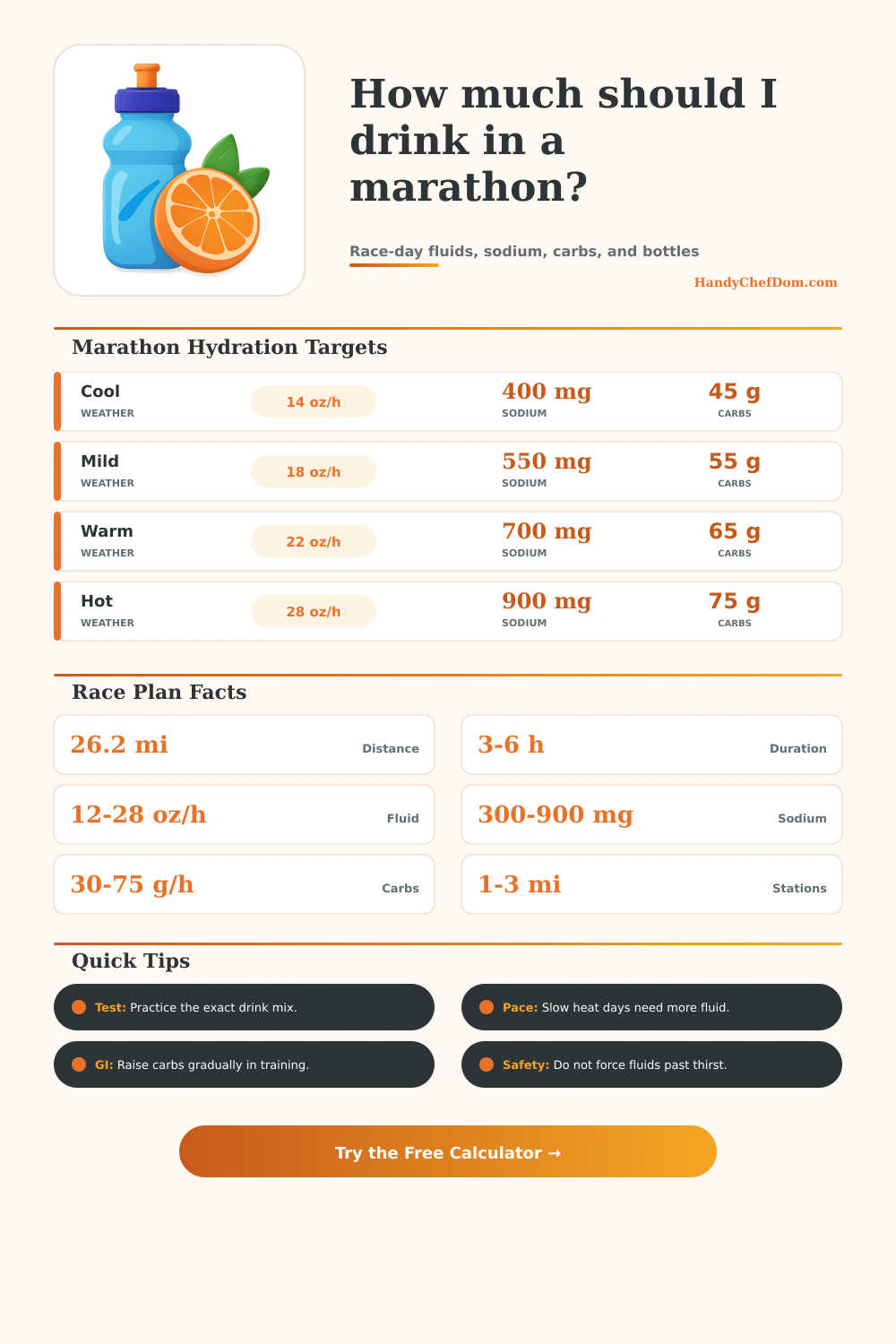
| Cool race, under 55°F | 12-18 oz/hr | 300-500 mg/hr | Lower thirst, still practice intake. |
| Mild race, 55-70°F | 16-22 oz/hr | 400-700 mg/hr | Most runners can use steady sips. |
| Warm race, 70-80°F | 20-28 oz/hr | 600-900 mg/hr | Expect earlier heat drift in pace. |
| Hot or humid race | 24-32 oz/hr | 700-1100 mg/hr | Use caution and slow if symptoms appear. |
| Sweat Sodium Clue | Typical Estimate | Drink Mix Match | When To Adjust |
|---|---|---|---|
| Low salt marks | 300-600 mg/L | Light electrolyte drink | Cool race or low sweat rate. |
| Some salt on kit | 600-900 mg/L | Moderate sodium mix | Most marathon plans start here. |
| Heavy white streaks | 900-1300 mg/L | Higher sodium mix | Test tablets or stronger bottles. |
| Lab-tested salty sweater | 1300+ mg/L | Custom sodium plan | Work with a sports dietitian. |
| GI Tolerance | Carb Range | Drink Mix Strength | Practice Cue |
|---|---|---|---|
| Low | 30-45 g/hr | Dilute or split with gels | Increase by 5 g/hr in long runs. |
| Moderate | 45-65 g/hr | Standard marathon mix | Practice at goal pace effort. |
| High | 65-90 g/hr | Multi-carb drink mix | Only use if rehearsed repeatedly. |
| Race-day upset | Back down quickly | Use water and small sips | Do not chase missed carbs at once. |
| Aid Station Pattern | Best For | Bottle Plan | Risk To Watch |
|---|---|---|---|
| Every 1 mile | Hot city races | Small sips often | Overdrinking without sodium. |
| Every 2 miles | Typical road marathon | One bottle plus cups | Skipping early stations by accident. |
| Every 5 km | International courses | Plan larger station targets | Longer gaps late in the race. |
| Personal tables | Fast or elite runners | Pre-mixed labeled bottles | Missing a bottle handoff. |
To run a marathon, an athlete must manage there fluid and carbohydrate intake. The incorrect balance of these two variable can lead to physical problem during a marathon race. Most runners utilize the same running and fluid plan for each of the marathon they run.
However, runners must alter their fluid plan if the weather change or the temperature increase during the marathons. The calculator use different mathematical estimates based off the inputs that a runner type into the calculator. These inputs include the runner’s marathon pace, the runner’s sweat rate, the expected temperature during the marathon, and the runner’s gastrointestinal system tolerance for carbohydrate.
Plan Your Fluids, Carbs and Salt for a Marathon
A runner’s marathon pace will determine how long the runner will be run. The runner’s sweat rate will determine how many fluid that runner will lose from their body during the marathon. If the temperature during the marathon is higher, then the runner will need to sweat more to regulate their body temperature.
The gastrointestinal system tolerance for carbohydrates will determine how many carbohydrate that a runner can consume in one hour without causing gastrointestinal problem. A runner can adjust their fluid plan for different temperature during marathons. For example, a runner might lose twenty ounces of fluid every hour while running in cool weather.
However, if the weather is hot and the temperature high, that same runner can lose thirty ounces of fluid every hour. The calculator incorporate a heat factor into the fluid calculation for runners to account for the impact of heat on fluid loss. To account for the different amounts of fluid that runners might lose at different temperatures, runners should measure their fluid loss during marathon training.
Another factor to consider when planning for fluid intake during a marathon is the sodium that runners lose through their sweat. Some runners will lose more sodium than others. A runner can determine their sodium loss by looking for the salt on their clothing or by tasting their mouth when they are running.
The field for sodium in the calculator will allow the runner to input how many milligram of sodium per liter of fluid that they lose with each marathon race. Using this measurement, the calculator will determine how many sodium tablet that a runner should consume each marathon race. If the amount of sodium is not replaced, runners could suffer from muscle cramping or feeling dizzy while running.
Since a runner’s body has a limit to the amount of carbohydrates that it can ingest, the carbohydrate input in the calculator has a limit to the number of carbohydrates per hour that can be consumed. If the gastrointestinal system tolerance is low, then the number of carbohydrates that can be consumed per hour will be lower. If the gastrointestinal system tolerance for carbohydrates is high, then a higher number of carbohydrate per hour can be consumed.
Runners can adjust the carbohydrate limit according to the gastrointestinal system tolerance for carbohydrates. Runners can adjust the number of bottle of fluid that a runner will consume during a marathon if they adjust the distance between aid stations. If the aid stations are closer together, then there is no need to carry as much fluid as a runner who has to travel further to the next aid station.
The tables at the end of the calculator will provide information for runners about the amount of fluids, sodium, and carbohydrates that can be lost during marathons at different temperatures. These tables are not rules that all runners must follow. However, these tables can help runners to understand their bodies and how they can change based on various factor.
For instance, runners who lose high amounts of sodium will have different fluid needs than runners who lose a little sodium with their sweat. The calculator is merely a starting point for runners to prepare for the marathons that they will compete in. The information from the calculator can be adjusted based on the changes in the temperature during the marathons and the bodys reaction to these fluids during races.
If a runner find that their gastrointestinal system reacts differently to the carbohydrates that they consume at marathons, there should be rules established for runners for when they should consume fewer carbohydrates during their marathons. This tool allow runners to see how each variable affects the other. For instance, if the distance between aid stations is changed, the fluid that should be consumed per hour will change.
If the pace that a runner intends to run at during the marathon is changed, the amount of fluid that should be consumed per hour will change. By adjusting each variable, runners can learn how each of these variable may impact the other. If the weather change between the day that the runner plans for the marathon and the day of the race, then it is a good idea to use the calculator again the day before the marathon to adjust for the different weather.
If the weather during the marathon is hotter then on the planning day, then the runner can insert the new temperature into the calculator to determine if any change should be made to the fluid that is consumed. Using the calculator will remove the guesswork that runners have to use to determine how many carbohydrate or fluids to consume during marathons by using the mathematical calculations within the tool.