Matcha Latte Caffeine Calculator
Estimate caffeine from matcha grams, scoop density, powder grade, latte dilution, serving count, and drinking window.
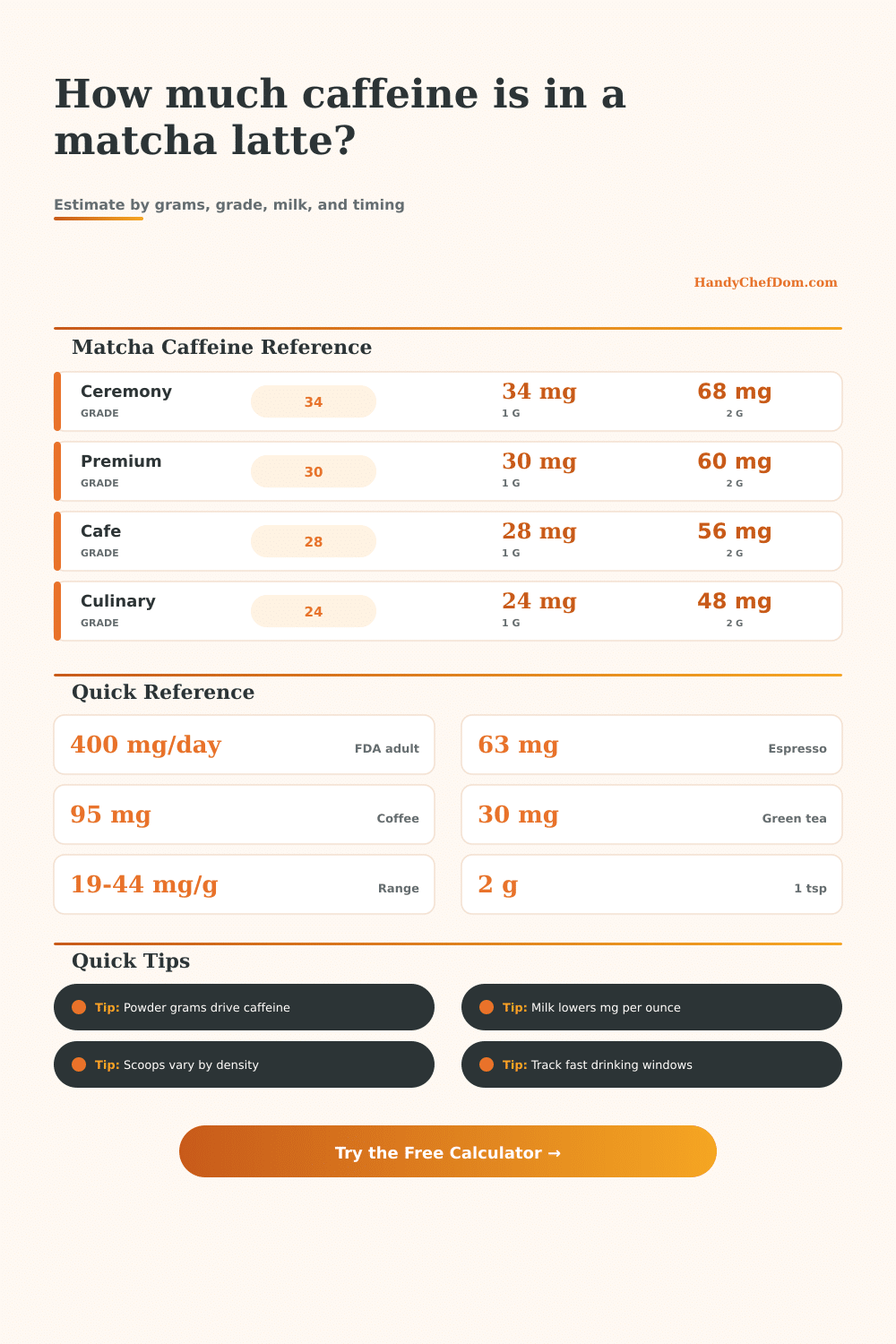
| Grade | Working Value | Typical Range | Best For |
|---|---|---|---|
| Ceremonial | 34 mg/g | 30-44 mg/g | Short latte |
| Premium Daily | 30 mg/g | 26-38 mg/g | Home latte |
| Cafe Barista | 28 mg/g | 22-36 mg/g | Iced latte |
| Culinary | 24 mg/g | 19-32 mg/g | Blended drink |
| Shade-Grown Strong | 38 mg/g | 34-44 mg/g | High caffeine |
| Light Blend | 18 mg/g | 12-24 mg/g | Lower caffeine |
| Measure | Approx Grams | At 30 mg/g | Typical Use |
|---|---|---|---|
| 1/2 tsp | 1 g | 30 mg | Gentle latte |
| 1 tsp | 2 g | 60 mg | Classic latte |
| 1 1/2 tsp | 3 g | 90 mg | Large iced |
| 2 tsp | 4 g | 120 mg | Strong double |
| Drink | Serving | Caffeine | Reference Use |
|---|---|---|---|
| Matcha powder | 1 g | 19-44 mg | Tea range |
| Green tea | 8 fl oz | 25-30 mg | USDA/Mayo context |
| Espresso | 1 fl oz | 63 mg | Mayo context |
| Brewed coffee | 8 fl oz | 95 mg | USDA/Mayo context |
| FDA adult reference | 1 day | 400 mg | General cap |
| Milk Share | Matcha Base | Effect | Example |
|---|---|---|---|
| 40% | 60% | High strength | Short latte |
| 65% | 35% | Balanced | Hot latte |
| 80% | 20% | Soft strength | Iced latte |
| 90% | 10% | Very diluted | Large cup |
| Window | Pace | Use | Watch Point |
|---|---|---|---|
| 0.5 hr | Fast | Pre-work | Higher hit |
| 1 hr | Quick | Morning cup | Notice jitters |
| 2-3 hr | Moderate | Desk drink | Steady intake |
| 4+ hr | Slow | Sipping | Track totals |
Matcha: You walked into a cafe, ordered a matcha latte, expecting that gentle, grounded energy the tea’s so famous for. You get your drink and, fifteen minutes later, youre vibrating with a frequency more commonly associated with espresso shots. What gives? In most cases, the reaction has nothing to do with the ice or milk. The culprit is almost always the powder. Caffeine in matcha isn’t some fixed constant like gravity, it’s a variable. And it depends on how much actual leaf dust ends up in your cup. Once you understand that difference, your approach to tea consumption will change entirely.
Grade matters. The difference between grades is more than just marketing fluff or price points; they simply offers different quality and caffeine concentrations. Younger leaves are used for ceremonially grown products (hence the name) and ground finely enough to maintain their amino acid content. This can translate into a denser dose of caffeine, so it also tend to be pricier. Older leaves are use to make culinary grade matcha, which may contain stems as well. These is less concentrated per gram.
Why You Should Measure Your Matcha by Weight
After entering your weight and grade into the calculator on this page, it do the rest of the math for you. It eliminates guesswork: Is that sparkling green stuff going to wake me up? Or will it give me a mellow jolt? Why do the inputs matter? They will help you stick closer to reality then assumption when estimating the effect. Even if the scoop appear the same size, a switch from a culinary-grade to a ceremonial-grade matcha will double the stimulant effect if you’re putting the former into baked goods, but the latter in your morning latte. Changing quality alters the outcome completely.
Measuring tools are notoriously bad. What does that metal cafe scoop hold? What about that packed teaspoon? What about a whisk made from a piece of bamboo called a chasen? Different tools can holds different amounts of powder that look the same. For example: one may give you 1 gram of powder, and another may give you 3. Because of this, weighing out your matcha is the cleanest way to get the data. If you use scoops, then you must understand how packed your powder is. Is it fluffy or is it settled? Settled weighs more than fluffy. Use the calculator to specify size of your scoop in grams. Whatever goes into your system will then be reflected in the output. It is not just how much you think it should of been.
One strange element in all this math is that milk dilutes things. Whole dairy and steamed oat milk don’t subtract any caffeine from your cup, but they do reduce the concentration by volume. That matters because it affects how you drink it. If you have a twenty-ounce iced latte with two grams of matcha, that’s equal to a six-ounce hot shot using an equivalent amount of powder… Yet you’re consuming that larger volume across three hours. That spread-out load avoids the spike-and-crash effect caused by fast consumption. The tool will help you visualize this rate with its drinking window input. That lets you know exactly how much (in milligrams) you’re taking in per hour, something far more relevant when aiming to manage your energy over the course of a workday.
Numbers alone aren’t everything; a comparison between coffee and matcha also depends on context. Typically, a drip-brewed cup of coffee will hit around ninety-five milligrams of caffeine. For espresso drinkers, a single shot packs about sixty-three milligrams. High-quality matcha powder could fall somewhere in between, with two grams containing approximately sixty milligrams. Because matcha is rich in an amino acid called L-theanine, which encourages feelings of calm alertness, the way matcha’s effects are delivered sets it apart from its counterpart. Matcha offers a gradual release while coffee’s effects hits like a sharp jolt.
Understanding how much you’re getting allows you to combine your coffee and tea drinking habits without pushing past a safe amount. As a general rule of thumb, the FDA recommends sticking to four-hundred milligrams per day. To get matcha’s benefits, however, you don’t have to reach that limit, and there’s no reason to worry if you’re keeping things at a moderate pace. But where the magic happens is knowing your own starting point. Begin with fewer grams than tweak from there as needed after an hour. Then consult the reference charts to see what’s normal for each grade. These are your sanity checks on your entries. The scoop weight and the grade selection can help confirm that you’re on track if something doesn’t seem right in your math.
Measurement is more accurate than guesswork. Measure by weight, not by volume. Dose yourself. The next time you brew up a steaming mug of green powder stirred into hot milk and water, think about this: You’re not only making a drink; you’re making chemistry. And the grade of the leaf matters, as do those grams on the scale. How much energy you get out depends entirely on the grams and the grade. Pace yourself, measure yourself, and enjoy the clarity without the jitter. That’s the power of the powder, and you now know what kind of power is in your cup.