Calorie Calculator for Meals and Prep
Estimate meal calories, per-serving totals, and batch weight with a pink calculator that keeps food type, density, appetite, and leftovers visible.
Start with a food profile, then fine-tune calories per 100g, serving weight, appetite, and leftover cushion. The calculator keeps every adjustment visible from tray to plate.
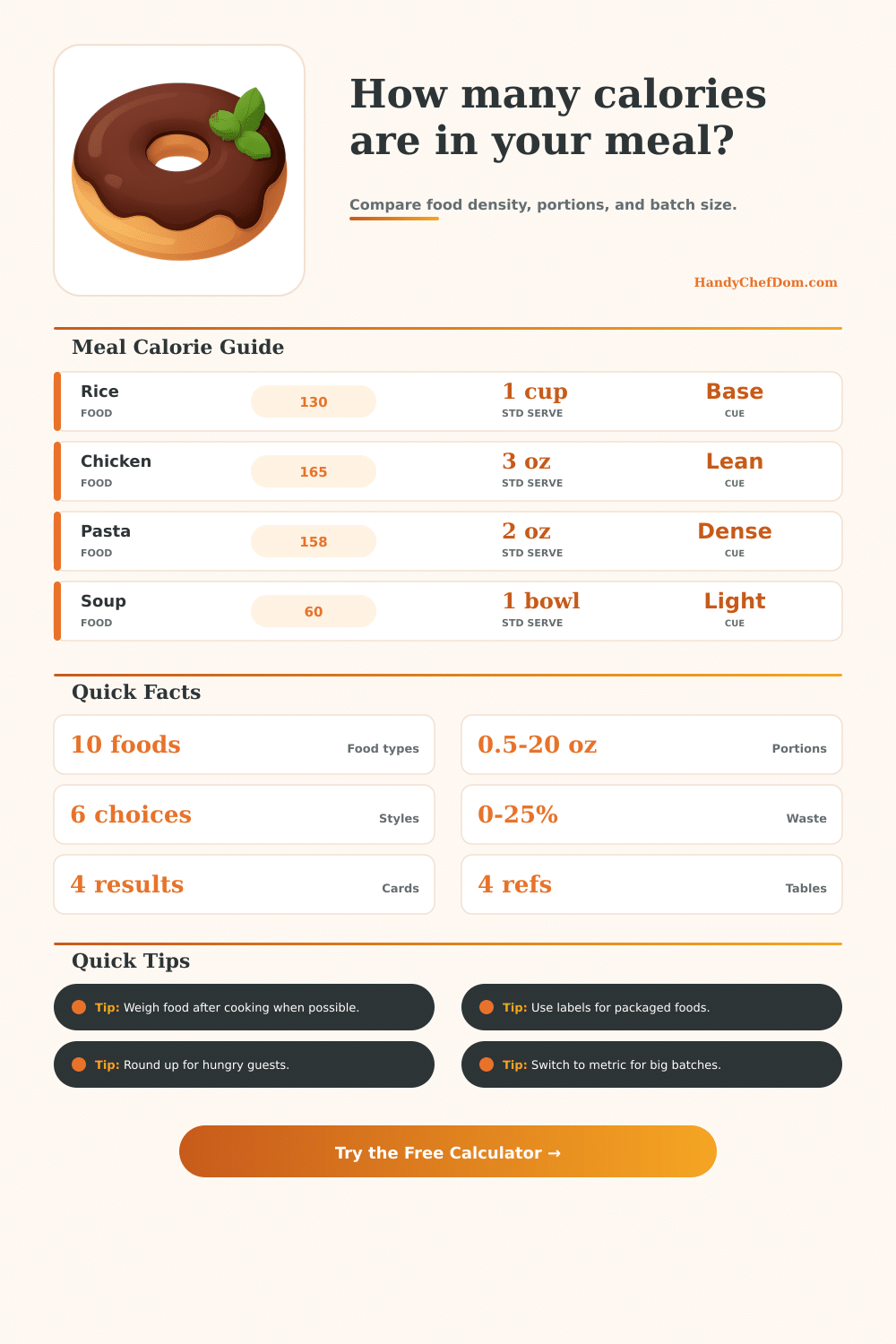
| Food | kcal/100g | Std serve | Cue |
|---|---|---|---|
| Rice | 130 | 158 g | Base |
| Chicken | 165 | 85 g | Lean |
| Pasta | 158 | 140 g | Dense |
| Soup | 60 | 240 g | Light |
| Salmon | 208 | 85 g | Rich |
| Tofu | 76 | 85 g | Soft |
| Oats | 389 | 40 g | Hearty |
| Salad | 20 | 85 g | Crisp |
| Style | Factor | Weight cue | Best for |
|---|---|---|---|
| Plated | 1.00x | Tight set | Solo meal |
| Family | 1.08x | Shared bowl | Table food |
| Buffet | 1.15x | Self serve | Seconds |
| Meal prep | 0.95x | Tray pack | Containers |
| Kids | 0.75x | Small plate | Small eaters |
| Sampler | 0.85x | Half scoop | Tasting |
| Brunch | 1.05x | Mid size | Late morning |
| Hearty | 1.20x | Full bowl | Big appetites |
| Level | Factor | Portion cue | When to use |
|---|---|---|---|
| Light | 0.85x | Small scoop | Snack plate |
| Standard | 1.00x | Normal bowl | Everyday |
| Hearty | 1.10x | Full plate | Hungry crowd |
| Extra | 1.20x | Big plate | Active day |
| Waste | 0-20% | Trim buffer | Prep loss |
| Leftovers | 0-25% | Reserve | Extra meals |
| Travel | 0.95x | Flexible | On the go |
| Budget | 0.90x | Lean plate | Calm cuts |
| Imperial | Metric | Result cue | Portion cue |
|---|---|---|---|
| 1 oz | 28.35 g | Small weight | One scoop |
| 2 oz | 56.7 g | Side piece | Half bowl |
| 4 oz | 113.4 g | Classic plate | Starter |
| 6 oz | 170.1 g | Main portion | Dinner |
| 8 oz | 226.8 g | Large portion | Big bowl |
| 12 oz | 340.2 g | Hearty bowl | Buffet |
| 1 cup rice | 158 g | Dry base | Starch cue |
| 1 cup veg | 85 g | Light filler | Volume cue |
When planning meal, a person may underestimate the amount of food they will need to eat and may overestimate the amount of food that they have prepared for the week. In attempting to estimate the portion of food that they will eat, many individual may look at the food that they will eat. However, looking at the food isnt an accurate way of measuring the food portions that individual need to consume during the week.
Additionally, the portions of food that a person may prepare for the week may change throughout the week. Thus, individuals must understand how to accurately measure the food that they prepare in advance for the week. One of the reason that it is difficult to accurately measure the amount of food that a person will need to eat may be due to the density of the food that they prepare.
Use Weight to Plan Meals
Furthermore, the density of the food is one of the reason that individuals must measure the food that they use in their meal by weight. For example, an individual may measure the amount of both salad and pasta that they use in a meal by cup. However, the amount of energy that is contained in a cup of salad is not the same then the amount of energy that is contained in a cup of pasta.
For instance, a small addition of rice to a meal can add to the total amount of energy that is provided to the individuals that eat the meal. The use of a calculator to convert the energy that is present in different type of food can save the individual the step of manually calculating the amount of energy that each type of food contain. Another reason that the total amount of food that individuals can prepare is different from the amount of food that is actualy available for consumption is due to the loss of food during the preparation of meals.
For instance, when an individual prepares a steak, the cook can remove the fat that is contained in the steak before the steak is cooked. Additionally, carrots contain skin that must be peeled before they are cooked. As a result, the weight of the steak or the carrot can decrease as a result of this trimming of the food.
Thus, individuals must account for the loss of food during preparation of the meals. The level of appetite that an individual has can change throughout the week. For instance, an individual may have more food that is needed to supply the energy that is required after exercising as compared to a person that is feeling tired throughout the week.
Thus, if individuals design meal plans with a static number of calories that are to be consumed, that static number may not provide enough energy for individuals to remain active throughout the week. An adjustment to the meal plan to allow for higher level of energy on certain days will help the individual to remain consistently energetic throughout the week. The way in which food is served to an individual can change the amount of food that the individual consumes.
For instance, if food is served in a shared bowl, an individual may eat more of that food than if it was served in a portioned container. Thus, the way in which food is served to an individual must be considered in the calculation of the amount of food that they need to serve each individual. During the meal preparation process, an individual must ensure that the batch weight of the food is correct.
In measuring food, rounded weight should be used instead of decimal weights. If the process of measuring food is too difficult for an individual, they may not measure the food at all. Thus, the process of measuring food should be made easy for individuals so that they continue to measure the amount of food that they prepare each week.
Although the weight of food is the most accurate method of measuring food, many individuals use volume measurement for the food that they prepare. Volume measurements are inaccurate in relation to the amount of food that is to be consumed because food item, such as spinach and oats, may occupy different amount of volume in the same cup depending upon the amount of pressure that is placed onto the food. The use of a weight-based system for measuring food removes the guesswork of the amount of food to be prepared and allows for more accuracy in the cooking process than would otherwise be allowed for with a system that is based upon volume measurements.
Because each food contains a different amount of energy per gram of food, individuals can understand the reason for the difference in energy content of different foods. In preparing meals, individuals desire to reach a level of practical accuracy in relation to the food that is to be prepared. In this case, it is only necessary for individuals to know if the batch weight of the food is sufficient for the entire week.
It is not necessary for an individual to know the exact amount of calorie of the food by a decimal point. If an individual creates a safety margin for the amount of food that they prepare for the week, they will ensure that they do not run out of food prior to the end of that week. By using the weight of the food as a means of measuring the food that is to be prepared for the week instead of using guess as to the amount of food that should be prepared, individuals can prepare their meals with logic and ensure that their food portion are consistent each week.
They should of used weight to be more comfortabley.