Potato Carb Calculator
Estimate total carbs, net carbs, fiber, cooked yield, and per-serving carb load from potato weight or potato count, adjusted by variety, peel, method, moisture loss, and add-ins.
Nutrition values are practical kitchen estimates per 100 g raw edible potato. Final cooked weight changes with water loss or gain; total potato carbs do not disappear during ordinary cooking.
Your Potato Carb Estimate
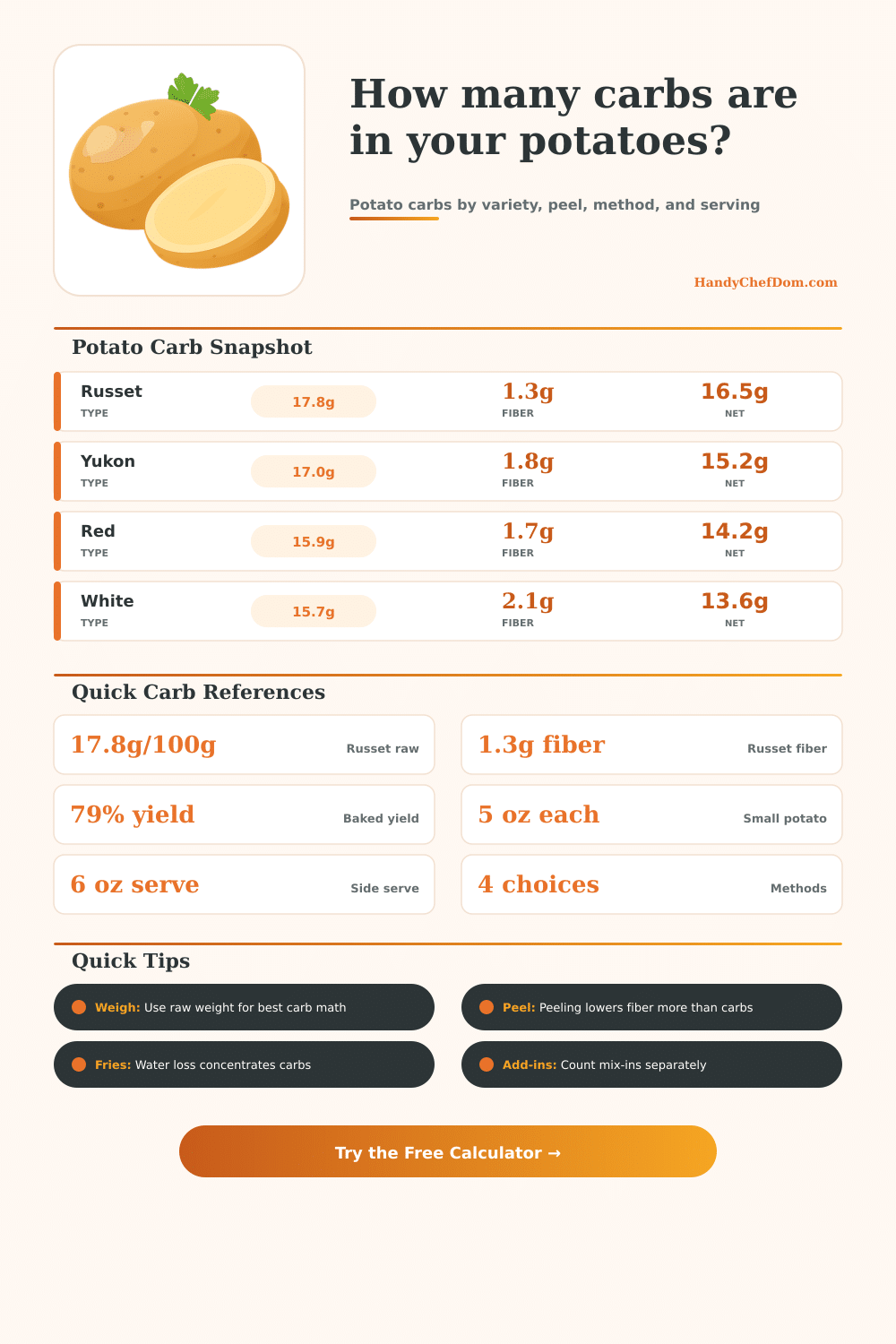
| Variety | Total carbs per 100 g raw | Fiber per 100 g raw | Net carbs per 100 g raw | Average medium weight |
|---|---|---|---|---|
| Russet potato | 17.8 g | 1.3 g | 16.5 g | 213 g / 7.5 oz |
| Yukon Gold potato | 17.0 g | 1.8 g | 15.2 g | 170 g / 6 oz |
| Red potato | 15.9 g | 1.7 g | 14.2 g | 170 g / 6 oz |
| White potato | 15.7 g | 2.1 g | 13.6 g | 173 g / 6.1 oz |
| Fingerling potato | 16.0 g | 1.6 g | 14.4 g | 45 g / 1.6 oz |
| Purple potato | 17.2 g | 1.8 g | 15.4 g | 150 g / 5.3 oz |
| New potato | 14.8 g | 1.5 g | 13.3 g | 85 g / 3 oz |
| Sweet potato | 20.1 g | 3.0 g | 17.1 g | 130 g / 4.6 oz |
| Method | Typical cooked yield | Cooked weight from 1 lb raw | Carb effect | Best calculator setting |
|---|---|---|---|---|
| Baked or roasted | 79% | 12.6 oz / 358 g | Carbs concentrate by water loss | Use typical or dry yield |
| Boiled and drained | 100% | 16 oz / 454 g | Carbs stay close to raw total | Use typical yield |
| Mashed potatoes | 94% | 15 oz / 426 g | Add-ins can raise carbs | Add milk or custom carbs |
| Fries or wedges | 55% | 8.8 oz / 249 g | Highest carbs per cooked ounce | Use dry yield if crisp |
Grid values show estimated net carbs per 100 g cooked food. Baked and fries look higher because less water remains in the cooked portion.
| Add-in choice | Calculator carb add | Fiber add | Typical use | Notes |
|---|---|---|---|---|
| Butter only | 0 g per serving | 0 g | Baked, mash, wedges | Fat changes calories, not carbs |
| Milk in mash | 1.5 g per serving | 0 g | Mashed potatoes | Use custom carbs for large amounts |
| Cream cheese mix | 1 g per serving | 0 g | Mashed or loaded potatoes | Small carb increase |
| Light gravy | 4 g per serving | 0.1 g | Mash or roasted potatoes | Starch-thickened sauces vary |
| Ketchup dip | 5 g per serving | 0 g | Fries or wedges | Use custom carbs for more dip |
| Flour coating | 6 g per serving | 0.2 g | Crispy fries or wedges | Coating changes total carbs |
| Serving goal | Cooked side portion | Raw russets needed | Baked yield | Boiled yield |
|---|---|---|---|---|
| Dinner for 4 | 6 oz each | 1.9 lb / 860 g | 1.5 lb cooked | 1.9 lb cooked |
| Family of 6 | 6 oz each | 2.8 lb / 1.3 kg | 2.3 lb cooked | 2.8 lb cooked |
| Potluck for 12 | 5 oz each | 4.8 lb / 2.2 kg | 3.8 lb cooked | 4.8 lb cooked |
| Event for 25 | 5 oz each | 9.9 lb / 4.5 kg | 7.8 lb cooked | 9.9 lb cooked |
The nutrition facts on a package of potatoes are calculated from raw weight. This number won’t realy tell you anything if you’re eating boiled, baked, or fried potatoes with or without the skin. There’s a calculator that take all those factors into account so you know when it’s time to say no thanks to that potato side dish.
Water removal through baking will increase concentration of carbohydrate left behind (i.e., concentrated carbs). This is why a baked potato is different then its raw state, despite having the same overall amount of starch. There is fewer molecules in the same amount of space. 100g of baked potato is not identical to 100g of any other kind of potato.
Why Cooking Changes Potato Carbs
This calculator also relies on yield factors… These are used to transform raw amounts to cooked amounts. Frying reduce weight by about half, whereas boiling retains almost all original mass. Knowing this will help you avoid comparing cooked weights directly without accounting for the change in density.
Skin matters a lot for fiber. You get much of your dietary fiber from the skin. Since this lowers net carb count. Eating skinned vegetables like potatoes means you get no fiber benefit at all. For example, 100 grams of skin-on Yukon Gold potato have almost two grams of fiber. That’s quite a big deal if you’re counting net carbs.
The calculator let you select partial or full peeling to adjust the fiber content correctly so you can take that into account. The calculator also allows you to choose between fully peeled and partially peeled. For partially peeled, it assumes some skin remains and makes an appropriate adjustment. It doesn’t guess; it know how to reduce fiber by a certain percentage depending on how much surface area remain edible.
Another element that complicates things is the type of potato. Some, such as russet varieties, are denser and starchier, perfect for frying (they don’t fall apart). Others, such as waxy potatoes (fancy fingerlings, red potatoes) retain their shape after boiling but have a slightly different makeup in carbs. Then there are sweet potatoes, with higher fiber and naturaly occurring sugars than traditional potatoes.
The table below is starting point for nutritional information per serving (before preparation), including the average weight of each variety. While one might taste better to you then another, understanding the density of what you’re eating allows you to portion accordingly based off any dietary objectives.
People often miss tracking add-ins. A bit of milk to mashed potatoes adds a small amount of carbs per serving. Ketchup or other gravies may double this impact. Butter bring calories/fat without bringing much carb with it. You’ll see that we’ve got common add-ons covered in the calculator, you enter exactly how many additional grams of carbs your sauce brings to the party.
This matters, because two servings of fries, one dipped in nothing, another dipped in ketchup and another dipped in ranch, may have vastly different metabolic consequences. Breaking out the potato plus toppings allows for a better count versus making a ballpark guess at whole plate.
Texture is also dependent on the cook method: some methods retain more weight, which means a lower concentration of carbs per ounce. For example, boiling retains most weight whereas frying reduces so many ounces of water that the fried food end up very dense with carbs. In this way, roasted potatoes will have more carbs per ounce then boiled potatoes.
If you meal prep, keep in mind that cooked potatoes shrink about 20% when baked (e.g., if you weighed out six ounces of raw potato, you’ll end up with much less after cooking). Plan accordingly! You should of accounted for shrinkage so you can be sure the amount you weigh for breakfast is the same as what you eat at night.
Cooking methods change potatoes (among other things), so they aren’t precisely the same amount before or after you cook them. They shrinks as they lose moisture; things get added in. If you want to count carbs accurately, you have to account for those differences. Raw weight alone does not account for those differences. It is like weighing everything in volume instead of mass. This can work some of the time but it will be off enough to frustrate you over time.
When you enter both the type of thing and the way you cooked it, you’re getting a number based on what actualy happened, not some estimate someone made up somewhere else. A potato is still a potato, but knowing how it changed during the process makes you more confident that what you think it did is realy what happened.