🍹 Drink Size Calculator
Plan party drink servings, glass volume, ice dilution, batch containers, bottles, mixers, and garnish portions before the first tray goes out.
Enter the crowd, event length, drink mix, glass size, dilution, and service style. If drink shares do not add to 100, the calculator normalizes them automatically.
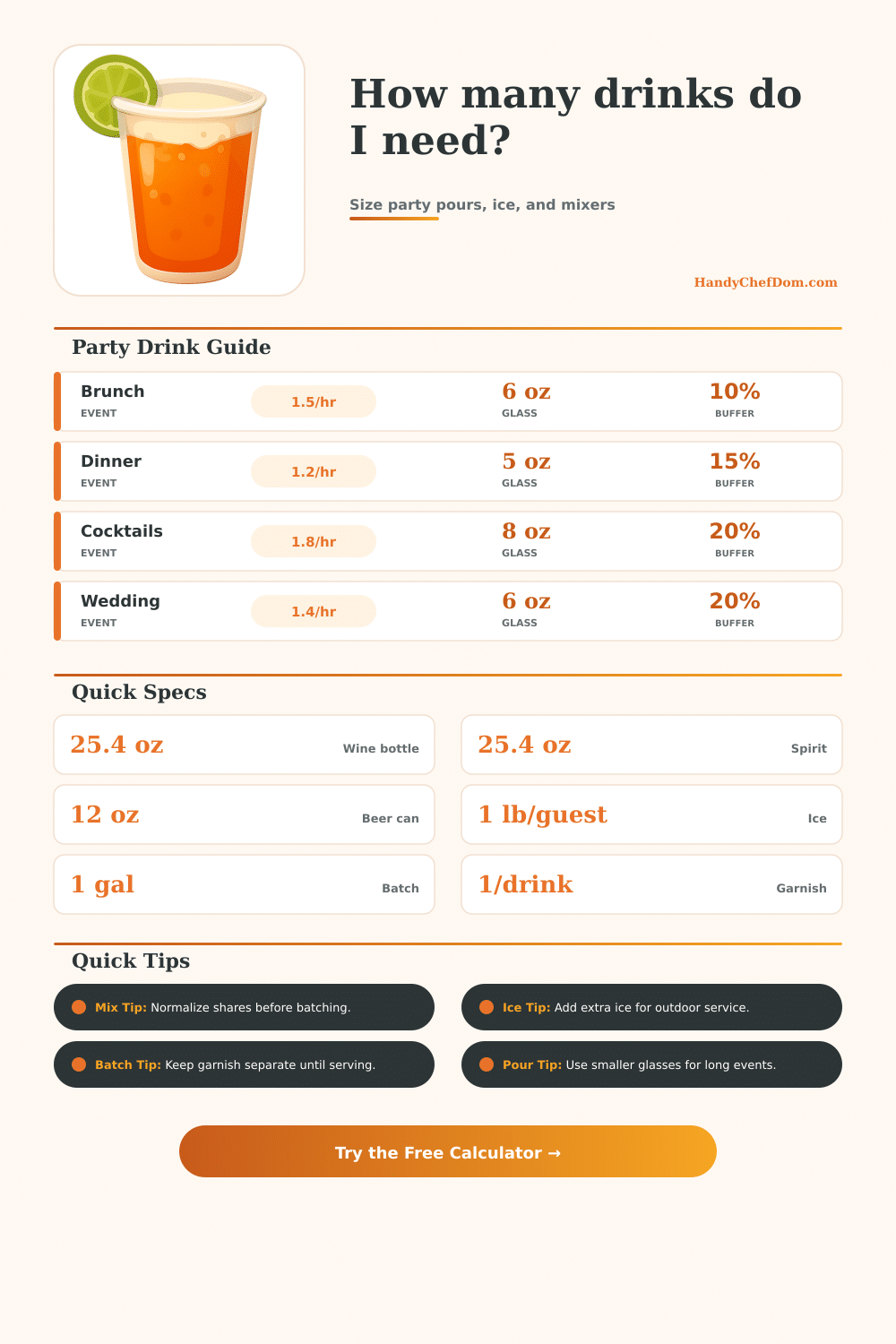
| Event Style | First Hour | Later Hours | Planning Note |
|---|---|---|---|
| Brunch spritz bar | 1.2 drinks | 0.7 drinks | Lighter pace with bubbly mixers |
| Dinner party | 1.3 drinks | 0.8 drinks | Wine tends to lead the mix |
| Cocktail hour | 2.0 drinks | 1.2 drinks | Short event with fast pours |
| Backyard BBQ | 1.6 drinks | 1.1 drinks | Beer and chilled soft drinks matter |
| Wedding reception | 1.5 drinks | 1.0 drinks | Add more buffer for waves of service |
| Open house | 1.0 drinks | 0.6 drinks | Guests arrive and leave in rounds |
| Container | Typical Size | Approx Servings | Best Use |
|---|---|---|---|
| 750 ml spirit bottle | 25.4 oz | 12 to 17 | Cocktails and mixed drinks |
| 1 liter spirit bottle | 33.8 oz | 16 to 22 | Medium bar setup |
| 1.75 liter handle | 59.2 oz | 30 to 39 | Large batch cocktails |
| 750 ml wine bottle | 25.4 oz | 5 glasses | Dinner, toast, and reception |
| 12 oz beer can | 12 oz | 1 serving | Cooler or casual table |
| 2 liter mixer | 67.6 oz | 8 to 13 | Highballs and spritzes |
| Drinkware | Glass Size | Ice/Dilution | Batching Note |
|---|---|---|---|
| Coupe or nick and nora | 4 to 5 oz | 0 to 10% | Batch chilled liquid, serve up |
| Rocks glass | 6 to 8 oz | 15 to 25% | Plan extra ice for each pour |
| Highball | 8 to 12 oz | 25 to 35% | Mixer volume drives the batch |
| Wine glass | 5 oz pour | 0% | Five pours per 750 ml bottle |
| Punch cup | 4 to 6 oz | 10 to 20% | Use small cups for long events |
| Mocktail tumbler | 8 to 10 oz | 20 to 30% | Keep garnish count high |
| Garnish Type | Portions | Prep Count | Serving Note |
|---|---|---|---|
| Citrus wheels | 1 per drink | 8 to 10 per fruit | Plan extras for water and mocktails |
| Herb sprigs | 1 per drink | 18 to 24 per bunch | Best added just before serving |
| Cherries or berries | 1 to 2 each | Use drink count | Skewer in small batches |
| Olives or onions | 2 each | Double drink count | Useful for savory cocktails |
| Salt or sugar rims | 1 tsp each | Batch by glass count | Set a rim tray beside the bar |
| No garnish | 0 | None | Use for simple cooler service |
When calculating the amount of liquid that will be needed for a party, a person must consider the amount of liquid that will move from the bottles into the glass. The number of guests that will attend a party is not the only factor that will impact the amount of liquid that is require; other factors includes the size of the crowd, the weather at the party, and the size of the glasses that will be used to serve the guest. Beyond considering the total amount of liquid that will be needed for the party, it is also necessary to calculate the amount of liquid that will be needed for each period of the party.
The amount of liquid that will be consume during the first hour of the party is likely to be the highest amount that will be consumed during the party. This is likely due to the fact that the guests will be arriving at the party and drink to greet there friends and others that will attend. After the first hour of the party, the amount of liquid that is consumed is likely to be lower then that which is consumed after the first hour.
How to Plan Drinks and Ice for a Party
However, providing too much liquid for the first hour of the party may lead to leftovers of that liquid after the party has concluded; providing too little liquid for the first hour, however, may lead to have to mix drink for guests that are waiting to arrive. Glasses of different size may contain different amounts of liquid. Small glasses may appear to be filled with the drink that is to be served, but the small size of those glasses will lead to the glasses appearing to be empty after the ice within the drink melt.
Glasses of eight ounce or ten ounces can contain the same amount of liquid, and the liquid will remain cold for a longer period of time. A calculator can help to determine the amount of liquid that will need to be provided to guest based off the size of the glasses and the amount of liquid that the ice will melt. The percentage in which the drink will be mixed may also impact the calculation.
It is likely that the host of the party assume that all of the guests will drink the same type of liquid. However, not all of the guests will desire the same type of drink. For instance, if the party is held in the outdoors in the summer, there will likely be more beer and spritzes that will be consumed than there will be wine guest.
Adjusting the percentage of the drinks before performing the calculations will ensure that there is enough of each type of drink to serve each guest. Ice is another resource that will dissapear quickly at the party. The more the temperature of the party increase, the more quickly the ice will disappear.
If the party is to be held indoors, there may be a modest amount of ice that will be needed. However, if the party is to be held outdoors, there will be an extra amount of ice that will need to be provide. Additionally, if the ice melts quickly at the party, the guests will finish their drink quickly.
Thus, there will be an increased amount of ice and liquid that will be needed. Batching is another technique that can be used to provide the liquid for the guests. Batching of the liquid allow for the preparation of the liquid in bulk.
However, care must be taken to ensure that the carbonation of the liquid and the garnish for the drinks are not combine with the batch preparation. A calculator can show the total amount of liquid that will be needed, the amount of container for that liquid, and the portion of the spirits that will be needed for the batch. Thus, when the portion of the batch that contains the spirits is separated from the batch of liquid, the host can calculate the amount of bottles of spirits that will be needed.
Garnishments are another consideration that must be accounted for. Providing a piece of citrus fruit to each drink may seem like a small amount, but if that amount is multiplied by the total number of drink that will be provided to guests, the total amount of citrus juice will be calculated. Counting the portion of both cocktails and mocktails will ensure that there are sufficient garnishments for each guest.
Tables that list the amount of liquid that may be contained in bottles of drinks of various type can help to determine whether the calculations of the host of the party are accurate to the recommendations of common calculation method. For instance, a 750 milliliter bottle of wine will contain five serving of wine. The number of servings of wine, however, may change if the size of the wine glasses or the amount of liquid that is pour into each glass changes.
These tables will help to determine whether any adjustment should of be made to the calculations of the number of bottles of each type of wine that will be needed. Beyond calculating the amount of liquid that will be needed for the party, it is also necessary to calculate the number of individual guest that will attend the party. For instance, a group of guests that will remain at the bar will consume more ice than a group of guests that will roam the party venue.
Additionally, those that have access to a self-serve table will consume more liquid than those that consume drink that are provided at the bar. Calculations of the amount of liquid that will be consumed by each of these group will ensure that the number of bottles of liquid that will be stocked at each area is accurate. Furthermore, having a surplus of the drinks and ice at the party will ensure that the party will not end due to depletion of those supply.