🥜 Almond Flour Protein Calculator
Estimate almond flour grams, protein per batch, protein per serving, cup or tablespoon equivalents, blend share, and yield-adjusted portions.
Choose the measuring form first. Cups and tablespoons are converted with the selected almond flour density, while grams stay direct for the cleanest protein estimate.
| Almond Flour Type | Protein Per 100g | Typical Grams Per Cup | Best Calculator Setting |
|---|---|---|---|
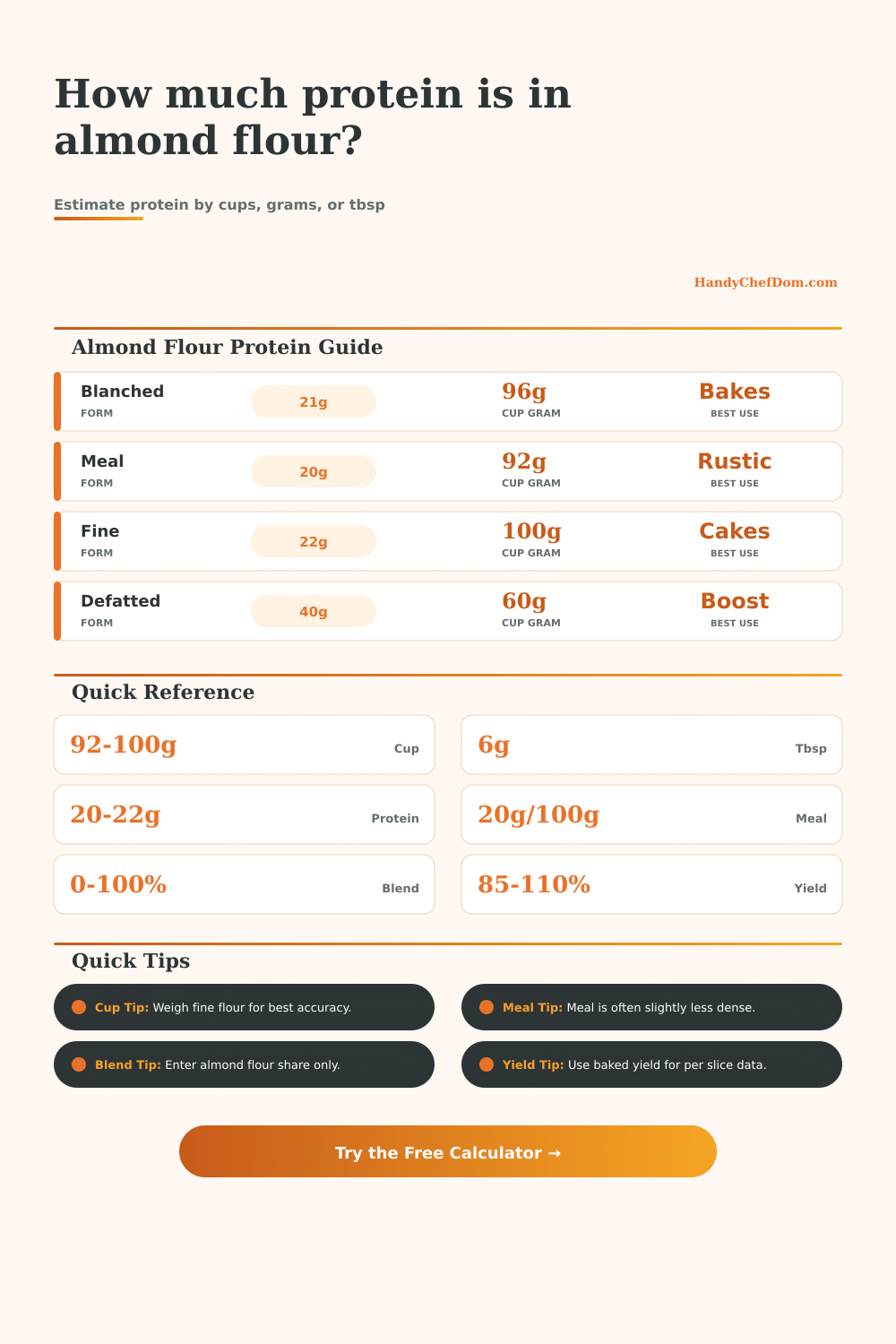
| Blanched fine almond flour | 20.5 to 22.0 g | 92 to 100 g | Use 21.2 g protein and 96 g per cup |
| Natural almond meal | 19.0 to 21.0 g | 88 to 96 g | Use 20.0 g protein and 92 g per cup |
| Superfine blanched almond flour | 21.0 to 23.0 g | 98 to 104 g | Use 22.0 g protein and 100 g per cup |
| Partly defatted almond flour | 35.0 to 45.0 g | 55 to 70 g | Use label data because brands vary widely |
| Coarse almond meal | 18.5 to 20.5 g | 82 to 92 g | Use 19.5 g protein and 86 g per cup |
| Homemade ground almonds | 19.0 to 21.5 g | 85 to 100 g | Use 20.5 g protein and 90 g per cup |
| Measurement | Fine Flour Weight | Approx Protein | Volume Equivalent |
|---|---|---|---|
| 1 tablespoon | 6 g | 1.3 g | 1 tbsp |
| 2 tablespoons | 12 g | 2.5 g | 1/8 cup |
| 1/4 cup | 24 g | 5.1 g | 4 tbsp |
| 1/3 cup | 32 g | 6.8 g | 5.3 tbsp |
| 1/2 cup | 48 g | 10.2 g | 8 tbsp |
| 1 cup | 96 g | 20.4 g | 16 tbsp |
| Recipe Type | Common Almond Flour | Common Servings | Yield Adjustment |
|---|---|---|---|
| Macaron shells | 90 to 130 g | 20 to 30 shells | 92% to 98% |
| Muffins or cupcakes | 120 to 220 g | 10 to 12 pieces | 95% to 105% |
| Pancakes or waffles | 60 to 140 g | 3 to 6 servings | 100% to 110% |
| Cookies or bars | 100 to 260 g | 12 to 24 pieces | 90% to 100% |
| Tart crust or crumb base | 120 to 220 g | 8 to 12 slices | 88% to 96% |
| Gluten free flour blend | 25% to 75% share | Varies by pan | Use finished weight if known |
| Blend Ratio | What It Means | Protein Impact | Calculator Use |
|---|---|---|---|
| 100% almond flour | All dry flour is almond flour | Highest almond contribution | Other blend protein is ignored |
| 75% almond flour | One quarter is another flour | Protein depends on the second flour | Enter other flour protein if known |
| 50% almond flour | Half almond, half another flour | Per serving protein can drop or rise | Use total dry blend weight as amount |
| 25% almond flour | Almond flour is a support flour | Almond taste and protein are lower | Check label data for the main flour |
| High protein blend | Uses defatted almond flour or protein flour | Protein can be much higher | Override protein per 100g |
| Low protein blend | Mixed with starch or rice flour | Protein per serving drops | Set other flour protein lower |
People who bake at home find themself discovering almond flour because they no longer wish to eat wheat. Sure, the texture is something else too but there’s a reason most recipes don’t talk about variable densities: when you substitute one ingredient for another, things gets complicated. You pick up a bag of blanched almonds, pour some into the grinder, and now you’re working with variables that recipes haven’t even prepared you for.
First is density. A cup of almond flour isn’t necessarily the same as any other cup of almond flour. Depending on whether you scoop firmly or spoon lightly, that cup will vary by weight, which means your protein count will vary a lot if you’re counting macronutrients. The handy tool above does this math for you so you can avoid guessing how many grams of anything are lurking in that slightly overfilled cup.
How to Measure Almond Flour Protein
But more than the amount itself, there’s the grind. The flour is pale, smooth, tightly packed and blanched. Meal has skins on (called natural meal) and they increases the bulk but not the protein. So the protein-per-hundred-grams number decreases a little if you choose meal for the setting. Not a big change, but when you’re making an entire loaf, it does make a difference.
What about defatted almond flour? That’s a different animal altogether. Most of the oil has been extracted, leaving a highly concentrated level of protein. Because of this, you’ll need fewer grams of defatted flour to reach the same nutritional goal. That is why that form chooser is important. It roots all the following calculations into something real: the actual ingredient in front of you, in the bowl.
It’s also an exercise in learning how to manage moisture, which can be tricky when baking with almond flour. Ground nuts absorbs water differently than wheat flour. When you make a batch of muffins or a cake, not all of that weight sticks around. Some of it will evaporate during the baking. This is why there’s an option to adjust for yield. This takes into account the fact that some of the weight evaporates. The finished weight of your muffins/cake is lower than the combined weight of the ingredients before they were baked. The protein gets more concentrated as a result. Per gram of finished food, there’s simply more protein. That doesn’t change the overall protein content of the whole batch, just how much there is on a per slice basis. People don’t realize this distinction. They weigh the dry ingredients, then forget that cooking or baking removes water. Adjusting for yield provides a more accurate picture of what you’re really putting in your mouth.
There’s more: blending. A lot of gluten free recipes combines different flours; usually almond flour and some sort of starch (tapioca starch, maybe, or rice flour). Those starches have little protein. For example, if you replace some of your almond flour with a starch, your protein per serving drops. The blend ratio input captures that tradeoff. You’ll enter the percent of almond flour in your dry mix. From there, the calculator use the protein contribution from whatever else is in the mix. By default it just has a baseline… Something like “other ingredient” will contribute x grams of protein. But you can override this if you want; you may know exactly what kind of starch you’re using, for example. That’s where the simplicity breaks down in these other recipes. They assume one flour type but in reality most real cooking doesn’t work that way.
The macros aren’t everything. Fat. One hundred grams of almond flour contains almost six hundred calories. Calorie dense. Why does that matter? Precision. If your scoop is off by even a half cup, which can be a vague guess at times, then it might be twenty grams of protein or it might be thirty. Those margins increases over time. Either more protein than intended or less structural support as desired. To help put the ranges into context, there are some reference tables provided on page. These illustrate the range of each grind/brand. Set your expectations before mixing so you know what you’re getting yourself into.
But really, all the calculator does is reflect the decisions you’ve made in the kitchen. What kind of flour did you use? How dense do you want it? How many servings do you want to break this batch into? Those are all up to you and the math just shows you the result of your decision. There is no wrong answer, only informed ones.
Knowing precisely what’s in your bowl shifts everything about baking, whether you’re cooking quick banana bread or trying to make macaron shells. It removes the guesswork. It replaces it with engineering, which turns an experiment gone wild into something predictable and repeatable. The protein content is no longer a mystery; it’s a feature. You measure out your flour, you know what you put in, and then you let the results speak for themself. And that clarity would of been worth the added few seconds of prep time.