🌻 Protein in Sunflower Seeds Calculator
Estimate sunflower seed protein from hulled kernels, shell-on snacks, tablespoons, ounces, grams, roasting style, salt level, servings, and protein targets.
Choose how you measured the sunflower seeds. Shell-on entries are converted to edible kernels first, then protein is calculated from the raw or roasted seed profile.
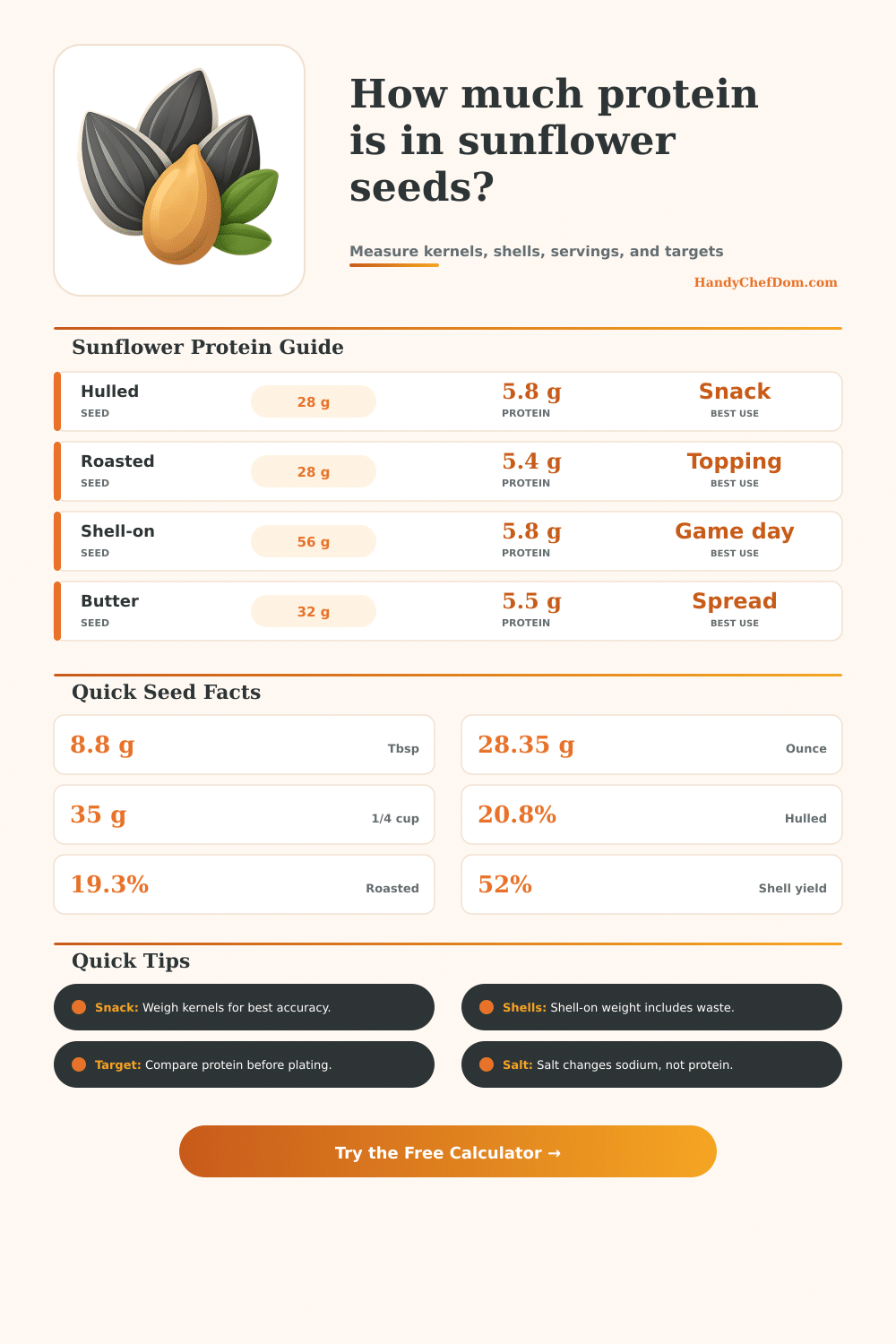
| Sunflower Seed Form | Edible Yield | Protein per 100 g | Best Calculator Use |
|---|---|---|---|
| Hulled raw kernels | 100% | 20.8 g | Most accurate for weighed snacks |
| Dry roasted kernels | 100% | 19.3 g | Roasted topping or snack bags |
| Oil roasted kernels | 100% | 17.2 g | Crunchy prepared snack mixes |
| Shell-on sunflower seeds | 52% | 20.8 g edible | In-shell snack weight estimates |
| Sunflower hearts | 100% | 21.0 g | Small bakery kernels and granola |
| Sunflower seed butter | 100% | 17.2 g | Spreads, dips, and smoothie scoops |
| Kitchen Measure | Hulled Weight | Raw Protein | Roasted Protein |
|---|---|---|---|
| 1 tablespoon | 8.8 g | 1.8 g | 1.7 g |
| 2 tablespoons | 17.6 g | 3.7 g | 3.4 g |
| 1 ounce | 28.35 g | 5.9 g | 5.5 g |
| 1/4 cup | 35 g | 7.3 g | 6.8 g |
| 1/2 cup | 70 g | 14.6 g | 13.5 g |
| 100 grams | 100 g | 20.8 g | 19.3 g |
| Use Case | Typical Amount | Protein Range | Portion Note |
|---|---|---|---|
| Snack bowl | 1 oz kernels | 5.4-5.9 g | Strong single serving |
| Salad topping | 2 tbsp kernels | 3.4-3.7 g | Crunch without crowding |
| Oatmeal topping | 1 tbsp kernels | 1.7-1.8 g | Small daily boost |
| Bread mix-in | 1/2 cup kernels | 13.5-14.6 g | Split across slices |
| Trail mix batch | 1 cup kernels | 27-29 g | Divide by snack bags |
| Shell-on snack | 2 oz in shell | 5.6-6.1 g | Accounts for discarded shells |
| Salt Choice | Sodium Estimate | Protein Impact | When to Choose |
|---|---|---|---|
| Unsalted | 2 mg per oz | No change | Baking, bowls, meal prep |
| Lightly salted | 80 mg per oz | No change | Balanced snack cups |
| Salted snack seeds | 170 mg per oz | No change | Ready-to-eat snack bags |
| Low sodium salted | 45 mg per oz | No change | Lower salt snack tracking |
Sunflower seed can be found in an variety of foods. However, many person are unaware of the amount of protein that is contained within sunflower seed once the shell are removed. The protein content of sunflower seeds can change depending on the amount of sunflower seed that are consumed, whether as a snack or as part of a meal.
As such, a calculator can help to easy convert the different unit of measurement of sunflower seeds (such as tablespoons, ounces, grams, and shells) into each other. The calculator additionally allow for the user to input the type of sunflower seed that are to be consumed. For instance, the calculator can account for whether the sunflower seeds that is selected contain plain hulled kernels, sunflower seed heart, sunflower seed butter, or sunflower seeds that is still in there shells.
How to Measure Protein in Sunflower Seeds
Each of these forms contain different amount of edible sunflower seeds relative to the total weight of the form of sunflower seeds, and each of these forms have different amounts of protein per unit weight of sunflower seeds. Some form of sunflower seeds contain more protein per gram of sunflower seeds than others. For instance, roasted sunflower seed in oil contain different amount of protein per unit weight than raw sunflower seeds.
However, the amount of salt that is added to sunflower seeds do not impact the amount of protein that is contained within the seed. Sunflower seeds can be measured in a variety of ways. For instance, the amount of sunflower seeds can be measured by volume (such as cups, tablespoons) or by weight (such as ounces or grams).
The weight of a tablespoon of plain hulled sunflower seed kernel will be different than the weight of a tablespoon of sunflower seed butter. Additionally, if the sunflower seeds that are to be consumed are still within their shell, the calculator will subtract the weight of the shell of the sunflower seeds prior to calculate the protein content. This is accomplished to ensure that counting the weight of the shells will not lead to inaccuracy in the protein count.
Sunflower seeds are considered to be a useful food for a variety of reason. For instance, sunflower seeds can store well, and do not require refrigeration prior to use. Sunflower seeds can be carried in small jar, for instance.
Additionally, sunflower seeds can be added to a grain bowl to increase the protein content of that meal. Sunflower seeds have a mild flavor, which allow them to be used in both sweet and savory dish. In addition to the general type of sunflower seeds, there are also different preparation style of sunflower seeds.
For instance, dry roasted sunflower seeds contain less water than raw sunflower seeds. As a result, the protein density of dry-roasted sunflower seeds are different from that of raw sunflower seeds. Oil-roasted sunflower seeds contain more calories than other type of sunflower seeds.
However, the protein content of oil-roasted sunflower seeds remain the same as other type. Each preparation style can be selected on the calculator to reflect the actual protein content of the sunflower seeds that are currently present within the kitchen. Sunflower seeds can be used in a variety of portion size.
For instance, one individual may consume one ounce of sunflower seeds as a snack. However, one ounce of sunflower seeds may also be incorporated into a large salad or batch of muffin. The calculator allow individuals to divide the total amount of sunflower seeds to be consumed into a number of serving.
This can help individuals to understand the amount of protein that each individual will receive from the total serving of sunflower seeds. Additionally, sunflower seeds can be compared to other type of seed that are available. For instance, pumpkin seeds contain more protein per ounce than sunflower seed.
However, pumpkin seed are larger in size and have a stronger flavor than sunflower seeds. Furthermore, hemp heart contain more protein than sunflower seeds, though they are softer in texture. Sunflower seeds, therefore, are an alternative to seeds that contain more protein but with different flavor and texture characteristic.
Finally, the calculator allow individuals to go from guessing the protein content of the sunflower seeds that they consume to measuring the protein content of those seed. After indicating the edible weight of the sunflower seeds and the preparation style of those sunflower seeds, the calculator can determine the protein content of those seed. Additionally, the protein content percentage of sunflower seeds can be compared to the individual protein target.
Thus, sunflower seeds can be used as a reliable component to the individuals daily protein planning.