Wine Fortification Calculator for Port, Madeira, and Dessert Styles
Calculate spirit additions to reach a target ABV with realistic cellar assumptions, then check batch size, bottle count, and sweetness impact before blending.
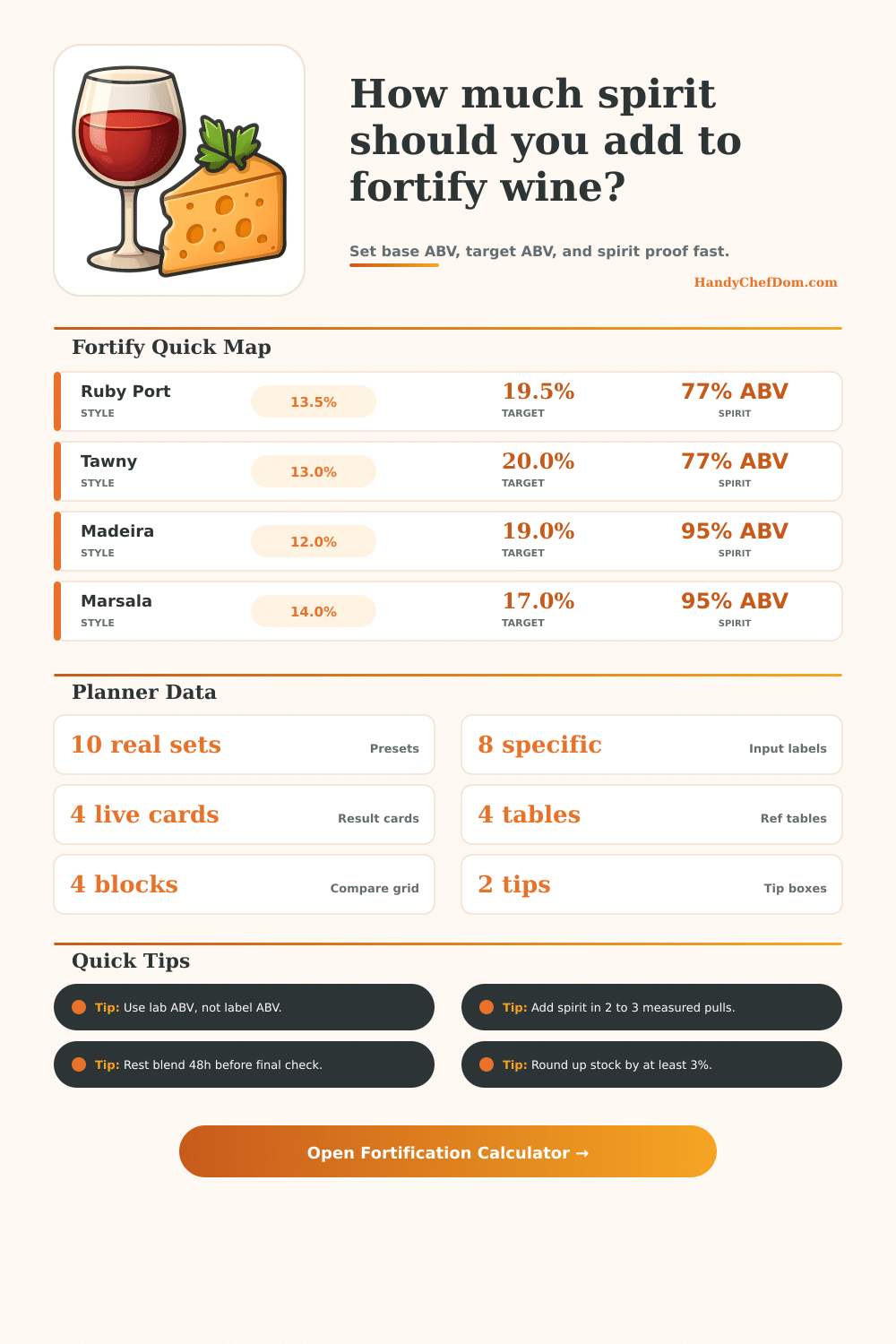
Core formula: spirit volume = (target ABV - base ABV) / (spirit ABV - target ABV) x base volume. Keep target below spirit ABV.
| Fortifier | ABV | Use Case | Notes |
|---|---|---|---|
| Aguardente | 77% | Port styles | Traditional for Douro lots |
| Neutral spirit | 95% | Madeira | Lower volume needed |
| Brandy base | 65% | Aromatized | Adds flavor weight |
| Grape spirit | 80% | Vin doux | Fruit aligned profile |
| Style | Low | High | Typical |
|---|---|---|---|
| Ruby Port | 19.0% | 20.0% | 19.5% |
| Tawny Port | 19.0% | 20.0% | 20.0% |
| Madeira dry | 18.0% | 19.5% | 19.0% |
| Madeira sweet | 18.0% | 19.5% | 19.0% |
| Marsala Fine | 17.0% | 18.0% | 17.5% |
| Aromatized | 14.5% | 18.0% | 16.0% |
| Sweetness | g/L | Style Cue | Perception |
|---|---|---|---|
| Dry | 0-40 | Sercial | Crisp, nutty |
| Medium dry | 40-80 | Verdelho | Balanced lift |
| Medium | 80-120 | Bual | Round palate |
| Sweet | 120-180 | Malmsey | Rich texture |
| Very sweet | 180-240 | Mistela | Dessert intensity |
| Container | Volume | Per 100 L | Use |
|---|---|---|---|
| Half bottle | 375 ml | 266 units | Tasting flight |
| Standard | 750 ml | 133 units | Retail bottle |
| Magnum | 1.5 L | 66 units | Cellar release |
| 3L box | 3.0 L | 33 units | By-glass service |
Fortifying wine are a process of adding spirit to base wine. Fortifying wine stop the fermentation process, raises the alcohol content of the wine, and locks in the sweetness of the wine. Port and Madeira wine are two types of wines that must be fortified, and the fortification process allow these wines to remain stable.
To fortify wine successfuly, precise measurement of the ingredients must be used; using instinct to measure the ingredients can lead to the addition of to much spirit to the wine. The equation for fortifying wine require the consideration of several variables. The variables to consider are the volume of the base wine, the current alcohol content of the base wine, the target alcohol content to be achieve through the fortification process, and the proof of the spirits to be added to the base wine.
How to Fortify Wine Correctly
The volume of the base wine will tell you how much of the spirit must be added to achieve the target alcohol level. The current alcohol content of the base wine will tell you how much more alcohol the wine need. The target alcohol content will tell you what type of wine you are attempting to create.
Finally, the proof of the spirits to be added will allow you to determine the amount of the spirit to be added to the base wine to achieve the target alcohol level. The more higher the proof of the added spirit, the less of that spirit that must be added to achieve the target alcohol level. Conversely, using a spirit with a lower proof will require more of that spirit to be added to the wine.
The type of spirit to be added to the base wine will impact the flavor of the resulting wine. For instance, using an aguardente spirit at 77% alcohol is the preferred spirit for Fortified wine like Port. However, neutral spirits of 95% alcohol is used in wines like Madeira.
The reason for this is that the 95% spirit allow the wine to reach it’s target alcohol level with the addition of less of the spirit. Using less of the spirit has the benefit of reducing the impact of the flavor of the added spirit on the final finished wine; however, the benefit of using less of the spirit also comes with the drawback of leaving less opportunity to make corrections to the amount of spirit added. Residual sugar must be considered in the fortification of wine; the residual sugar content of the wine will determine whether the wine is sweet or dry.
The decision of the amount of residual sugar that will be present in the wine is another of the decisions that the winemaker must make. This decision will impact the blend of the wine. Tables exist that can allow winemakers to determine the amount of grams of sugar per liter of wine that should be used to create different types of wine.
For instance, Sercial-style Madeira and Malmsey-style Madeira wines has similar alcohol percentages, but contain different amount of residual sugar. When calculating the amount of wine that will be produced after the winemaking process, the losses that occur during the movement of the wine through the winemaking facility must also be considered. These transfer losses occur when wine move through transfer pumps, hoses, and winemaking tanks.
Winemakers typically allow for the loss of 3% of the total volume of wine when accounting for these transfer losses; this allowance is a conservative number that ensures that winemakers do not create bottling issues. Furthermore, the allowance for wine losses is applied after the addition of the fortifying spirit; applying this percentage after the addition of the spirit to the wine ensure that the winemaking and bottling process will still produce the amount of wine that was calculated in the winemaking process. Some of the mistakes that winemakers make when fortifying wine include not treating the various inputs into the winemaking process as adjustable variables, and not allowing the wine to blend for long enough to produce accurate analyses of the wine’s properties.
For example, winemakers should not use the alcohol level indicated on the label of the wine as the measurement for the alcohol level of the wine to be fortified; the label measurement of alcohol content is not likely to be accurate. Additionally, winemakers should not add all of the spirit to the wine in one single pour; this leaves no opportunity to adjust the amount of spirit that is added to the wine. Finally, winemmakers should not wait only a few hours after blending the wine to test the amount of alcohol in the wine; the wine need to be blended for a longer period of time to ensure the accuracy of the measurements of the wines properties.
Winemakers should use a staged addition approach to the winemaking process; using this approach will ensure that winemakers reduces the mistakes that they may make during the winemaking process. Winemakers should also consider the type of packaging in which they will package their wine during the winemaking process. For instance, winemakers can use the calculated yields of wine to determine how many bottles of wine can be produced; the number of bottles that will be produced will allow winemakers to order the correct amount of glass bottles of the desired size.
For instance, 100 liters of wine will produce enough wine to fill 133 bottles of standard size; however, it will only be enough to fill 66 magnums. By knowing how many bottles will be produced prior to blending the wine, winemakers can ensure that they produce the wine that will be best enjoyed by their target audience. The goal of using these types of calculations in the winemaking process is to make informed decisions about the winemaking process.
Furthermore, the goal of using these types of calculations is to ensure that the added spirit preserves the sweetness of and the structure of the wine, while allowing the fruit and acidity of the wine to remain balanced.