🥄 Sauce Reducing Time Calculator
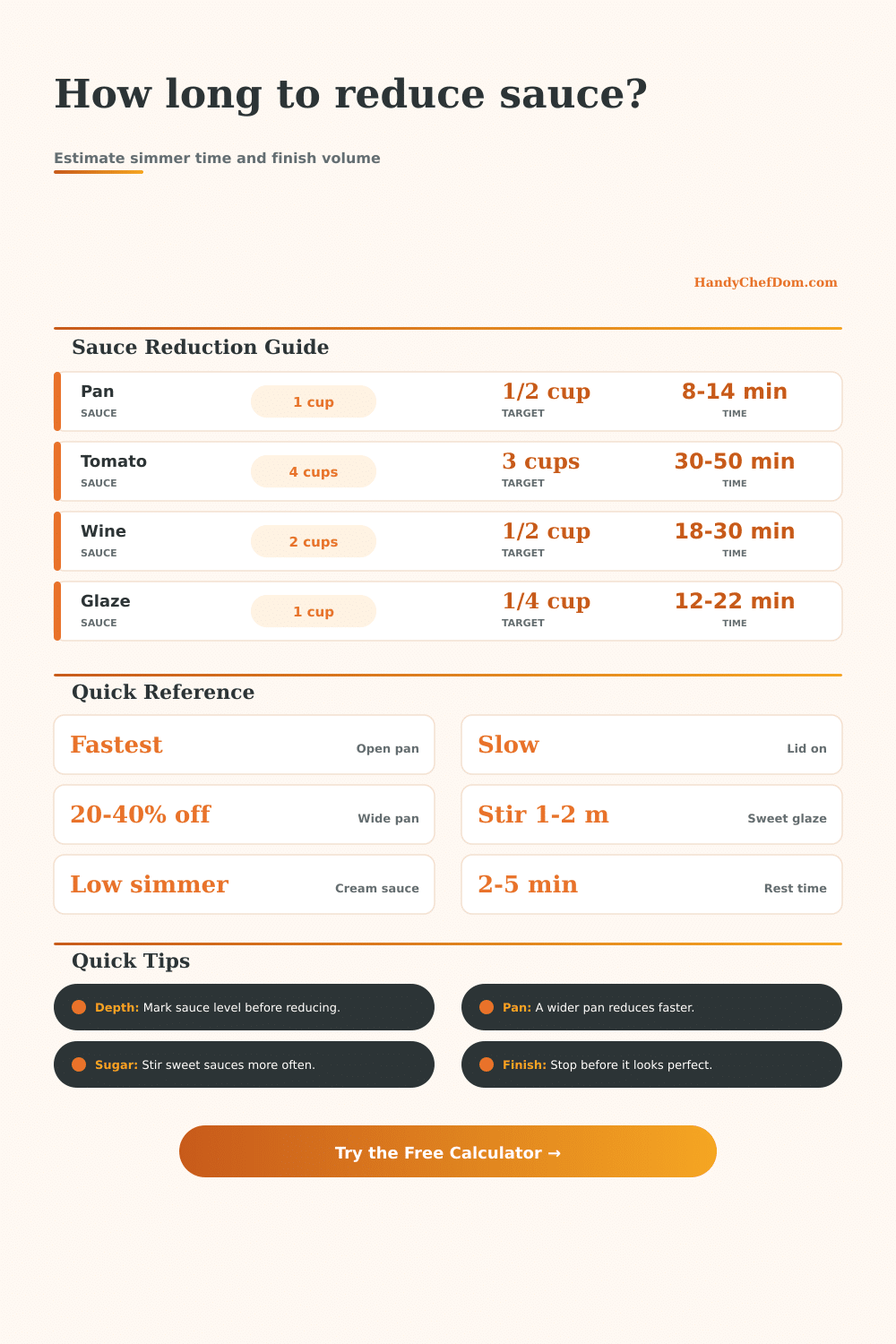
Estimate sauce reducing time from starting volume, target volume, target thickness, pan diameter, simmer intensity, sauce type, sugar or fat content, lid status, stirring frequency, altitude, and simmer temperature.
Choose the closest sauce profile, then enter the volume drop, pan width, heat, lid, stirring rhythm, altitude, and simmer temperature. The estimate is a planning window; final thickness still depends on pan material, burner output, and sauce solids.
| Sauce Type | Typical Starting Volume | Common Target | Timing Behavior |
|---|---|---|---|
| Pan sauce or skillet jus | 1 to 2 cups | 1/2 to 1 cup | Fast because the batch is shallow and often in a wide pan. |
| Tomato sauce or marinara | 3 to 8 cups | 75% to 85% of start | Moderate; tomato solids thicken while water leaves. |
| Wine or vinegar reduction | 1 to 3 cups | 25% to 50% of start | Quick at first, then slower as sugars and acids concentrate. |
| Cream or coconut sauce | 2 to 5 cups | 65% to 85% of start | Gentle heat is best because fat can split at a hard boil. |
| Fruit coulis or sweet glaze | 1 to 4 cups | 25% to 60% of start | Scorch risk rises late as sugar thickens. |
| Demi-glace or stock concentrate | 4 to 16 cups | 20% to 50% of start | Longer, steadier reduction with gelatin body. |
| Pan Diameter | Surface Area | Relative Speed | Best Use |
|---|---|---|---|
| 8 in / 20 cm | About 50 sq in | Slower | Small glazes and careful dairy finishes. |
| 10 in / 25 cm | About 79 sq in | Baseline | Pan sauces, gravies, and small tomato batches. |
| 12 in / 30 cm | About 113 sq in | Fast | Wine reductions and medium sauce batches. |
| 14 in / 36 cm | About 154 sq in | Very fast | Stock concentrating and larger restaurant-style batches. |
| Deep saucepan | Less exposed area | Slower | When splatter control matters more than speed. |
| Wide roasting pan | More exposed area | Fastest | Large stock or jus reductions with lots of steam release. |
| Method Factor | Fast Setting | Slow Setting | Calculator Effect |
|---|---|---|---|
| Lid status | Open pan | Mostly covered | Covered pans can take several times longer to reduce. |
| Simmer intensity | Active simmer | Lazy edge bubbles | More steam speeds reduction but increases sticking risk. |
| Sugar content | Lean stock | Honey, fruit, glaze | Sweet sauces need closer stirring near the finish. |
| Fat content | Lean broth | Cream, butter, coconut | Fatty sauces often need lower heat and extra patience. |
| Starch or puree | Thin liquid | Roux or tomato solids | Texture may thicken before the planned target volume. |
| Stirring | Every 1 to 3 min | Every 8 to 12 min | Shorter intervals lower scorch risk in thick sauces. |
| Altitude / Temperature | Boiling Reference | Reduction Note | Use In Calculator |
|---|---|---|---|
| Sea level | 212°F / 100°C | Standard simmer behavior. | Use 0 ft or 0 m altitude. |
| 2,500 ft / 760 m | About 207°F / 97°C | Lower boil; simmer looks softer. | Expect a small timing increase. |
| 5,000 ft / 1,520 m | About 203°F / 95°C | Water boils cooler. | Use an active simmer if safe for the sauce. |
| 7,500 ft / 2,285 m | About 198°F / 92°C | Evaporation behavior changes noticeably. | Plan a wider ready window. |
| Low simmer | 185 to 195°F | Safer for dairy and sweet glazes. | Longer time, lower scorch risk. |
| Active simmer | 200 to 210°F | Faster water loss. | Watch sweet or starchy sauces closely. |
Reduction is one of the biggest mysteries in the kitchen to most home cooks: They pour some liquid into a pan, let it evaporate until it’s reduced, then hope it’ll be good. But realy, reduction isn’t magic; it’s physics. It’s heat management, surface area, and evaporation pretending to be cooking. Ignore the variables and you’re left with a burned and bitter sauce, or a watery and weak one.
This tool will show you the variable before you ever even get to turning on your stove.
How the Reduction Calculator Works
This is the second variable: the pan itself. More surface area exposed to air equals faster evaporation. So whereas a deep saucepan will take longer to decrease a given amount of liquid (say, four cups of tomato sauce), a wide skillet will do it in a fraction of that time. In other words, if you’re attempting to simmer down four cups in a narrow pot, you may be waiting an hour before they thickens. Same volume, wide sauté pan, and you’ll be done in half that time. Not patient? Me neither. It is geometry. That’s why the calculator lets you type in your pan diameter and tweaks its estimate accordingly. Because different pans lets more or less steam escape per unit of time.
Yes, heat is important. But there’s such a thing as too much. Many cooks believe cranking the dial to high will speed up the process. Nope. When making a sauce with cornstarch or dairy, a rolling boil might create graininess. Gentle simmering tends to work better: It evaporates at a steady rate without disturbing the emulsion. To show this change, the calculator lets you set intensity of simmer, knowing that an active bubble differs from a lazy one. That difference is particularly significant when working with reduction sauces (such as cream ones) or béchamel which split under aggressive heat.
But add sugar into the equation and things change completely. A lean stock cooks down quick and is forgiving of mistakes, but something like a berry coulis or a balsamic glaze is a whole different story. The sugar makes the mixture more concentrated as it loses its water, dropping the burning point of the mixture. Something that was a safe simmer initially can be a scorching hazard by the end. That’s why the tool asks if there’s sugar. It’ll adjust how often it recommend stirring so that you don’t walk away only to return to a pot of blackened candy.
The lowdown is that altitude is a silent saboteur. And if you call Denver (or another hilly town) home, it causes water to boil at a lower temp. So even after that timer dings, your sauce may yet be thin; the evaporation won’t occur as quick as shown by standard charts. Here is your solution. You’ve got some simmering to do; because while your timer says “done,” your sauce tastes more like soup. The calculator takes altitude into account and adds time to your guesswork so you don’t end up with a soup rather than a sauce.
And then there’s the finishing: Don’t serve your sauce when it appears finished in the pan. Carryover cooking means sauces continues to thicken as they cool. If you let the sauce cook until it just barely coats the spoon, it will be gelatinous by the time it lands on the plate. To allow for this small increase in thickness, the finish volume number the calculator gives you is slightly higher than what you might expect.
But in the end, a calculator cannot taste. No calculator looks through a window. It doesn’t tell you when to check the depth or when its time to start stirring. But it does provide you with that safety net, that plan, that window. And then it’s up to your nose and your eyes.
Is there a sheen? Is it still holding its consistency? Follow your judgment instead of the clock. Math will get you to the kitchen; judgment will get you to the table.