Bananas Carb Calculator
Estimate total carbs, net carbs, fiber, sugars, recipe servings, and daily target coverage from banana size, weight, and ripeness.
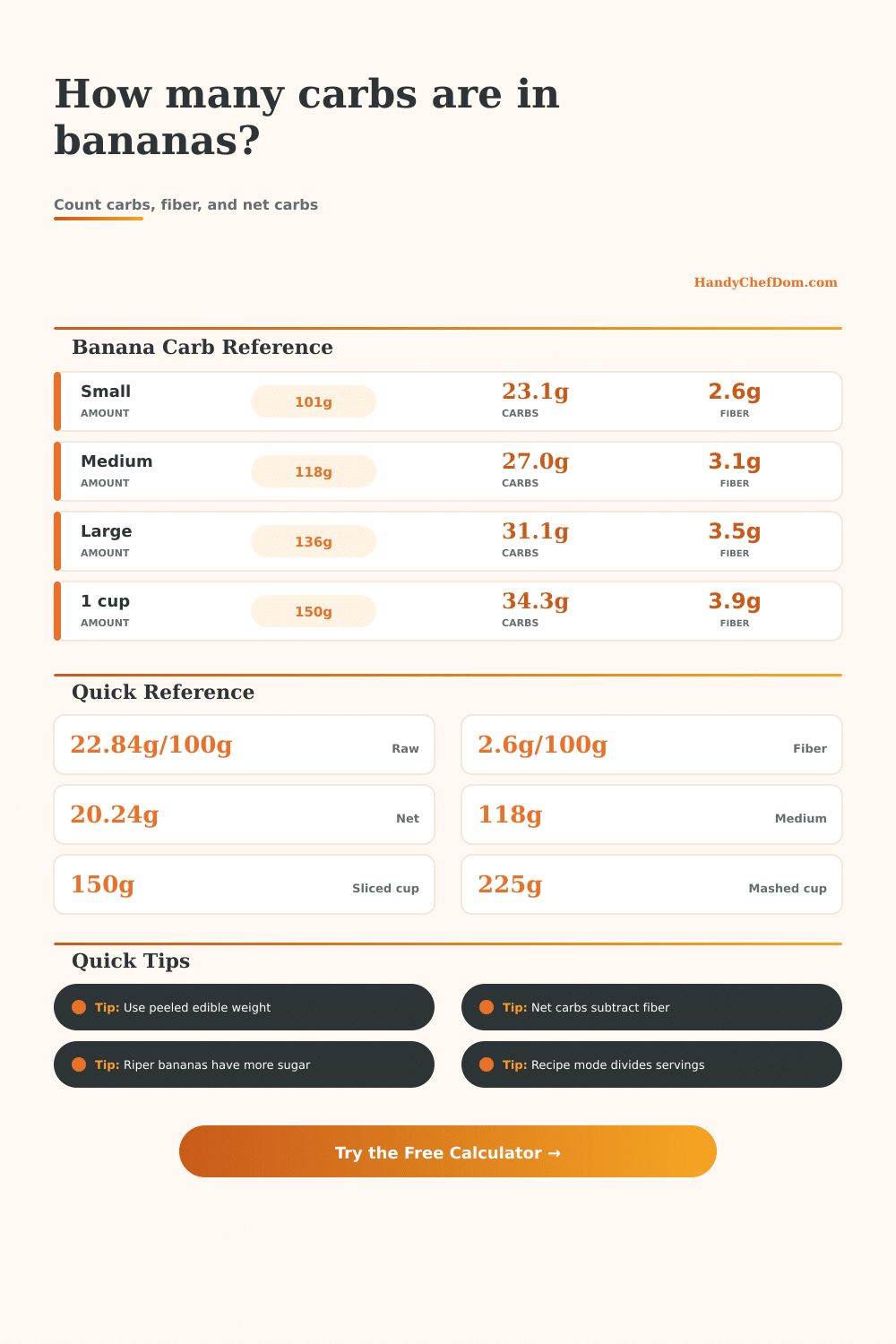
| Nutrient | Per 100 g | Medium 118 g | Large 136 g | Data Note |
|---|---|---|---|---|
| Carbohydrate, by difference | 22.84 g | 27.0 g | 31.1 g | FoodData Central SR Legacy 173944 |
| Fiber, total dietary | 2.60 g | 3.1 g | 3.5 g | Edible raw banana weight |
| Net carbs | 20.24 g | 23.9 g | 27.5 g | Total carbs minus fiber |
| Total sugars | 12.23 g | 14.4 g | 16.6 g | Raw banana sugar baseline |
| Starch | 5.38 g | 6.3 g | 7.3 g | Higher in less-ripe fruit |
| Calories | 89 kcal | 105 kcal | 121 kcal | Calculated energy value |
| Ripeness | Carbs/100 g | Fiber/100 g | Sugars/100 g | Starch/100 g | Best Use in Calculator |
|---|---|---|---|---|---|
| Green / starchy | 22.5 g | 2.8 g | 7.0 g | 12.0 g | Starch-forward estimate |
| Yellow firm | 22.84 g | 2.60 g | 12.23 g | 5.38 g | USDA raw banana baseline |
| Ripe yellow | 23.0 g | 1.7 g | 15.82 g | 3.66 g | FDC ripe/slightly ripe |
| Spotty ripe | 22.4 g | 1.7 g | 15.8 g | 1.7 g | Between ripe and overripe |
| Overripe | 20.1 g | 1.7 g | 15.8 g | 0.41 g | FDC overripe banana |
| Amount | Weight | Total Carbs | Fiber | Net Carbs | Sugars | Target % |
|---|
| Recipe Input | Banana Weight | Batch Carbs | Servings | Carbs Each | Typical Use |
|---|---|---|---|---|---|
| 1 medium banana | 118 g | 27.0 g | 6 | 4.5 g | Pancakes or oats |
| 2 medium bananas | 236 g | 53.9 g | 8 | 6.7 g | Smoothie portions |
| 1 cup mashed | 225 g | 51.4 g | 10 | 5.1 g | Banana bread slices |
| 1 cup sliced | 150 g | 34.3 g | 4 | 8.6 g | Breakfast topping |
| 3 large bananas | 408 g | 93.2 g | 12 | 7.8 g | Muffin batch |
| 4 medium bananas | 472 g | 107.8 g | 16 | 6.7 g | Freezer prep |
| Method | Formula | Medium Banana | When Helpful | Calculator Setting |
|---|---|---|---|---|
| Total carbs | All carbohydrate grams | 27.0 g | Nutrition labels and broad tracking | Track Total Carbs Only |
| Net carbs | Total carbs minus fiber | 23.9 g | Meal planning that subtracts fiber | Net Carbs = Total - Fiber |
| Half-fiber net | Total minus half fiber | 25.4 g | Conservative fiber subtraction | Total - Half Fiber |
| Recipe share | Batch carbs divided by servings | Depends | Muffins, bread, oats, smoothies | Recipe Batch Servings |
For most of us, a banana is just a banana. That is, until we start counting macronutrients. Suddenly the fruit isn’t a food, but a math problem: Carbs plus potassium equals… Wait. Is this one within my daily allotment? Or have I already gone over? Depending on whether you’re counting fiber and what stage of ripeness, the peeled banana in your hand will either be a delicious snack… Or a nutritional minefield.
Here’s why nutrition labels can get so confusing. But when you separate sugar from starch, the information is right there for all to see. Volume doesn’t equal consistency, and size matter more than you might expect. For example, a large banana is around 136 grams, but a small one will weigh closer to 101 grams. That difference amounts to almost ten grams of carbs per day if you’re on a tight carb budget.
Why Banana Size Matters for Counting Carbs
By default, most tracking apps has assumed a “medium” size, so it’s easy to make an error in your data by logging a small and then consuming a large. Your mind thinks you’ve eaten half a serving… while you’ve just consumed enough carbs to qualify as a full meal! The calculator above fill this gap, allowing you to specify the exact size category (or even input the true weight) rather than guessing based off what the banana looks like.
Nutritionally speaking, ripeness also have an effect. Green bananas consist mostly of resistant starch, which passes fairly intact through your system and acts more like fiber during digestion. When they turn yellow with brown speckles, their starch begin to be broken down by enzymes into simple sugars. Carbohydrate content doesn’t change all that much during this process; instead, the glycemic effect becomes quite different than before. While the sugar goes up, the starch go down, so over-ripe bananas spike blood glucose at a higher rate then firm green ones. This can matter in terms of managing your energy levels.
For fast pre-sprint fuel, go for the speckled one. For careful insulin control, get out the solid yellow one. There is no such thing as a good or bad banana here; you are simply matching the food with desired physical result.
Depending on your framework for diet, there is one additional wrinkle; fiber. Depending on how you count your net carbs (total minus fiber), some folks deducts all fiber. Others go with a conservative approach by counting only half of it as fiber, and still others just count total carbohydrates. You can choose how to account for this in the tool and output will match what you are trying to track. For example, the net carb load is reduced when you subtract out the three grams of fiber from a medium-sized banana, making that the difference between feeling full after eating it vs. It feels like you blew through your day’s budget.
The same applies for banana portions used in smoothies and baked into things. A one-cup serving of mashed banana is about 225 grams. This means it will have far more carbs than an equal weight of whole fruit because you are packing the fruit into a smaller space and increasing its density. Since all of that weight gets added to your baked good’s batter when you make banana bread, divide that by however many slices you get out of it, voila! This gives you a realistic per-slice estimate. If you ignore this, you end up underestimating what you eat because the carb content is concentrated instead of diluted by other ingredients.
These becomes the variables that make the guesswork precise. Instead of wondering if a banana is on your plan or not, you use it as a strategic sweetener, texture boost, source of energy, etc. Until you take this information and use it on something you’ll literally place in your mouth, it’s simply data. Knowing how preparation methods, ripeness, and weight affects the carb profile turns each banana from a food puzzle into a conscious decision.
You should of known that earlier.