🍩 Donut Calorie Calculator
Estimate calories, sugar, fat, and carbs by donut type, size, glaze, filling, topping, count, and bite-size portion.
Choose a donut label, portion size, add-ins, and count. The calculator totals calories plus sugar, fat, and carbs for the full plate and per serving.
| Donut type | Calories | Sugar | Fat | Carbs | Protein |
|---|---|---|---|---|---|
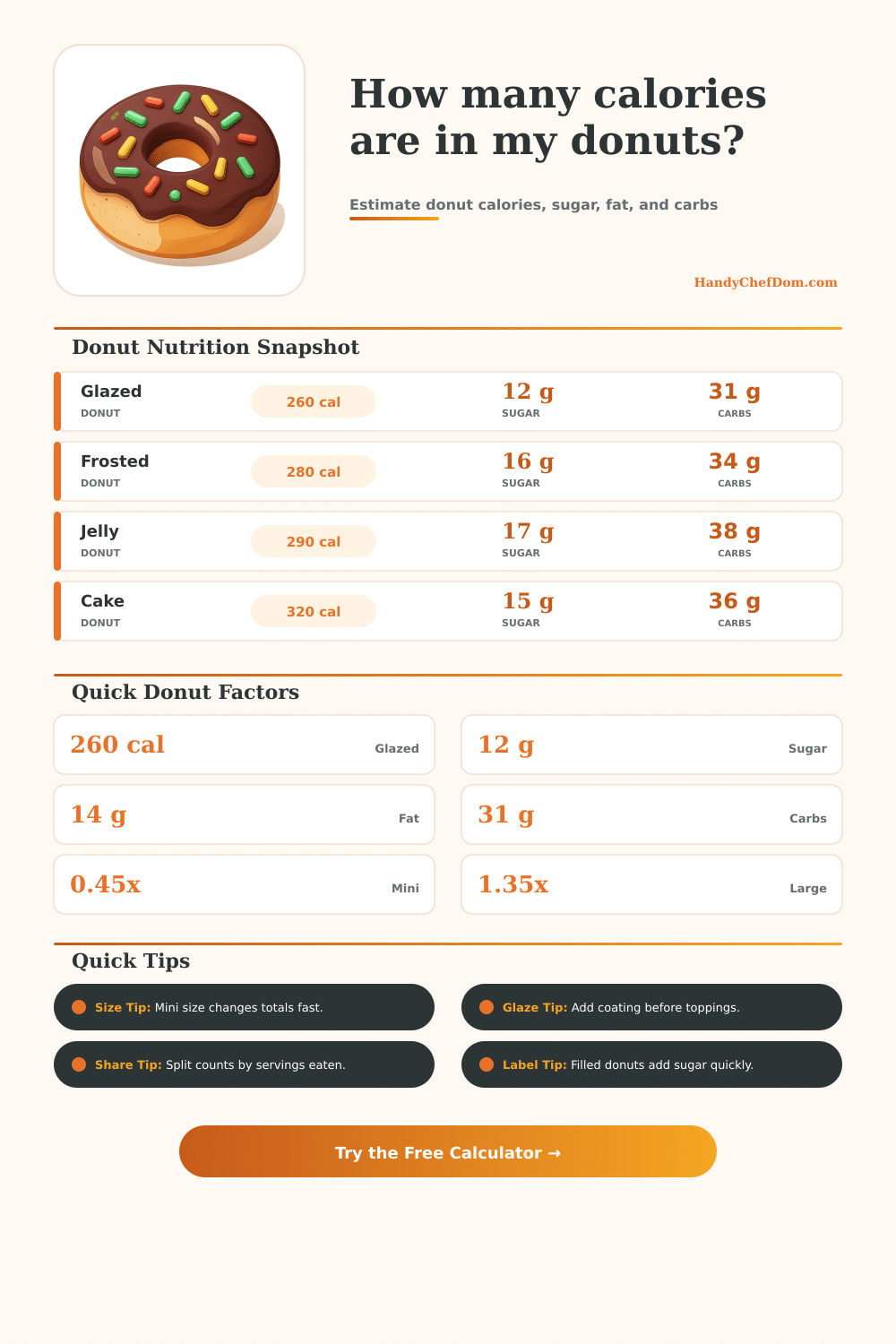
| Classic glazed ring | 260 | 12 g | 14 g | 31 g | 3 g |
| Chocolate frosted ring | 280 | 16 g | 15 g | 34 g | 4 g |
| Jelly filled donut | 290 | 17 g | 14 g | 38 g | 4 g |
| Cream filled donut | 330 | 19 g | 18 g | 39 g | 5 g |
| Cake donut | 320 | 15 g | 18 g | 36 g | 4 g |
| Old-fashioned donut | 300 | 11 g | 17 g | 30 g | 4 g |
| Powdered sugar donut | 250 | 13 g | 12 g | 33 g | 3 g |
| French cruller | 230 | 10 g | 13 g | 24 g | 4 g |
| Portion label | Factor | Best use | Count example |
|---|---|---|---|
| Bite piece | 0.20x | Sampler bite | 5 bites = 1 donut |
| Mini donut | 0.45x | Mini box | 2 minis = 0.9 donut |
| Regular donut | 1.00x | Standard label | 1 donut |
| Large bakery donut | 1.35x | Oversized case | 1 large = 1.35x |
| Jumbo donut | 1.60x | Share plate | 1 jumbo = 1.6x |
| Custom factor | User set | Half or sample | 0.5 = half |
| Add-in | Calories | Sugar | Fat | Carbs |
|---|---|---|---|---|
| Light sugar glaze | 20 | 5 g | 0 g | 5 g |
| Classic glaze | 45 | 10 g | 0 g | 11 g |
| Chocolate glaze | 65 | 9 g | 3 g | 12 g |
| Jelly filling | 70 | 14 g | 0 g | 18 g |
| Custard filling | 95 | 10 g | 4 g | 14 g |
| Sprinkles | 25 | 4 g | 1 g | 5 g |
| Crumb topping | 60 | 5 g | 3 g | 9 g |
| Chopped nuts | 45 | 1 g | 4 g | 2 g |
| Scenario | Count | Portion | Likely range | Macro note |
|---|---|---|---|---|
| Coffee snack | 1 | Regular | 230-330 cal | 24-39 g carbs |
| Shared half | 1 | 0.50x | 115-165 cal | Split sugar |
| Mini trio | 3 | Mini | 310-445 cal | Easy to add up |
| Office dozen | 12 | Regular | 2760-3960 cal | Use serving split |
| Filled pair | 2 | Regular | 580-660 cal | Sugar rises fast |
| Party sampler | 18 | Bite | 830-1190 cal | Count each bite |
There’s a problem in the office breakroom donut box: Human body processes don’t match up with good intentions. You’re going to have one. Then another, and another. (Three pastries from the marketing team.) And it’s not always about being hungry. It’s math. The problem is never just the hunger. It is the math.
They overestimates how much food they eat by counting number of things. But the weight of each thing changes your calorie balance, e.g., a plain cake donut isn’t the same as a jelly-filled cream puff, but they both fit into one slot in your brain labeled “one sweet treat. Details matter, so swap the abstract feeling of guilt for something concrete.
Make Smart Donut Choices With Math
There’s a free calculator up top that will run the numbers for you, taking portion size, filling type, and glaze density into consideration. You just pick which variables aligns with what’s on your plate. And then once you’re fully aware of how many grams of sugar are hiding in that chocolate frosting, you can make an informed choice: Does it fit into your day? Did it?
They also look like they’re taking into account some of the details of their real world counterparts. All glazed donuts aren’t created equal. A thin layer of powdered sugar will add very little, while a hearty maple coat could add as many as 45 calories alone. Add to that, two or three, and suddenly it doesn’t seem like such an insignificant amount.
Then there’s the fillings which further swing the balance in wild directions. When comparing a regular yeasted ring to a cream filled donut, well the former will have less fat due to the dairy based filling. And thus the tool factor in those layers so that the final total is a reflection not of a generic package average but a real world representation of what was eaten.
Most estimates go wrong on portion size. A mini donut is typically only a fraction of the caloric value of a regular pastry, but people think it’s a complete serving. Meanwhile, a jumbo-sized bakery donut may contain more calories than an entire small meal. The calculator allows you to specify bites, minis and jumbos to account for this, eliminating the tendency to underestimate volume.
Plus, if you’re splitting a dozen with some friends at work, it splits up the overall number evenly so you can accurately see how many calories are in your personal portion. That stops you from guessing and eating too much.
The psychology of the snack matters too, beyond the numbers. Are you getting your dopamine fix through some comfort food like donuts? That’s fine! But knowing what’s in it doesn’t take away from that enjoyment. It empowers you. Now you know how many grams of sugar are in it… No more sneaking around. No hidden fats to surprise you.
The reference tables on the page show different styles against one another, so now you understand how an old-fashioned cake donut stacks up against a lighter, airier French cruller. With this knowledge, you’re choosing what sounds best depending on your goals at any given time. What we don’t want to do is remove all enjoyment from eating. We want what you eat to match what you are aware of.
If you’re aware of the price tag of that heaping dollop of heavy cream inside, you’ll choose differently. Maybe you skip the loaded specialty item and get a simple glazed instead. Or maybe you postpone your splurge until a Saturday night indulgence (vs. It is a Tuesday morning habit. The math reveals the trade-off.
Next time you’re tempted to grab that pink box, take a beat. Examine your selection. Assess the size, the filling, the glaze. Use whatever tools are provided to anchor your assumptions in reality. And while you may not count individual grains of sugar, it’s helpful to know about the general layout. Yes, the donut will be delicious. It’ll taste like a celebration. But this time, you’re doing so with your eyes open. It feels less like an error in judgment than a conscious decision.
That change in perspective is perhaps the most precious ingredient in the blend.