Soy Sauce in Noodles Calculator
Scale soy sauce for stir-fried, tossed, chilled, saucy, or brothless noodles with dry or cooked noodle entries, servings, sodium targets, topping salt, sauce coating, and sesame oil balance.
1Soy Noodle Presets
2Noodle, Soy, Sodium, and Oil Inputs
The calculator converts dry noodles to cooked yield when needed, estimates how much soy sauce can fit your sodium target, then blends that with the sauce coating needed for the noodle style. Sesame oil is treated as a carrier, not a salt source.
Noodle Sauce Estimate
Your soy sauce, oil, and sodium estimate will appear here.
3Ingredient Breakdown Cards
4Calculation Breakdown Table
| Calculation step | Current amount | Converted amount | Why it matters |
|---|---|---|---|
| Dry noodle basis | 300 g | 10.6 oz | Starts the sauce scale when noodles are uncooked |
| Cooked noodle basis | 780 g | 5.0 cups | Coating is calculated against drained cooked noodles |
| Total soy sauce | 55 ml | 3.7 tbsp | Main salty and savory seasoning |
| Sodium from soy | 825 mg | 850 mg per serving | Checked against the selected sodium target |
| Oil and sesame carrier | 20 ml | 11 ml sesame | Helps soy cling without making noodles harsh |
| Loosening liquid | 45 ml | 9 tsp | Prevents dry patches and spreads soy evenly |
5Noodle Style Soy Reference
| Noodle style | Soy ml per cooked 100 g | Oil guide | Calculator interpretation |
|---|---|---|---|
| Simple tossed noodles | 5 to 7 ml | 0.4 tsp per serving | Light seasoning, soy is an accent |
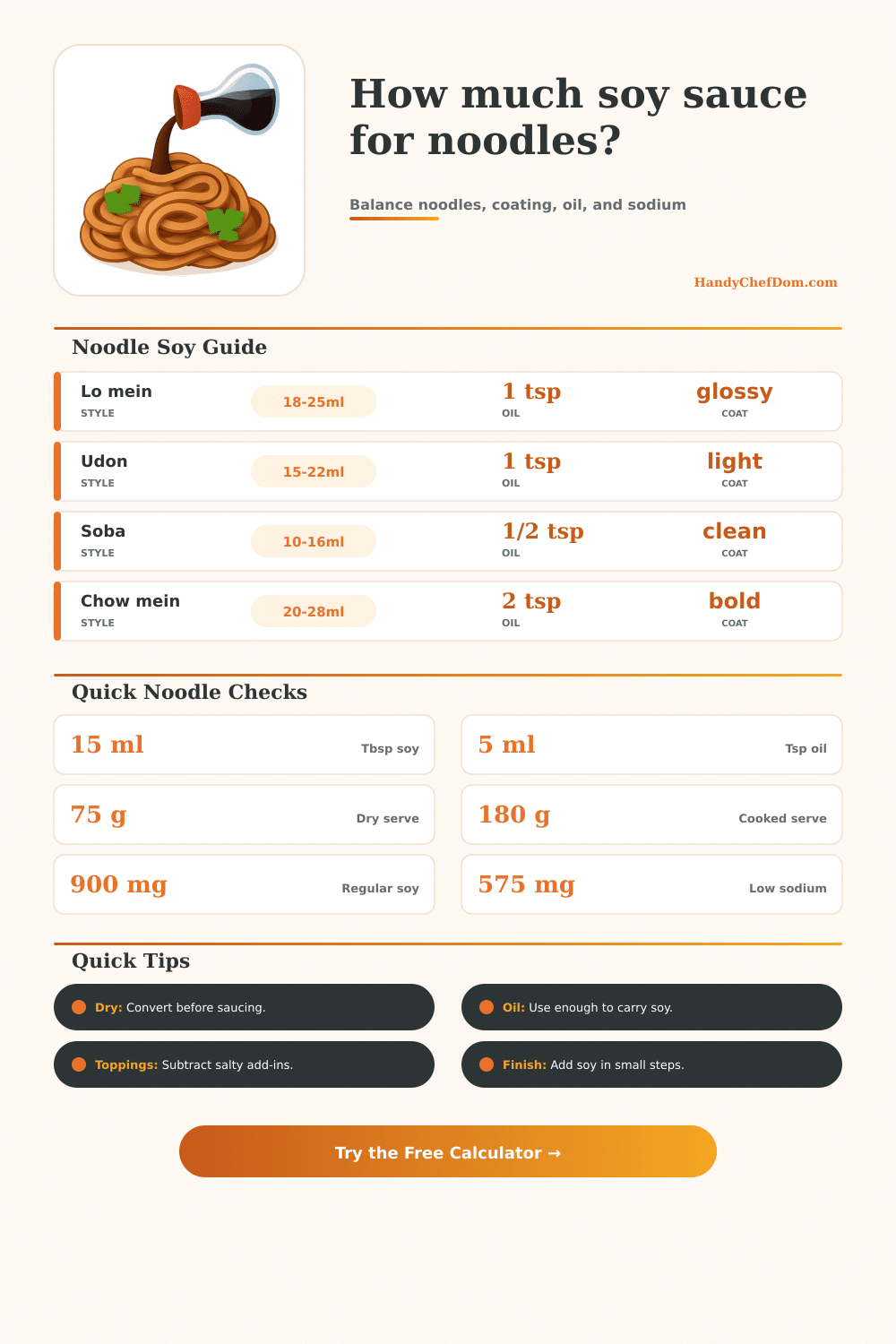
| Lo mein sauced noodles | 7 to 10 ml | 0.8 to 1.2 tsp per serving | Balanced coating for wheat noodles |
| Chow mein stir-fry | 9 to 12 ml | 1.5 to 2 tsp per serving | Bolder because wok heat mutes salt |
| Cold noodle salad | 6 to 9 ml | 0.8 tsp per serving | Extra liquid helps chilled noodles loosen |
| Udon sauce bowl | 5 to 8 ml | 0.8 tsp per serving | Thick noodles need gentle, even coating |
| Sesame soy noodles | 6 to 9 ml | 1.4 tsp per serving | Sesame carries flavor so soy can stay moderate |
6Dry to Cooked Noodle Yield Table
| Noodle type | Dry serving guide | Cooked yield factor | Coating behavior |
|---|---|---|---|
| Thin wheat noodles | 70 to 85 g | 2.5x to 2.8x | High surface area, takes soy quickly |
| Lo mein wheat noodles | 75 to 90 g | 2.4x to 2.7x | Classic sauced noodle texture |
| Udon noodles | 90 to 120 g dry | 2.2x to 2.5x | Thick strands need more tossing |
| Soba noodles | 70 to 85 g | 2.3x to 2.6x | Buckwheat flavor prefers less soy |
| Rice stick noodles | 60 to 80 g | 2.2x to 2.6x | Soaks sauce after resting |
| Glass noodles | 45 to 65 g | 3.1x to 3.8x | Absorbs seasoning as it sits |
7Soy Sauce and Sodium Reference
| Soy sauce type | Approx sodium per tbsp | Flavor strength | Best noodle use |
|---|---|---|---|
| Regular soy sauce | 900 mg | Medium-bold | All-purpose tossed noodles |
| Low sodium soy sauce | 575 mg | Medium | More soy flavor within lower sodium targets |
| Chinese light soy | 960 mg | Bright and salty | Lo mein and chow mein seasoning |
| Tamari | 1000 mg | Deep and round | Gluten-free style bowls when suitable |
| Dark soy sauce | 650 mg | Color-heavy | Use as part of the soy total, not all of it |
| Coconut aminos | 300 mg | Mild and sweet | Needs more volume for salty impact |
8Serving Scale Table
| Servings | Dry noodles at 80 g each | Balanced soy estimate | Oil estimate |
|---|---|---|---|
| 1 serving | 80 g / 2.8 oz | 1 to 1.5 tbsp | 1 tsp |
| 2 servings | 160 g / 5.6 oz | 2 to 3 tbsp | 2 tsp |
| 4 servings | 320 g / 11.3 oz | 3.5 to 5 tbsp | 4 tsp |
| 6 servings | 480 g / 16.9 oz | 5.5 to 7.5 tbsp | 6 tsp |
| 8 servings | 640 g / 22.6 oz | 7 to 10 tbsp | 8 tsp |
| 12 servings | 960 g / 33.9 oz | 11 to 15 tbsp | 12 tsp |
9Comparison Grid
Best before cooking. The calculator converts dry weight into cooked noodle mass before setting soy and oil levels.
Best for leftovers. Sauce is based directly on cooked grams or cups, so the result follows actual bowl volume.
Subtracts toppings and salty add-ins, then solves how much soy sauce can fit the serving target.
Uses noodle style and coating target when flavor cling matters more than hitting a strict sodium number.
10Two Practical Soy Noodle Tips
In a noodle dish, the entire meal hinges on getting the soy sauce just right. If there isn’t enough, they’ll taste flat. If you add too much, the noodles will be salty by the time they reach the table. That doesn’t take into account the thickness of the noodle or whether it is measured dried or cooked. It also ignores how much else are going into the bowl and how thick you want the soy coating to feel when everything is tossed together.
When most cooks begin cooking, it’s often by gut guess: Four servings? OK, a few tablespoons of soy should do. For certain kinds of pasta, this is fine; for others, it will fall flat. After all, each kind of noodle behave differently when cooked. Udon is a thick noodle that requires tossing for a bit before the flavor coats every strand, whereas thin wheat noodles grabs onto the sauce immediately. This changes how much soy you actualy need, so knowing the serving weight and noodle type help you calculate it more accurately instead of just guessing.
How to Get the Soy Sauce Right for Noodles
Sodium is the one that throws people for a loop. There are about nine hundred milligrams in each tablespoon of regular soy sauce, which doesn’t take long to rise once you start adding chili crisp, pickles, or seasoned protein. You can plug your goal of sodium per serving into the calculator at the top, and it’ll subtract out whatever is already there due to toppings. What’s left? That’s how much soy you can squeeze into a dish before it go over the edge. If you opt instead for the low-sodium stuff, all that changes is the arithmetic, now you get to add just a bit more volume before you blow right by the same target.
Oil plays a less obvious supporting role. A light layer of neutral or sesame oil keeps the soy from pooling in the bottom of the bowl. Use too much and you’ll end up with greasy noodles. Use not enough, and they’ll feel dry to the touch in places. Unlike other ingredients, which get credited for their salt content, oil is listed simply as a carrier here, so the emphasis remain on the coating, not on any sodium lurking behind it, and that’s good: It ensures that the focus stay on getting the coating right without adding hidden sodium.
Broth or a splash of water makes everything slippery (noodles get a bit saucy; not clumpy). How much depend on how well coated you like your noodles. Use more if making a chilled noodle salad that needs some slipperiness when it goes into the refrigerator. Less if making a sticky stir-fry glaze so it remains thick and coats well over high heat.
After measuring out the soy, you would of known the volume of water and the balance of sweetness or acidity needed. This gives you a full picture of what will work in the final dish. Typically these oversights revolve around measuring by dry weight rather than cooked, or ignoring that your toppings has salt on them. The first error leans too heavily one way before you even bite into it; the second overshoots in the other direction. By running the numbers beforehand, all that guesswork is eliminated and you can adjust accordingly when everything’s in the pan.
Why? Because you wind up with noodles that aren’t salty on top, but bland below. They’re seasoned throughout. This makes you want another bowl, which I think is what we look for in our weeknight bowls.