🥩 Soy Sauce to Marinate Steak Calculator
Scale soy sauce marinade by steak pounds, thickness, soy style, marinating hours, cut texture, saltiness target, acid, oil, sugar, coverage, and servings.
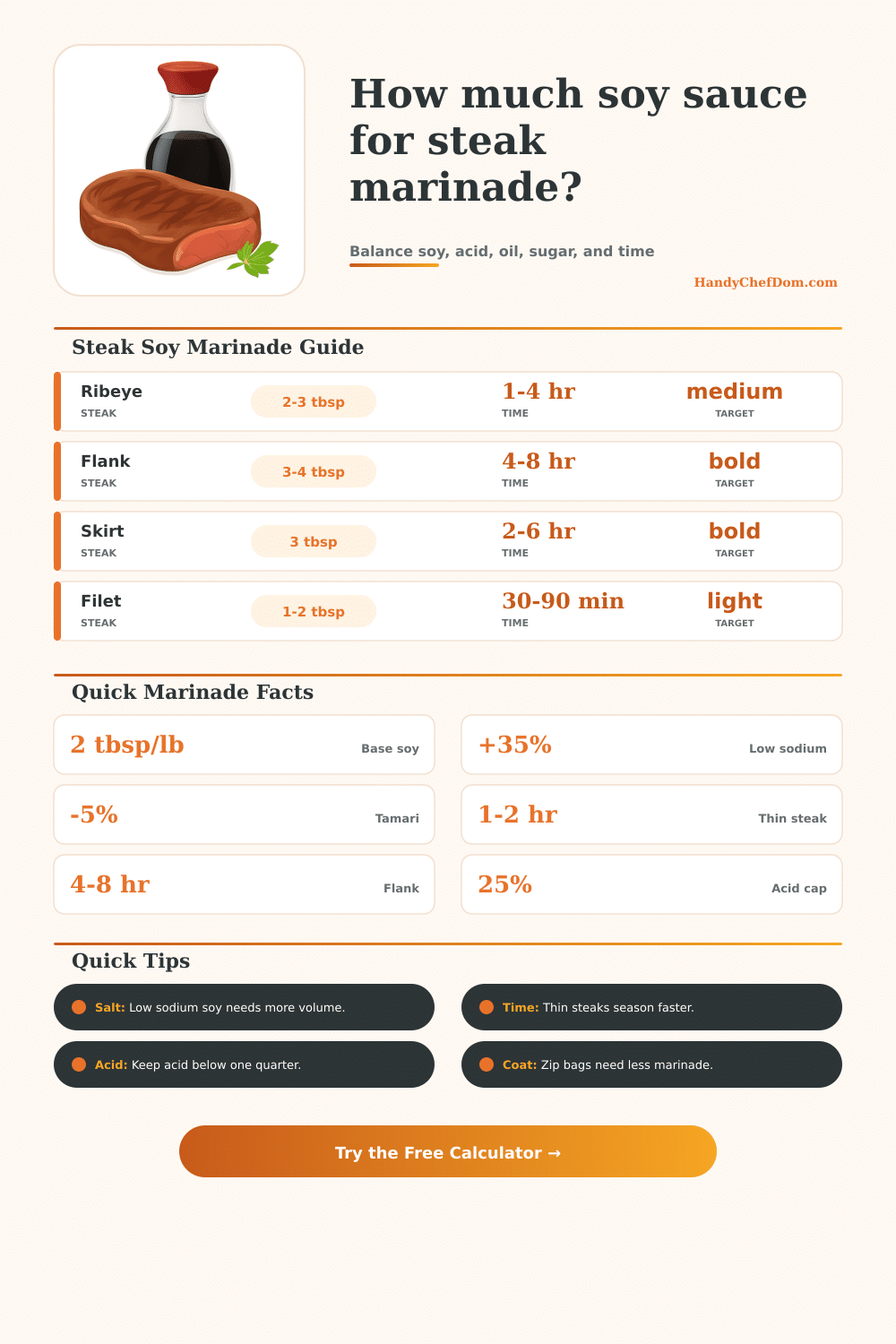
A balanced steak marinade often starts near 2 tablespoons soy sauce per pound, then changes for sodium level, steak thickness, cut type, marinating time, acid strength, oil ratio, sugar, and whether the steak is fully submerged or just coated.
| Soy type | Sodium cue | Calculator adjustment | Best steak use |
|---|---|---|---|
| Regular soy sauce | About 900 mg/tbsp | Base volume | Ribeye, strip, sirloin |
| Low sodium soy | About 575 mg/tbsp | More soy for same salt | Longer marinades |
| Light Japanese soy | Bright and salty | Slightly less volume | Thin steak |
| Tamari | Rich and rounded | Slightly less volume | Hanger, flat iron |
| Dark soy sauce | Lower salt, darker color | More volume, less acid | Glazed steak bowls |
| Coconut aminos | Much lower sodium | Higher volume | Light seasoning |
| Cut | Thickness | Soy per lb guide | Good time window |
|---|---|---|---|
| Ribeye or strip | 1 to 1.5 in | 1.5 to 2.2 tbsp | 1 to 4 hours |
| Sirloin | 1 to 1.25 in | 2.0 to 2.6 tbsp | 2 to 6 hours |
| Flank steak | 0.75 to 1 in | 2.5 to 3.5 tbsp | 4 to 8 hours |
| Skirt steak | 0.5 to 0.75 in | 2.2 to 3.3 tbsp | 2 to 6 hours |
| Filet mignon | 1.5 to 2 in | 1.0 to 1.8 tbsp | 30 to 90 minutes |
| Top round | 1 to 1.5 in | 2.8 to 4.0 tbsp | 6 to 12 hours |
| Balance style | Acid share | Oil share | Sugar cue |
|---|---|---|---|
| Soy-forward | 0 to 10% | 10 to 18% | Optional pinch |
| Balanced grill | 10 to 18% | 18 to 25% | 1 to 2 tsp per lb |
| Glaze-friendly | 10 to 18% | 18 to 25% | 2 to 3 tsp per lb |
| Tenderizing style | 18 to 25% | 10 to 18% | Keep modest |
| High acid | 25% plus | 18% plus | Use short time |
| Coverage method | Volume factor | Turning need | Best batch size |
|---|---|---|---|
| Zip bag pressed flat | 0.82x | Turn once | 1 to 4 steaks |
| Shallow pan | 1.00x | Turn once or twice | 2 to 6 steaks |
| Mostly covered pan | 1.18x | Minimal turning | Family batches |
| Fully submerged | 1.42x | No turning | Very lean cuts |
| Vacuum pouch | 0.72x | No turning | Flat steaks |
Marinating steak is one of those little decisions that affects entire meal. If there isn’t enough soy sauce then flavor will only be on top, not inside. If there’s too much, the salt start to pull moisture out of the meat before it even hits the grill. Every bite makes a difference and it can take several times to dial-in perfect amount. Scaling a marinade should never be guesswork.
With steak, way you cut and season also varies. Certain thickness hold seasoning better then others: A thin skirt steak will pick up salt more quickly, so go easy on the soaking time. Otherwise, you risk leatheriness. Meanwhile, a thick-cut ribeye hold its juiciness and will allow a deeper marinade penetration for a longer period of time. The bottom line is that the thicker your steak, the further the marinade penetrate into meat.
Why You Should Measure Your Marinade
This also makes all the difference between thinner cut like sirloin or top round (which are often lean) and well-marbled steaks (which don’t need quite as heavy treatment). This explains why a consistent amount of soy won’t suit all cuts.
Plug in your desired soak time. Enter the cut of steak, its thickness, and its weight. Choose whether you want light or dark soy (tamari) and specify your soy style (low sodium require extra volume for equivalent saltiness). Then choose acid, sugar, and any oil. How aggressive do you want your marinade? What flavor profile you want in your final steak?
How are you applying the coverage? Does that matter? Yes. A vacuum-sealed pouch will use less liquid than a flat-pressed zip bag. A flat-pressed zip bag will require less liquid than something laid out in shallow pan. You need to think about the ratios a lot.
In fact, the idea is just getting a certain level of salt in there that flavors things without making them dry, and then having the acid and oil support it. If you use enough acid that it’s more than maybe a quarter of the whole mix, after a longer time it’ll make the surface go mushy. So if I see it get up above that point with a longer soak, then I know I’m going to be having trouble. And sugar helps things brown, but too much will burn on the grill, so typically the balance end up being pretty moderate.
The timing result from tool tells you if your acid level and soak time work well together. Copying marinades from other brands of soy or other recipes not intended for your size of steak is common. What’s perfect for two pounds of flank will be overpowering to a few ounce, or even just be flat-out wrong on one filet. Keeping the math honest require adjusting up for serving size, plus a little buffer for what will get lost in the bag/pan.
When the numbers come together, the best marinades seem obvious. The meat in the bag is evenly coated but it’s not swimming. It looks like just enough time remains before it’s ready to cook and your chosen cut matches the timing. And that’s the whole idea behind the numbers versus a guess.