Soy Sauce in Green Bean Casserole Calculator
Estimate soy sauce for green bean casserole from bean pounds or cans, sauce volume, mushroom soup, soy type, sodium target, umami level, dilution, onion topping, and servings.
1Green Bean Casserole Presets
2Bean, Sauce, and Sodium Inputs
Your Soy Sauce Casserole Balance
Choose a preset or enter your beans, soup, sauce, soy type, and sodium target.
3Ingredient Breakdown
| Component | Amount | Sodium estimate | Calculator role |
|---|---|---|---|
| Green beans | 0 cups | 0 mg | Bean volume sets the soy and sauce base scale |
| Mushroom soup | 0 cups | 0 mg | Largest hidden sodium source in most casseroles |
| Sauce base plus dilution | 0 cups | 0 mg | Controls coverage and softens soy intensity |
| Soy sauce | 0 tbsp | 0 mg | Umami boost limited by sodium target |
| Crispy onion topping | 0 cups | 0 mg | Adds salt and topping-per-serving balance |
4Reference Tables
| Soy sauce type | Approx sodium per tbsp | Umami strength | Best calculator use |
|---|---|---|---|
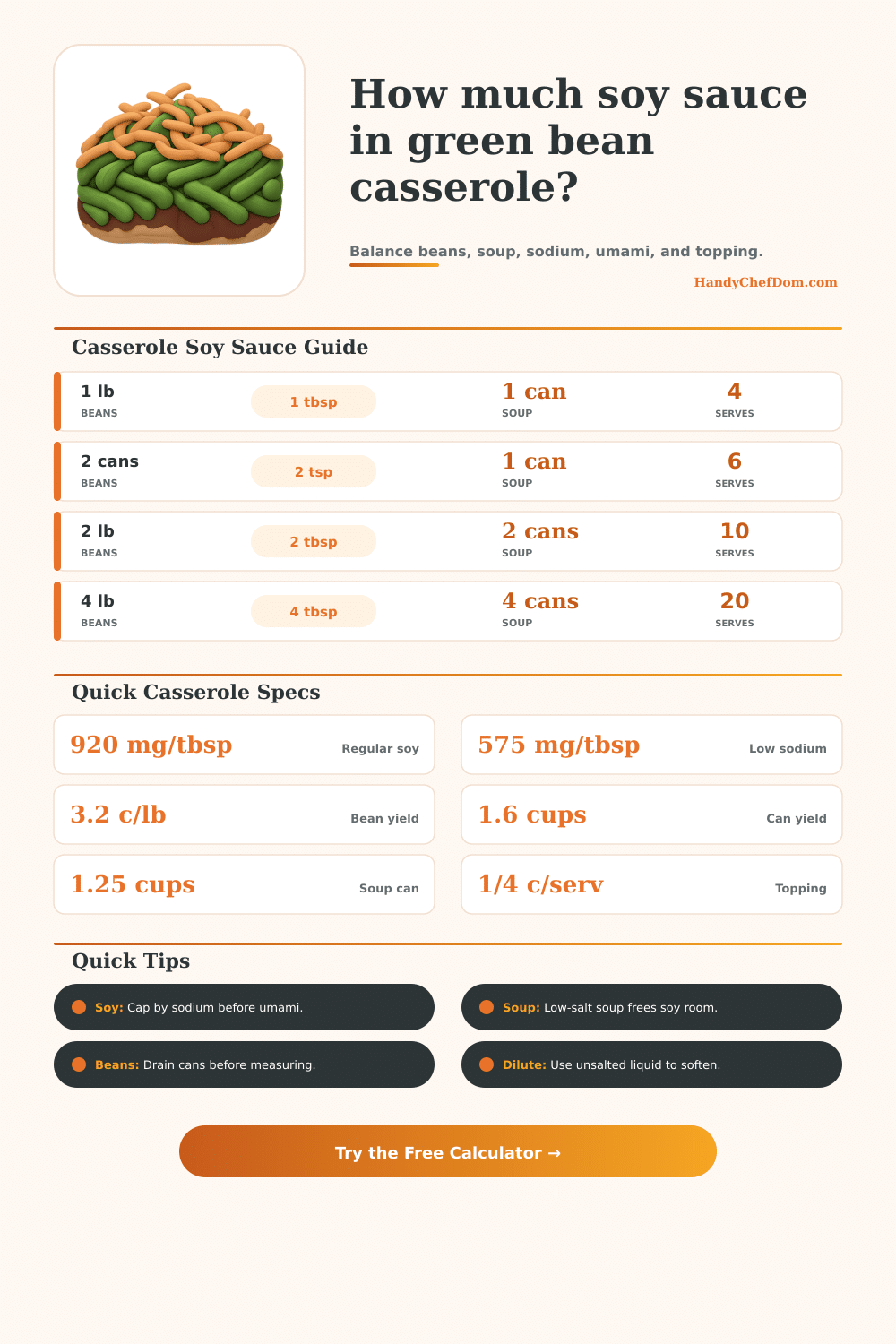
| Regular soy sauce | 920 mg | Classic salty umami | Small additions when soup is already salted |
| Low-sodium soy sauce | 575 mg | Moderate savory depth | Better fit with condensed soup |
| Tamari | 980 mg | Round, strong umami | Deep soy note with careful caps |
| Reduced-sodium tamari | 700 mg | Round and controlled | Middle ground for holiday pans |
| Coconut aminos | 270 mg | Mild and sweet-savory | More tablespoon room |
| Liquid aminos | 960 mg | Sharp savory salt | Treat like regular soy |
| Green bean form | Calculator yield | Common casserole cue | Input note |
|---|---|---|---|
| Fresh trimmed beans | 3.2 cups per lb | Firmest bean texture | Enter pounds after trimming |
| Frozen cut beans | 3 cups per lb | Easy family pan | Enter bag weight in pounds |
| 14.5 oz canned beans | 1.6 drained cups | Classic pantry casserole | Enter cans and can size |
| French-style canned | 1.5 drained cups | Softer, saucier bite | Use less dilution if watery |
| Thin haricot verts | 3.6 cups per lb | Higher surface area | Needs more sauce coverage |
| Casserole size | Beans | Sauce target | Onion topping range |
|---|---|---|---|
| Small side | 3 to 4 cups | 1.4 to 1.8 cups | 0.75 to 1 cup |
| Family pan | 5 to 7 cups | 2.2 to 3.1 cups | 1.25 to 1.75 cups |
| Potluck pan | 9 to 12 cups | 4 to 5.5 cups | 2.25 to 3 cups |
| Holiday tray | 16 to 22 cups | 7 to 11 cups | 4 to 5.5 cups |
| Sodium target | Per serving goal | Soy strategy | Soup strategy |
|---|---|---|---|
| Light | 300 to 400 mg | Coconut aminos or teaspoons | Reduced or unsalted base |
| Moderate | 400 to 600 mg | Low-sodium soy usually fits | Classic soup gets a small soy cap |
| Classic | 600 to 800 mg | Regular soy can fit | Watch topping contribution |
| Very savory | 800 to 1000 mg | Tamari or dark soy has room | Dilution softens sharpness |
5Soy Sauce Comparison Grid
Strong classic salt and umami. The calculator often caps it quickly when condensed soup and onion topping are both included.
Best all-purpose casserole choice when you want recognizable soy depth without using the entire sodium budget in one spoonful.
Gives rounder savory depth, but sodium can be similar to or higher than regular soy. Use the umami setting carefully.
Milder and much lower in sodium per tablespoon, so the calculator may recommend more volume for the same savory target.
6Two Practical Casserole Tips
While green bean casserole can be a holiday meal staple or even a weeknight side, a few splashes of soy sauce makes the entire flavor equation different than before. Soy sauce increase the saltiness (a lot), and also provides a savory note that is often missing from mushroom soup. It’s a tricky balance, too much and your dish will be inedibly salty.
But how do you find the right amount? It vary depending on what kind of soup base you’re using, and how many beans you have. Crispy onions and condensed soup are often overlooked as sodium bombs by most home chefs. A single can of either can easily consumes a significant portion of your day’s sodium allotment without even considering a squirt of soy sauce.
How to Use the Calculator
By entering your target sodium per serving, the type of soup, and bean profile, the calculator does the math on what will be left over for the soy sauce so you don’t have to guess how far down the road you are. Because soy sauce flavor depends on how it is mixed into the dish (through sauce coverage style or through a bit of dilution liquid) this is also considered by the calculator.
Beans: Beans are another category where it makes a difference what you choose. Canned, drained beans already contain significant amounts of sodium; fresh trimmed beans has virtually none. Depending on which ones you use, that affects how much soy product you might be able to include later in the dish. The tool allows you to switch between two bean profiles and the sodium budget will adjust itself accordingly. No need to re-calculate all over again.
It is handy if you’re scaling up a recipe from a small pan into a big holiday platter. Then there’s the soy sauce itself. Classic soy is going to impart your typical salty umami goodness, but it’s going to max out sodium fast. Coconut aminos and low-sodium varieties let you fit in a little more before hitting the limit, but they taste different than one another. By letting you choose what bottle you’re working with and how intense you’d like that umami hit to be, the calculator will adjust the recommendation so you don’t end up with a dish that’s too salty or too flat.
One thing that’s quietly crucial to this is dilution liquid, either milk or broth without salt added. (Broth won’t take out the salt; it will just distribute what was there over a greater volume of sauce.) You can see on the tool how adding the diluted liquid increases the percentage of coverage, which lets you see the trade-off: More liquid = less sharpness per bite. Why does your casserole taste sharper than expected? It’s because many people neglects this step.
The amount of onion topping also adds to the sodium count. That may come as a surprise to those who think of it only as a textural garnish. That crispy-onion layer contribute salt as well as crunch, so we factor it into our per-serving math. You can shave some sodium by using less topping (which frees up significant room for additional soy, if that’s your desired flavor direction).
But it’s when you run all those numbers simultaneously that the true payoff comes: Instead of finding out your casserole is salty after it’s already in the oven, you can see all those connections in one go. You get a sense for what’s contributing how much sodium, and what little tweaks will make space.
And while you may never reach for this tool again, you’ll carry that with you into other recipes: You begin to notice the same patterns elsewhere in the world of savory bakes.