🥜 Almond Butter Protein Calculator
Estimate almond butter protein, calories, fat, and fiber by tablespoons or grams for toast, smoothies, snack plates, and meal prep portions.
Enter almond butter by tablespoon or gram, pick the label style closest to your jar, and choose the serving plan you want to portion.
Optional jar protein overrides only protein. Calories, fat, and fiber still use the selected almond-butter label unless you change the label.
| Almond Butter Label | Texture | g/tbsp | Protein/tbsp |
|---|---|---|---|
| Classic smooth | Smooth | 16.0 | 3.4 g |
| Classic crunchy | Crunchy | 16.5 | 3.3 g |
| Unsalted smooth | Smooth | 16.0 | 3.5 g |
| Roasted crunchy | Crunchy | 16.5 | 3.4 g |
| Natural drippy | Drippy | 15.5 | 3.2 g |
| No-sugar smooth | Smooth | 16.0 | 3.6 g |
| Sprouted almond | Smooth | 16.0 | 3.8 g |
| Cocoa almond blend | Blend | 16.0 | 2.9 g |
| Serving Plan | Typical Amount | Protein Range | Best Entry |
|---|---|---|---|
| Toast spread | 1 tbsp | 3.2-3.8 g | Tablespoons |
| Smoothie scoop | 1.5 tbsp | 4.8-5.7 g | Grams |
| Snack spoon | 2 tbsp | 6.4-7.6 g | Jar label |
| Oatmeal swirl | 1 tbsp | 3.2-3.8 g | Tablespoons |
| Fruit dip | 1.25 tbsp | 4.0-4.8 g | Tablespoons |
| Baking portion | 2.5 tbsp | 8.0-9.5 g | Grams |
| Amount | Approx Grams | Smooth Protein | Snack Use |
|---|---|---|---|
| 0.5 tbsp | 8 g | 1.7 g | Light drizzle |
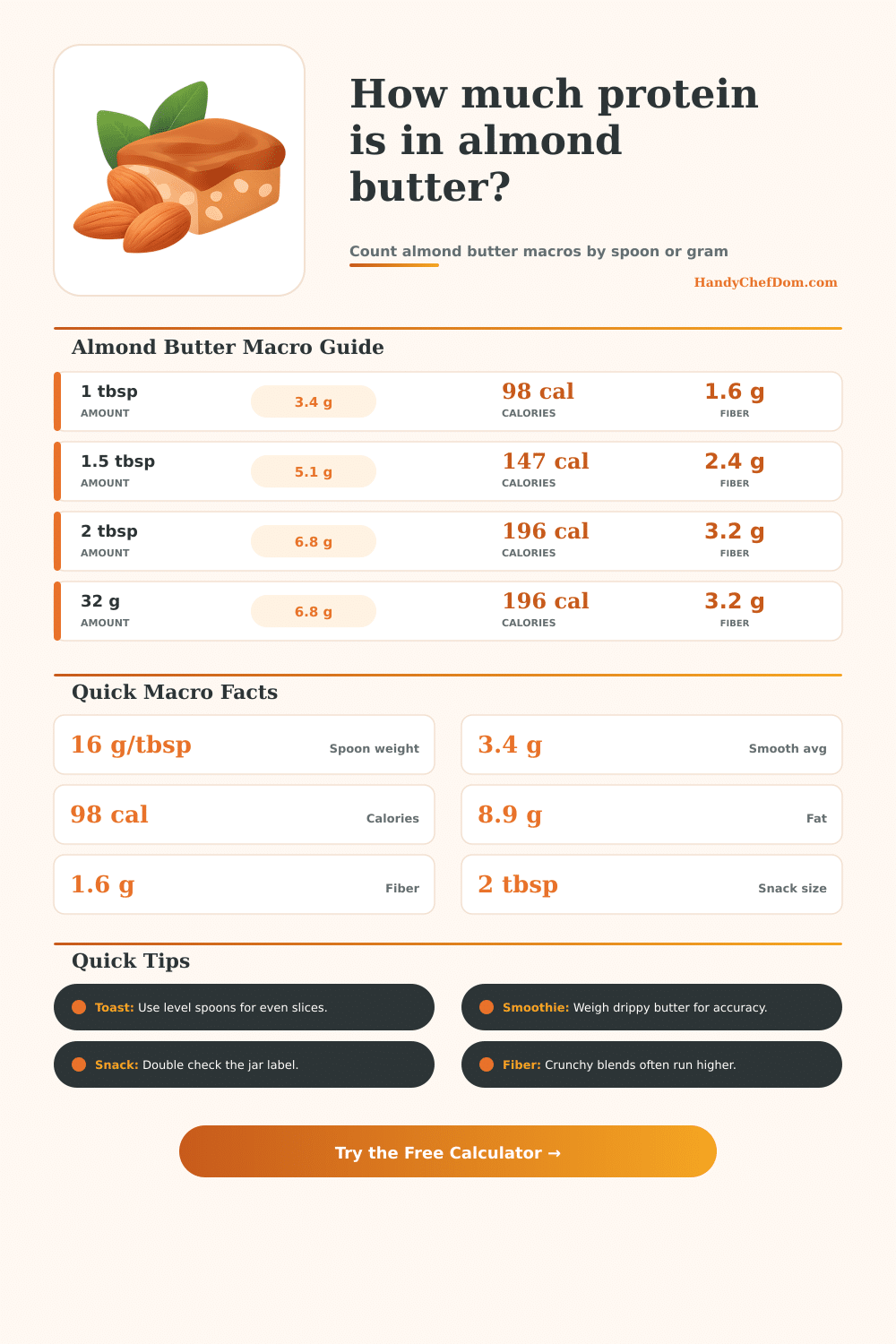
| 1 tbsp | 16 g | 3.4 g | Toast slice |
| 1.5 tbsp | 24 g | 5.1 g | Smoothie |
| 2 tbsp | 32 g | 6.8 g | Snack plate |
| 3 tbsp | 48 g | 10.2 g | Big bowl |
| 4 tbsp | 64 g | 13.6 g | Meal prep |
| Label Type | Calories/tbsp | Fat/tbsp | Fiber/tbsp |
|---|---|---|---|
| Classic smooth | 98 | 8.9 g | 1.6 g |
| Classic crunchy | 101 | 9.1 g | 1.7 g |
| Unsalted smooth | 98 | 8.8 g | 1.7 g |
| Roasted crunchy | 102 | 9.2 g | 1.8 g |
| Natural drippy | 96 | 8.7 g | 1.5 g |
| No-sugar smooth | 100 | 9.0 g | 1.9 g |
| Sprouted almond | 99 | 8.6 g | 2.0 g |
| Cocoa almond blend | 105 | 9.0 g | 1.4 g |
This is what happens: You’re standing in your kitchen holding a jar of almond butter when it hits you, the seemingly complicated question posed by such a harmless thing. Just how much are you consuming? Because the truth is, this spread offer hunger-satisfying nutrition while controlling calories. There’s just enough nutrient-rich goodness to leave you feeling full without so many calories that a misjudged serving can sabotage your efforts.
In other words, most of us scoop until we feel like we’ve got enough. Chances are, you’ll undershoot on the protein front, then overshoot on the lightness of the dish. So it’s a pretty cool tool, and it gets rid of all the guessing when I’m like, “Oh, I think there was a scoop in here.” It’s really nice to be able to just have an exact number of macros.
How to Track Your Almond Butter Portions
Do you want to put it in grams or do you want to spread some on toast? You can use grams or tablespoons. Then choose your label style, because some almond butters is different than others. They’re more smooth, they’re more drippy, they have chunks in them. All those things change the way it’s going to behave in terms of grams per tablespoon. We ask you for that detail and then crunch the numbers for you.
This way, you know what real deal is inside that jar instead of just going off an average. This post contains affiliate links. Along with volume, it is also key to understand what kind of label you are looking at. Almonds that have been ground into a butter are often packed with sugars or oil for better spreading and longer shelf lives, so it’ll alter the nutrition content from straight-up ground almonds.
Protein content depends on what is blended in. For example, cocoa powder might be added to some, while sprouted versions has fewer ingredients and a higher density. Because of this, a spoonful of plain almond butter may contain just a few more grams of protein than a flavored one. If you’re logging fat to hit ketosis, or counting out the grams of fiber for gut health, this can matter a lot after eating a jar every day for a few weeks.
Don’t try to commit all those numbers to memory, but having an idea of where your jar tilts (more protein? Knowing if there are more fats will help you tweak elsewhere. Unlike strict scientific rules, the interface’s serving sizes reflect how people actualy use food: a tablespoon of almond butter doesn’t really make sense when you’re putting it on toast (unless it’s a hearty breakfast), and sometimes you need a whole “smoothie scoop” rather than half to get the same effect because the liquid thins it out.
The difference add up fast if you guess-timate one tablespoon per item every day. For example: You might log an oatmeal bowl with a liberal dollop of almond butter but count it as a tiny snack. That will pull your daily logs away from what you actualy ate. With the serving size presets, you can choose which use case applies so the basic assumptions about average size and weight adjusts based off context.
The problem with good intentions is portion control. We might reason “almond butter can’t hurt me, it’s healthy!” without considering simple energy balance. Each tablespoon contain about three grams of protein. That’s a solid addition, but it won’t take you all the way toward your daily needs. To obtain 30 grams solely through almond butter, you’d have to consume almost ten tablespoons. But that means you would of be eating nearly a thousand calories from carbs and fats. Yikes!
Most of us don’t want that much food. So know your limits: recognize the calorie cost vs. Look at the benefit you get from each gram of protein. To accommodate the variability of today’s grocery store aisles, there’s an option to override the protein count in each item. For example, some almond butters fortify their products or use different roasting methods that concentrate the nutrients. If you find a brand with more protein per serving than the usual average, type it in… This way your logs will remain true-to-form.
This is what sets apart casual tracking vs. Rigorous nutrition tracking means acknowledging that what you eat isn’t stagnant and adjusting your inputs to match. If you’re not scared of density, almond butter is a culinary power player. From giving savory foods a deep flavor to making shakes creamy to enriching desserts, it does a lot with just a little bit.
With proper portion control, you’ll get those perks without any side effects. But the numbers game can be tricky; with the help of this calculator (above), you no longer have to figure out fractions, you get all the accuracy you want while maintaining simplicity. That’s how it should of be when tracking nutrition.