🍝 Spaghetti Meatballs Calorie Calculator
Estimate calories from dry spaghetti, meatball size, meat blend, sauce cups, cheese, oil, servings, and cooked pasta yield.
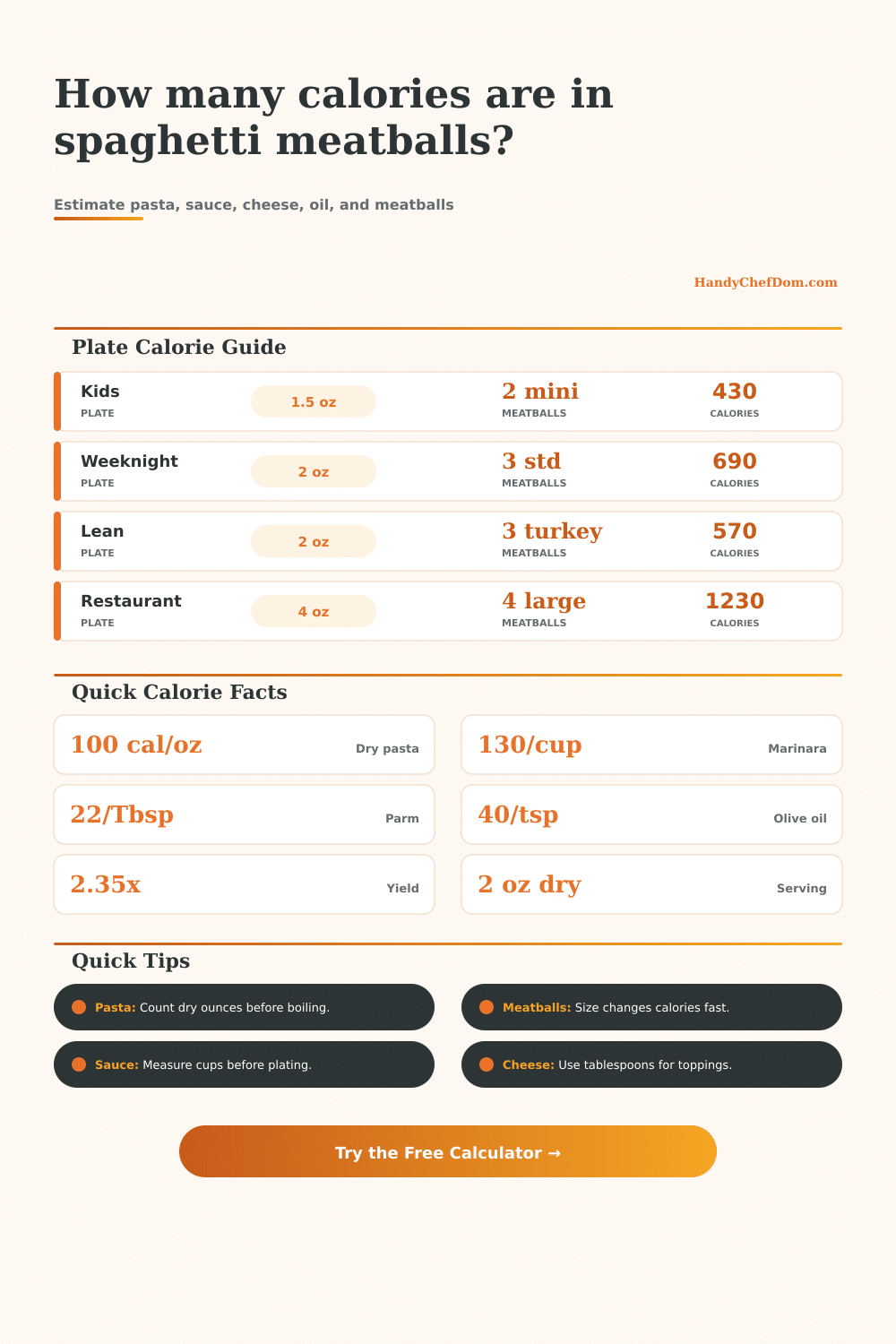
Enter the dry pasta weight before boiling. The calculator converts cooked yield, meatball calories, sauce, cheese, and oil into total and per-serving estimates.
| Dry Pasta | Cooked Cups | Calories | Plate Fit |
|---|---|---|---|
| 1.5 oz | 0.75 cup | 150 | Kids or light |
| 2 oz | 1 cup | 200 | Standard dinner |
| 3 oz | 1.5 cups | 300 | Hearty bowl |
| 4 oz | 2 cups | 400 | Restaurant plate |
| 8 oz | 4 cups | 800 | Four light plates |
| 16 oz | 8 cups | 1600 | Family pot |
| Meatball Type | Size | Each | Three Count |
|---|---|---|---|
| Lean turkey | 1.5 oz | 75 cal | 225 cal |
| Chicken | 1.5 oz | 83 cal | 249 cal |
| Lean beef | 1.5 oz | 95 cal | 285 cal |
| Beef and pork | 1.5 oz | 105 cal | 315 cal |
| Italian sausage | 1.5 oz | 128 cal | 384 cal |
| Plant-based | 1.5 oz | 90 cal | 270 cal |
| Sauce Type | Per Cup | 1/2 Cup | Best Use |
|---|---|---|---|
| Light tomato | 90 cal | 45 cal | Lean plates |
| Arrabbiata | 120 cal | 60 cal | Spicy bowls |
| Marinara | 130 cal | 65 cal | Classic dinner |
| Meat sauce | 220 cal | 110 cal | Extra protein |
| Creamy tomato | 280 cal | 140 cal | Rich pasta |
| Vodka sauce | 320 cal | 160 cal | Heavy entree |
| Meal Scenario | Servings | Pasta | Meatballs |
|---|---|---|---|
| Kids pasta night | 4 | 6 oz dry | 8 mini |
| Weeknight bowls | 4 | 8 oz dry | 12 standard |
| Family Sunday pot | 6 | 12 oz dry | 18 standard |
| Meal prep boxes | 5 | 10 oz dry | 15 turkey |
| Big potluck pan | 12 | 24 oz dry | 36 standard |
| Restaurant plate | 2 | 8 oz dry | 8 large |
When making spaghetti and meatballs from scratch, the kitchen counter quickly turn into chaos. There’s a pot of simmering sauce. Pasta water splatters everywhere. There’s a bowl of raw meat waiting to be shaped into ball. In all that action, there’s a crucial question that gets overlooked.
How many calories are on your plate? Why does it matter? It matters more then just hunger. It matters because you want to satisfy yourself without scarfing down half of your day’s calorie budget. So why does that matter? Because knowing what’s going on will alter the way you approach cooking.
Know Your Calorie Counts
You’ll see that most people weighs their pasta post-boil. That’s a no-no! Water doesn’t contribute any calories (water is just water), but it does contribute weight and volume. What contributes calories to your dish are the dry pasta that goes into your pot. No matter what happens to that pasta when it cooks, it starts as two ounces of dry spaghetti, which means that’s the amount of calories you’re consuming regardless of how much it expands. The tool automatically converts everything to cooked pasta so there’s no need to waste time trying to figure out how much a cup of boiled noodles will weigh.
Meatballs also comes with a lot of variation when it comes to calories. One little twist on the size make a huge difference to your overall consumption. That tiny little meatball may be small, but pop that sucker into your mouth six times and you’ve got yourself a caloric equivalent of two bigger balls.
Then there’s the type of meat you use: lean turkey or chicken will help keep things low-calorie, whereas a good old-fashioned beef and pork combination or even a hearty Italian sausage blend will push things up a notch. Fat isn’t everything here. Density is what we’re talking about. With the same amount of food, the meat has a different makeup and give you a different amount of energy. Go light and you get more bang for your buck (so to speak).
Toppings and sauces also adds up quietly to the final total. Although a simple marinara isn’t very high in calories, things like vodka sauces or cream based sauces pack a punch with each bite. Then there’s cheese…which piles on fast. While it may be grated Parmesan and thus not seem heavy, it certainly packs a lot of flavour into a small amount. Throw some on as a topping and before you know it those tablespoons starts to pile on the calories. Same thing goes for oil: a few teaspoons of olive oil will add plenty of body and taste, but they’re all just straight-up fat.
The page has a chart which breaks this down nicely and demonstrates how different amounts of same sauce will completely alter the nutritional breakdown of your meal (a heavy pour vs. A modest sauce scoop). These adjustments allows you to visualize what’s different before you begin cooking. Maybe on a typical weeknight, you’re making a simple family dinner, so the settings will skew towards something more balanced, like the usual meatballs with a moderate amount of sauce. Or maybe you have some meal prep in mind, in that case you’ll want a lighter tomato base and perhaps a leaner mix (like turkey) to reduce the per-serving number.
Run those options through the calculator. It allows you to play around with swaps, such as using regular semolina versus whole wheat pasta or adding an additional helping of cheese, to see impact on the grand total. It makes guesswork into data.
Nobody wants to take away the joy of making a good pasta dinner. The point here is to provide some predictability. Having a sense of how much you’re getting on your plate allows you to make intelligent tradeoffs: “I’ll get a little less pasta if I can have bigger meatballs.” “I’m in the mood for something richer than tomato, oh well, I guess I should of skip the cheese.” That’s simple to do with a baseline. Flying blind? Not so much.
That’s why home cooking has a leg-up on eating out. When you cook yourself, you’re in charge of the ingredients. How much cheese do you put on top? How much oil do you drop in the pan? Keep track of those inputs and suddenly a meal that could send you spiraling turns into something manageable, something that fits neatly into your day.
It’s the numbers, but they’re only a guide. What it boils down to is having a filling plate of home-cooked goodness with none of the anxiety of the unknown. You know what you’re getting into so you get to eat well. The kitchen’s still a mess, but at least you know where all the calories came from.