🫐 Elderberry Syrup per Day Calculator
Plan elderberry syrup spoon portions, bottle needs, and kitchen batch yield without turning the calculator into health or dosing advice.
Enter spoon servings and bottle volume for kitchen planning. The syrup strength and recipe use choices only adjust portion math, not health recommendations.
| Spoon | ML | Tsp | Kitchen Use |
|---|---|---|---|
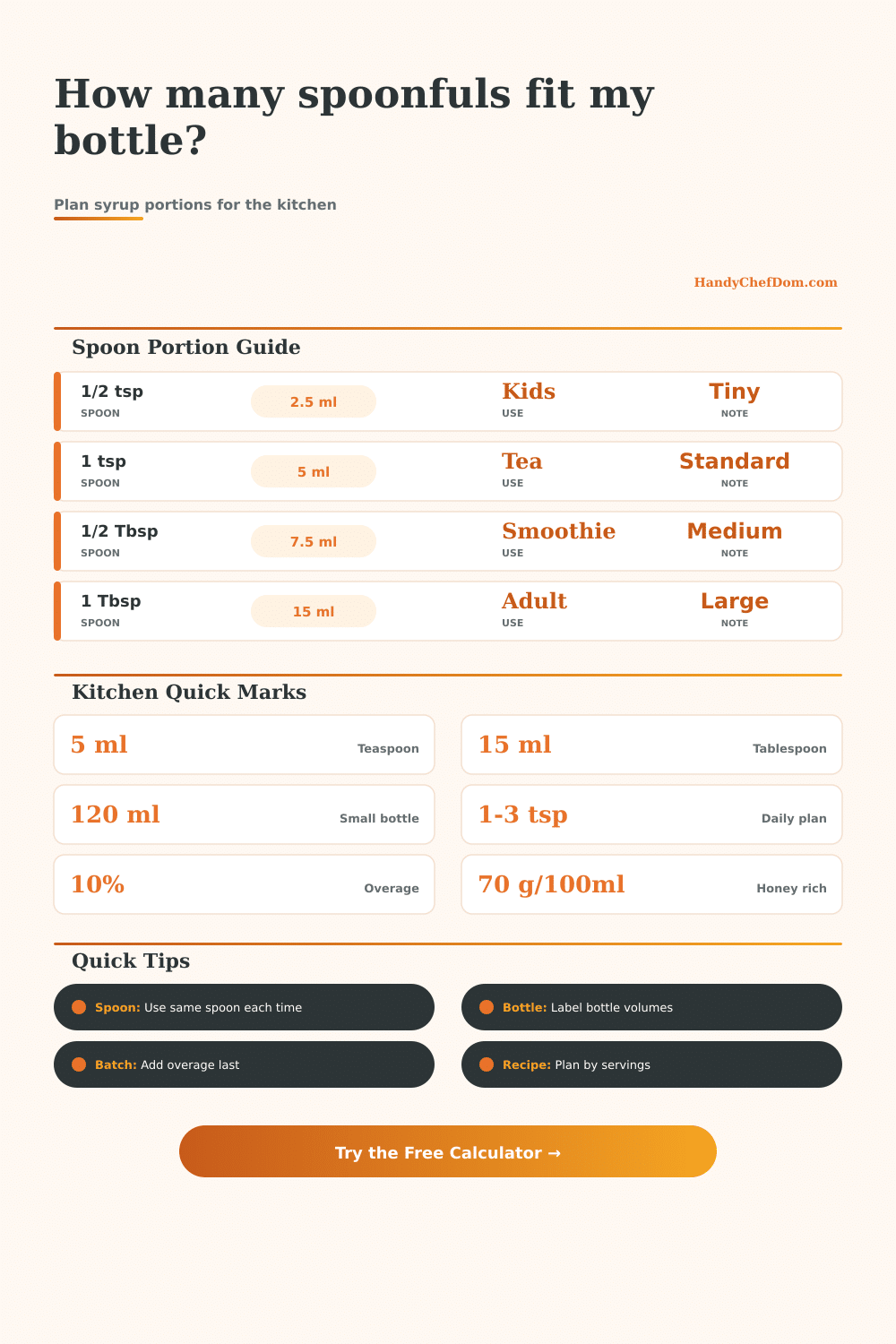
| 1/4 tsp | 1.25 ml | 0.25 | Flavor test |
| 1/2 tsp | 2.5 ml | 0.5 | Small spoon |
| 1 tsp | 5 ml | 1 | Tea stir-in |
| 1/2 Tbsp | 7.5 ml | 1.5 | Smoothie |
| 1 Tbsp | 15 ml | 3 | Large pour |
| 2 Tbsp | 30 ml | 6 | Recipe swap |
| Bottle | ML | At 5 ml/day | At 20 ml/day |
|---|---|---|---|
| Travel | 60 ml | 12 days | 3 days |
| Mini | 120 ml | 24 days | 6 days |
| Kitchen | 250 ml | 50 days | 12.5 days |
| Tall | 375 ml | 75 days | 18.8 days |
| Quart | 950 ml | 190 days | 47.5 days |
| Batch | 1000 ml | 200 days | 50 days |
| Concentration | Sweetener | For 250 ml | Texture |
|---|---|---|---|
| Recipe light | 25 g/100 ml | 63 g | Thin pour |
| Light | 35 g/100 ml | 88 g | Easy stir |
| Balanced | 50 g/100 ml | 125 g | Spoonable |
| Rich | 60 g/100 ml | 150 g | Glossy |
| Honey style | 70 g/100 ml | 175 g | Thicker |
| Very rich | 80 g/100 ml | 200 g | Dense pour |
| Use | Typical Spoon | Calculator Factor | Planning Note |
|---|---|---|---|
| Spoon serving | 1 tsp | 1.00 | Direct pour |
| Tea stir-in | 1 tsp | 1.10 | Mug mixing |
| Smoothie | 1/2 Tbsp | 1.25 | Blender loss |
| Sweet swap | 1 Tbsp | 1.50 | Recipe use |
| Bottle fill | 1 tsp | 1.00 | Label count |
| Pantry batch | 1 tsp | 1.05 | Reserve jar |
It’s a particular type of panic that sets in when you realize the elderberry syrup bottle is empty on day twelve of a seventy-day winter plan. An empty glass sits there, and you wonder: should I give in and buy a jar of tea from the store, or try to make another batch with whatever dried fruit is left? More often than not, it’s not that you lacked berries; it was just bad logistics.
People batch-cook their syrup out of passion. They do not typically use a spreadsheet, which is where you would need math. They also stuff jars until they are full rather than until they reaches a certain number of spoons. And that is where the math come in.
How to Know When Your Syrup Will Run Out
To figure out how long a jar will last in terms of real meals instead of milliliters, the website has to plan for volume. A 2500 milliliter jar sounds pretty large, but remember that most teaspoons are only five milliliters. That means one jar lasts for twenty-five days if two adult take a teaspoon each every morning. Add a kid who’s getting a half-teaspoon and you stretch it even longer… provided you keep track.
The website doesn’t make you do mental math as you reach for the spoon. Its portion-logic calculator know how much everyone is eating. It translates your bottle size and daily routine into real time. Is this an emergency of three days? Or is it a reserve of three weeks?
Which brings us back to the main point: What’s this thing really measuring? Because syrups don’t behave like water; they’re thick, syrupy stuff that sticks to everything and refuses to be messed with. Pour some into a cup (or a smoothie), and there’ll be a fair bit on both the spoon and the container. That’s where the overage buffer comes in.
Sure, you might reckon that, say, a hundred and twenty milliliters will do the job, but stick all that syrupy goodness inside the pitcher and you’ll lose some of that volume to the sides. Add another ten percent to account for what drops off the spoon. Add more for what stays in the pitcher instead of making it onto the spoon, and for the splash against the cupboard-side when your hands are already full. It is a slight tweak but it is enough to ensure no more empty-bottle crises before their time.
And then there’s the strength: Does your thick, sticky, honey-forward syrup feel more substantial than that light, recipe-style reduction? That’s what the calculator will take into account when figuring out how many portions you can make with your batch, not because one is healthier or anything like that!
If you have a very thick syrup, you may well want to naturaly pour less per serving; it’ll spread further on the tongue. Conversely, perhaps your syrup is more watery, and you’re looking to make a thin tea stir-in. In that case, you’d need a little more volume to achieve the same flavor impact. To normalize for this, the calculator lets you choose the syrup style which adjusts the projected daily use accordingly.
Why does it matter? One tablespoon of light syrup isn’t going to be the same experience as a tablespoon of concentrated extract. The final hidden variable is the sweetness level. How much honey or sugar are you putting into that jar? That determines not only its texture (a lot sweeter will be denser) but also its shelf life.
Also, what is the purpose? If you’re treating it like a direct sweetener substitute, you may want to grab two tablespoons to go into a sauce. Use it more as an additive to beverages and you can make a lower-concentration syrup. Again, the tool’s reference tables shows what a certain number of grams of sugar per volume means in terms of total weight of the batch.
So, you can think whether you’ve made a culinary ingredient or a medicinal preserve. That’ll tell you just how fast that bottle will dissapears.
The last thing most of us do is label it. After you’ve got the numbers, you write down the expected completion date. Sounds silly right? But I’ll tell you what, having something to look at helps you pace yourself. If you see finished by November fifteenth on the jar then you know when to crank out another batch.
They give you the date and you keep it in mind….that’s your job. It is prepping, yes, but it is also precision work. You do this not just because you want the flavor and the comfort, but also because you want the supply chain to hold up.
Why treat syrup as just something in your pantry when it’s a kind of inventory? Why wonder whether there’s enough left, when you know exactly how many mornings it covers? Why have it be a surprise that the bottle’s empty. Not when it would of been a planned event.