Sweet Potato Vitamin A Calculator
Estimate vitamin A as mcg RAE from sweet potato size, flesh color, baked vs boiled prep, cooked yield, serving size, and Daily Value target
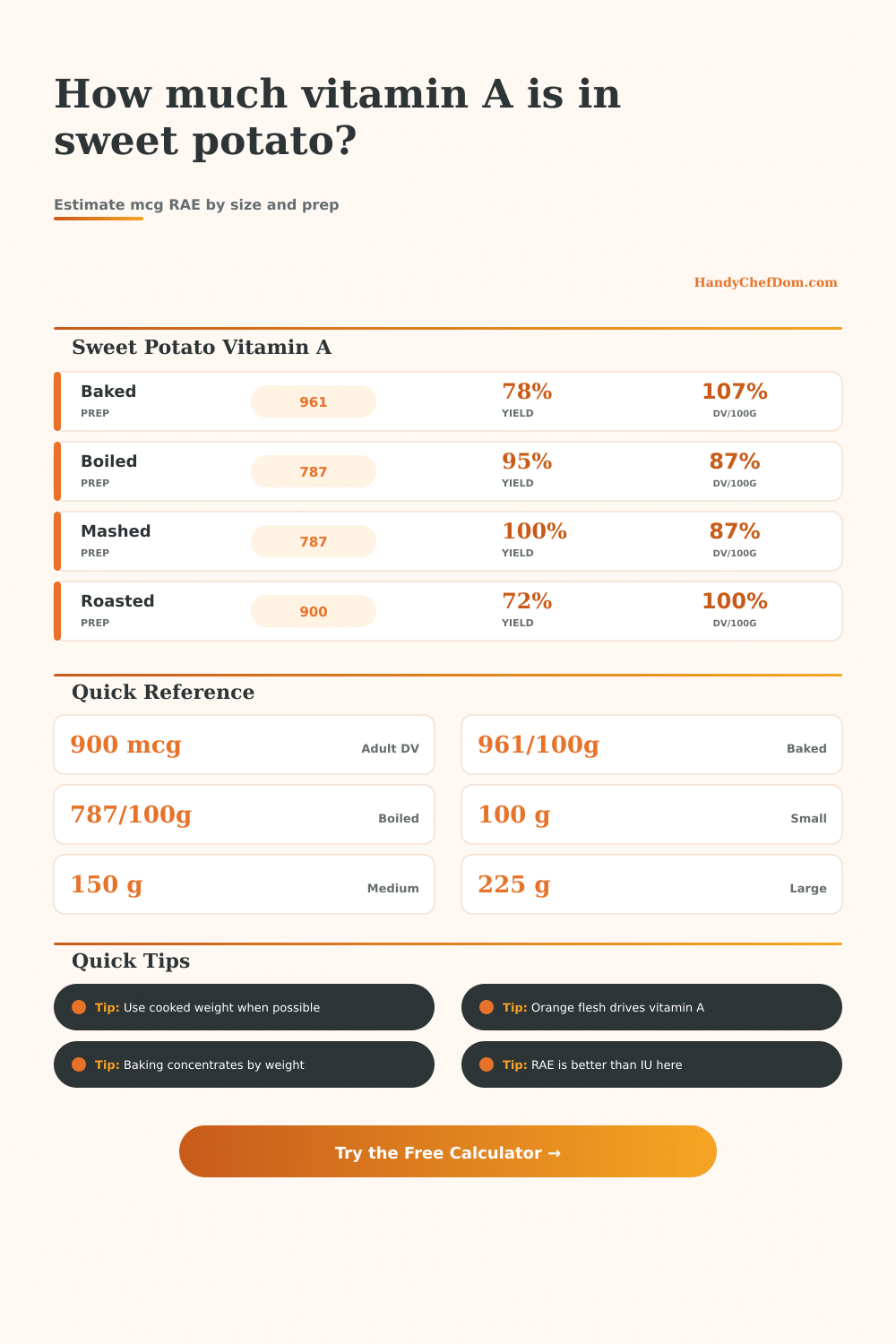
| Sweet Potato Form | Vitamin A | Cooking Yield | Calculator Use |
|---|---|---|---|
| Baked in skin, flesh | 961 mcg RAE/100g | 78% from raw | Main baked coefficient |
| Boiled without skin | 787 mcg RAE/100g | 95% from raw | Main boiled coefficient |
| Mashed from boiled | 787 mcg RAE/100g | 100% cooked input | Mashed bowl estimate |
| Roasted cubes | 900 mcg RAE/100g | 72% from raw | Moisture-loss estimate |
| Steamed cubes | 840 mcg RAE/100g | 92% from raw | Gentle-cook estimate |
| Raw orange flesh | 709 mcg RAE/100g | 100% raw weight | Raw weight comparison |
| Size | Raw Weight | Cooked Baked | Cooked Boiled | Baked RAE |
|---|---|---|---|---|
| Small | 100 g / 3.5 oz | 78 g | 95 g | 750 mcg |
| Medium | 150 g / 5.3 oz | 117 g | 143 g | 1124 mcg |
| Large | 225 g / 7.9 oz | 176 g | 214 g | 1686 mcg |
| Extra large | 300 g / 10.6 oz | 234 g | 285 g | 2249 mcg |
| One cup mashed | 328 g cooked | 328 g | 328 g | 3152 mcg |
| Half cup mashed | 164 g cooked | 164 g | 164 g | 1576 mcg |
| Reference | mcg RAE | Medium Baked | Half Cup Boiled | Calculator Target |
|---|---|---|---|---|
| Adult Daily Value | 900 | 125% | 143% | Default label DV |
| Adult male RDA | 900 | 125% | 143% | Male adult planning |
| Adult female RDA | 700 | 161% | 184% | Female adult planning |
| Child 4-8 RDA | 400 | 281% | 322% | Child reference |
| Child 9-13 RDA | 600 | 187% | 215% | Older child reference |
| Pregnancy RDA | 770 | 146% | 167% | Pregnancy reference |
| Lactation RDA | 1300 | 86% | 99% | Lactation reference |
| Scenario | Prep | Cooked g | mcg RAE | DV% | Approx IU |
|---|---|---|---|---|---|
| Small baked potato | Baked | 78 | 750 | 83% | 15000 |
| Medium baked potato | Baked | 117 | 1124 | 125% | 22480 |
| Large baked potato | Baked | 176 | 1691 | 188% | 33820 |
| Half cup boiled mash | Boiled | 164 | 1291 | 143% | 25820 |
| One cup boiled mash | Boiled | 328 | 2581 | 287% | 51620 |
| Roasted side scoop | Roasted | 120 | 1080 | 120% | 21600 |
| Steamed cube serving | Steamed | 130 | 1092 | 121% | 21840 |
| Pale flesh medium | Baked | 117 | 337 | 37% | 6740 |
The vitamin A in sweet potatoes has made them touted as a superfood. But not all orange roots is created equal. Boiled versus baked? That’s about more than just mouthfeel. How much provitamin A you’ll get depend on the flesh color, and water loss, which can concentrate nutrients by weight. If your goal is to hit your daily intakes without supplementation, it helps to know variables. Above is a calculator that runs math for you. But here’s why we ask so many questions…
Most of us are used to eyeballing our consumption. We figure out how many whole potatoes there are and say, “oh yeah, a medium-sized potato is a serving” and that works out just fine. Except it doesn’t. Potatoes come in all shapes and sizes. Some are small, weighing as little as 3 ounces, while others is very large and will easily exceed 8 ounces. How about we let you plug in your own food weight into the calculator?
How to Calculate Sweet Potato Vitamin A
You can choose to enter the weight before or after cooking. If you know how many you had but want to assume they were roughly equal, go for it. Best case scenario is choosing cooked edible weight. Why? Because potatoes has a lot of water in them, and when cooked (whether boiled or baked), some of that water turns into steam and leaves behind less actual potato. A baked potato is denser with nutrients per gram different than a boiled potato because it loses more water and concentrates the other nutrients. Boiled potatoes weigh more, but they have fewer concentrated nutrient.
Another gotcha for the casual cook: flesh color. USDA data is based off an orange-fleshed variety. While there are also purple and white sweet potatoes, those has a similar appearance and flavor but do not contain the carotenoids that get converted into vitamin A when eaten. Choose one of these paler varieties in the tool, and estimated intake is greatly reduced. This is not because the vegetable is flawed, but because it contains fiber and potassium instead of retinol activity equivalents.
Today’s standard for reporting vitamin A is RAE (retinol activity equivalents). It takes into account how efficiently beta-carotene converts to vitamin A in our bodies. The older measure was called International Units, and it made the value of plant-based precursors seem higher then it actualy was. To provide you with a good idea of what your body will be able to use, the calculator reports in terms of RAE.
Yield coefficients also adjust for preparation method. For instance, roasting (as with baking) tends to concentrate nutrients. However, some of this depends on how much moisture evaporates from the surface of food during cooking. Mashed potatoes are usually mixed with milk or butter, which don’t alter the vitamin A content of the actual potato itself, but do affect the total weight of serving. The tool accounts for these subtleties so you won’t be left wondering if that side dish at dinnertime hit the mark on your day’s goal.
Turns out one medium baked potato contains more than 900 mcg RAE, the adult daily value. Whoa! But it really isn’t that much because unlike with animal-derived retinol, plant-based vitamin A doesn’t get stored in the liver. It gets converted into what your body needs when needed. Any excess is either passed out of the body or causes your skin to take on an orange tinge (a harmless trait that will dissapears after avoiding too many carrots and sweet potatoes).
These figures turn into useful plans for parents of small children. Less food goes to a toddler than an adult, though, and they don’t eat as much. That’s where the age-specific breakdowns in the reference tables (page 2) come in handy. Notice how that half cup of mashed potato meets a large part of a kid’s needs? That helps when it comes time to decide what to make them.
You don’t have to stare at nutrition labels to try and figure out if your baked wedge is healthy enough. With this figure, you’ve got a real percentage (no guessing required). But the key is knowing what’s what. How do you weigh food? Most of us don’t (at home) because it would be tedious. So there are presets to help with typical situations such as a single serving or a family tray size. Based on an average, these presets offers you a ballpark without having to pull out a scale.
But if you’re logging meals for health purposes, try to be consistent in how you prepare things. Baking one week, then boiling next week… that’ll show up erratically in your daily records, though your real eating habits may be consistent. One of the few things I can think of that reliably delivers high nutrient density without requiring precise measurement is sweet potatoes. There’s no need to weigh every gram to gain its benefits. You should of used a scale for better results. But if you’re aware that one raw ounce weighs more than a cooked one, then what you put on your plate becomes more than just a side dish, it becomes a considered aspect of your daily nutrition plan. And while the orange color of their flesh may look pretty, it also packs a punch, and now you know just how big of a punch you’ll get with each bite.