🍅 Tomato Paste in Bolognese Calculator
Estimate tomato paste tablespoons, grams, can share, depth, yield, and reduction timing for a balanced bolognese batch.
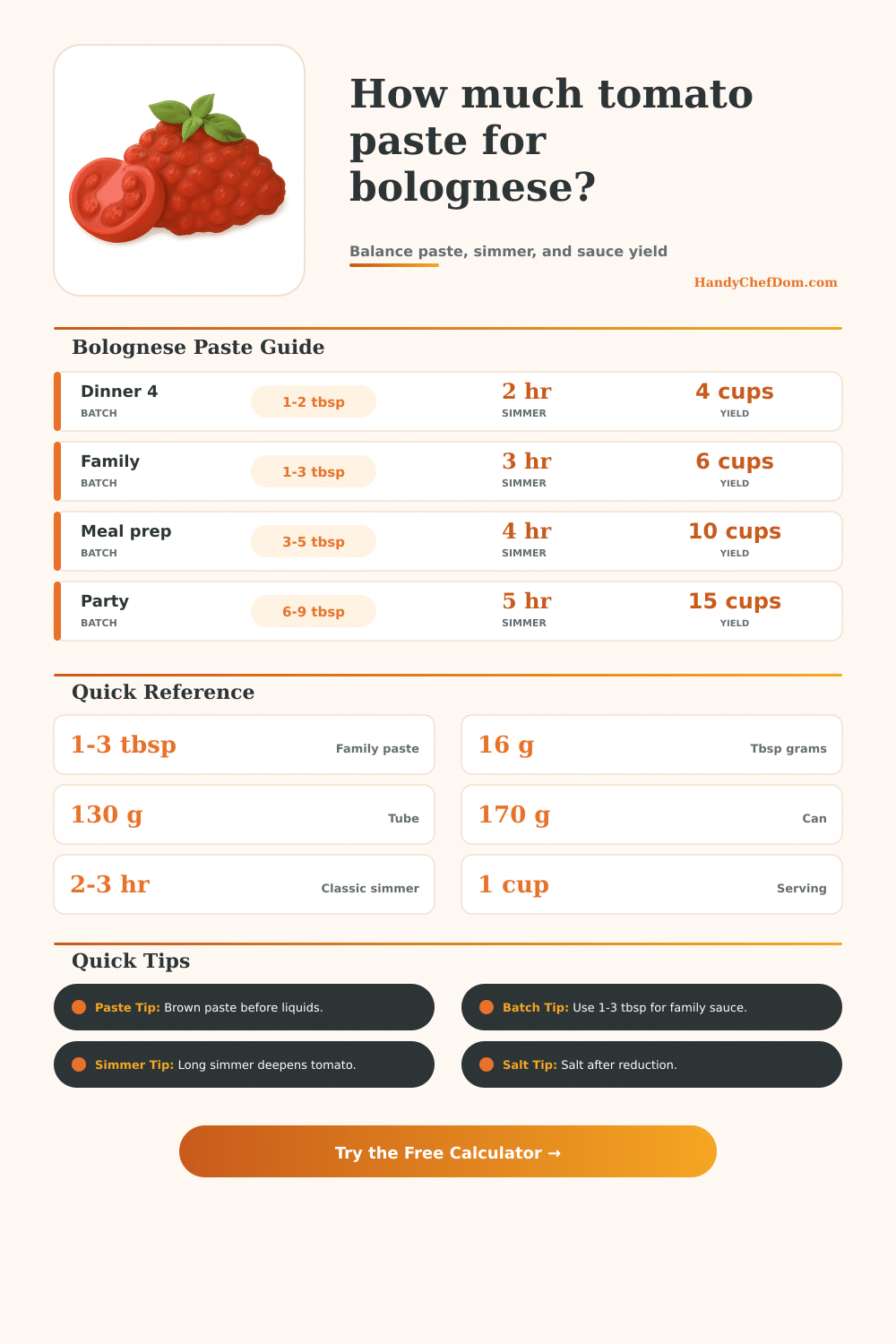
Tomato paste often lands around 1-3 tablespoons for a family bolognese batch. This calculator scales from that practical baseline, then adjusts for meat, tomato volume, simmer, richness, salt, and reduction.
| Batch Style | Meat | Tomato Base | Paste Target | Best Use |
|---|---|---|---|---|
| Light weeknight | 1 lb | 1 to 1.5 cups | 1 to 1.5 tbsp | Fast pasta night |
| Family classic | 1.5 lb | 2 cups | 1 to 3 tbsp | Balanced red sauce |
| Deep ragu | 2 lb | 2.5 cups | 3 to 4 tbsp | Rich tomato body |
| Meal prep pot | 3 lb | 4 cups | 4 to 6 tbsp | Freezer portions |
| Party batch | 5 lb | 7 cups | 7 to 10 tbsp | Large pasta trays |
| Extra tomato | 2 lb | 5 cups | 4 to 6 tbsp | Redder sauce finish |
| Measure | Tablespoons | Approx Grams | 130 g Tube | 170 g Can |
|---|---|---|---|---|
| Small dab | 0.5 tbsp | 8 g | 6 percent | 5 percent |
| Light batch | 1 tbsp | 16 g | 12 percent | 9 percent |
| Family middle | 2 tbsp | 32 g | 25 percent | 19 percent |
| Family rich | 3 tbsp | 48 g | 37 percent | 28 percent |
| Deep pot | 5 tbsp | 80 g | 62 percent | 47 percent |
| Large pot | 8 tbsp | 128 g | 98 percent | 75 percent |
| Simmer Time | Texture Effect | Paste Behavior | Reduction Cue | Depth Cue |
|---|---|---|---|---|
| 0.5 to 1 hr | Loose and fresh | Needs more help | Reduce early | Bright tomato |
| 1.5 to 2 hr | Lightly thick | Classic amount | Uncover late | Balanced |
| 2.5 to 3.5 hr | Silky and round | Paste melds well | Last 25 to 35 min | Deep savory |
| 4 to 5 hr | Dense ragu | Use slightly less | Watch bottom | Concentrated |
| 5.5 hr plus | Very reduced | Add in layers | Stir often | Dark tomato |
| Short restart | Reheated thick | Loosen first | Reduce gently | Already deep |
| Finished Sauce | Modest Portions | Generous Portions | Pasta Tray Use | Paste Range |
|---|---|---|---|---|
| 4 cups | 5 servings | 4 servings | Small skillet | 1 to 2 tbsp |
| 6 cups | 8 servings | 6 servings | Family pot | 1 to 3 tbsp |
| 8 cups | 10 servings | 8 servings | Half tray | 3 to 4 tbsp |
| 10 cups | 13 servings | 10 servings | Meal prep | 4 to 5 tbsp |
| 14 cups | 18 servings | 14 servings | Party bowl | 6 to 8 tbsp |
| 18 cups | 24 servings | 18 servings | Large tray | 8 to 11 tbsp |
Some small decisions at home, like getting your tomato paste just right for the bolognese (will ripple throughout the meal). Too little and you’ll be tasting tomato juice after several hours on the stove, too much and you’ve got pizza sauce. After a couple of hours when the liquids has cooked away and everything has concentrated, the distinction will be obvious. Use tomato paste to add depth, not as a main flavor from tomatoes.
It adds glutamates and concentrated sugars to round out veggies and meat without adding extra liquid volume. This mean the amount varies with amount of meat, the cooking time (longer = less paste), and any liquids added such as milk or wine. Those additions also contributes to initial liquid ratio and eventual texture, which is why the paste amount should of adjust to match.
How to Use the Tomato Paste Calculator
Plug in the variables for type of cook, where longer is deeper than. Add the amount of meat cooked, as heavier meat create more flavor in the savory base. The calculator above do the rest. It considers not only tomato volume (since passata and canned tomatoes brings different amounts of liquid and brightness), but also the fact that longer simmering diminishes the requirement for any added paste while further intensifying the tomato character.
There’s also an option to choose the richness: Want the tomato to play a stronger role or remain in the background? You can set that preference here. Then there is salt level and how much you reduce the sauce. If you reduce significantly, the sauce will be saltier at the finish; start lower on salt and you’ll have some wiggle room.
That’s where the tool comes in. It reduces the recommended amount of paste if it senses you are adding ingredient to make the sauce thicker. It also monitors your remaining sauce volume after reduction to see if the batch will cover desired serving size.
Another mistake is not differentiating between package sizes of tomato paste, as if they were all the same. A small can is used up quickly, but what happens to a large can after you only use two tablespoons? Chances are most of what’s left will be in the fridge going downhill soon. The calculator figures out how much of a typical size can/tube your batch calls for so you buy accordingly without wasting.
It also has another tweak that might make sense: the timing of adding the paste. Adding it after browning with the veggies/meat, rather than pouring in any liquid first, will help it blend better and lose some of its raw metallic edge. In many recipes, this is more important then the precise number of tablespoons used.
And this is where math come in: Running the numbers takes the guesswork out of these tradeoffs. For example, you’ll see how longer simmer time impact your need for paste. You will also see whether milk will soften the tomato’s presence. Little changes like that adds up as you go through cooking. When you understand the relationships, you begin to adjust with instinct instead of grabbing for a measuring spoon each time.