🍅 Tomato Paste in Spaghetti Sauce Calculator
Estimate tomato paste by final sauce cups, tomato cans, pasta servings, simmer time, meat style, acidity, and the richness you want.
Light Sauce
Classic Sauce
Rich Sauce
Thick Sauce
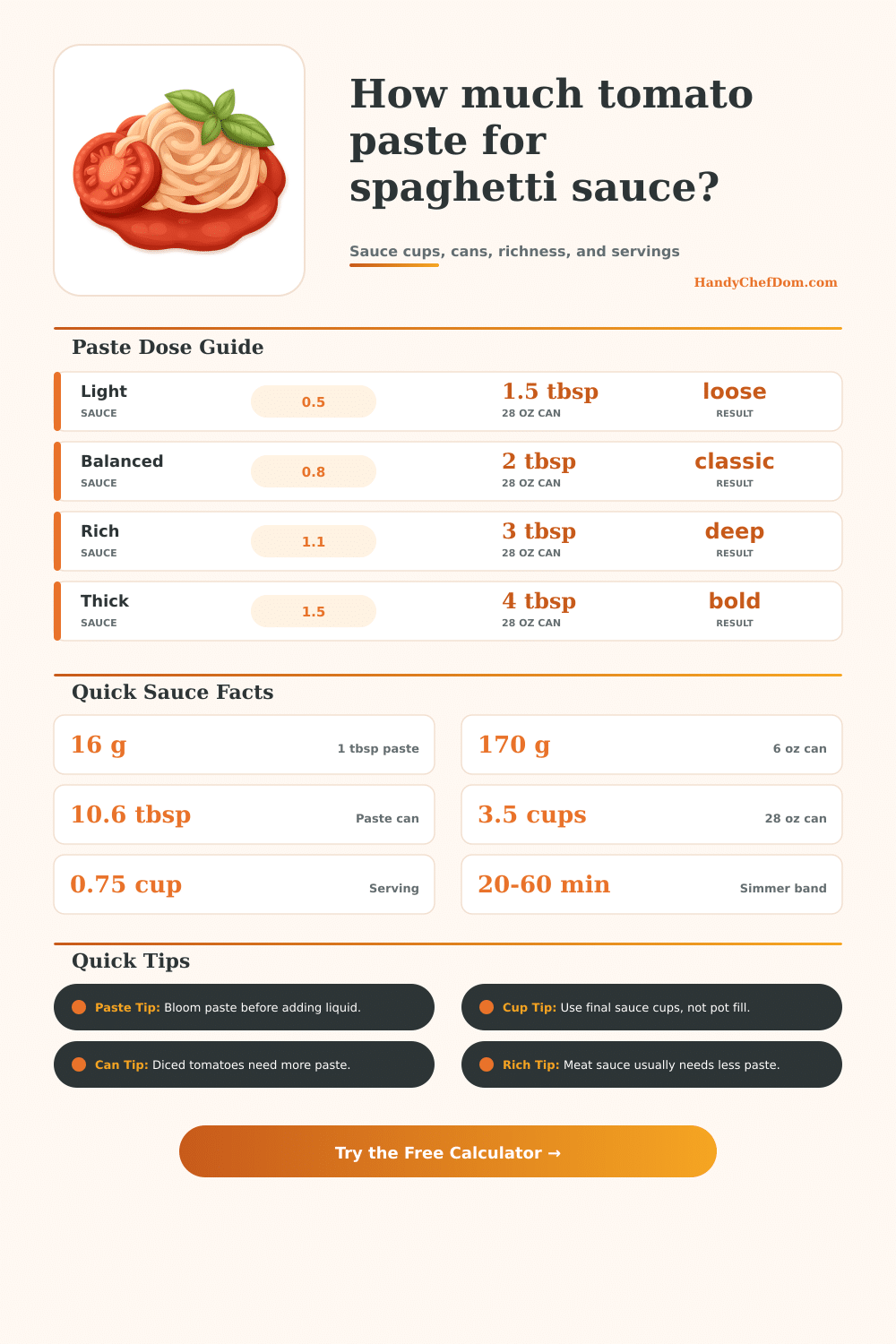
| Sauce Goal | Paste per Cup | Paste per 28 oz Can | Best Match |
|---|---|---|---|
| Light tomato lift | 0.4 to 0.7 tbsp | 1 to 1.5 tbsp | Fresh marinara, jar boost |
| Balanced spaghetti | 0.7 to 1.0 tbsp | 1.5 to 2.5 tbsp | Classic canned tomato sauce |
| Rich red sauce | 1.0 to 1.4 tbsp | 2.5 to 3.5 tbsp | Meat sauce or baked pasta |
| Extra thick coating | 1.4 to 1.8 tbsp | 3.5 to 4.5 tbsp | Fast simmer, loose tomato base |
| Tomato Base | Approx Volume | Paste Behavior | Adjustment |
|---|---|---|---|
| 28 oz crushed tomatoes | 3.5 cups per can | Good pulp and liquid balance | Use calculator as written |
| 14.5 oz diced tomatoes | 1.75 cups per can | More juice, less smooth body | Add 5 to 15 percent paste |
| 15 oz tomato sauce | 1.9 cups per can | Already smooth and seasoned | Reduce paste slightly |
| Fresh tomato puree | Varies by strain | Usually watery and bright | Increase paste and simmer |
| Simmer Time | Texture Effect | Paste Adjustment | Calculator Logic |
|---|---|---|---|
| 0 to 15 minutes | Loose and bright | Increase paste | Short simmer boost |
| 20 to 45 minutes | Classic sauce body | Baseline paste | Balanced adjustment |
| 60 to 90 minutes | Concentrated and glossy | Use less paste | Reduction credit |
| 120 minutes or more | Dense Sunday sauce | Use much less paste | Maximum reduction credit |
| Pasta Servings | Dry Pasta | Sauce Cups | Paste Range |
|---|---|---|---|
| 2 servings | 4 oz or 115 g | 1.5 cups | 1 to 2 tbsp |
| 4 servings | 8 oz or 225 g | 3 cups | 2 to 4 tbsp |
| 8 servings | 16 oz or 450 g | 6 cups | 4 to 7 tbsp |
| 12 servings | 24 oz or 680 g | 9 cups | 6 to 11 tbsp |
Getting the tomato paste just right on spaghetti sauce is a little thing, but that’s what makes or breaks the whole meal. Not enough paste and, no matter what else is right about it, your sauce will taste thin. Too much and suddenly it’s more like pizza sauce then what you thought was going to be spaghetti. It always depends on what happens once time and heat gets involved with the rest of the ingredients.
But most home cooks begin by taking whatever tomato product they have (or can get their hands on) and making an educated guess about how much concentrated paste might compensate for that. When base ingredient shifts, as it does from say, diced to crushed, or from fresh to jarred sauce, those guesses become less reliable. Jarred sauce is already seasoned and cooked, while fresh tomato puree tends to be bright and watery, requiring some assistance in holding its shape. A given amount of paste doesn’t always behave the same way with different starting points, meaning there isn’t often one fixed measurement suitable for all recipes.
How to Use Tomato Paste Calculator
All you have to do is explain your true situation, and then let the calculator do the math. It takes into account the number of people you’re serving, the amount of sauce (by volume) you desire, and the type of tomato base you’re working from. It also considers whether you intend to cook it for a long time which will reduce the volume and concentrate flavors.
Adding meat also matter. Sausage or ground beef-based sauces gives up some of their juices and fat that round out the flavor of the tomatoes, and you can often get away with using less paste then you would otherwise with pure marinara. Similarly, richness matters, and so does acidity. A weeknight sauce typically requires slightly less; the addition of some paste will help soften its edge with a smoother note. Conversely, sharp tomatoes may want a bit more to help soften the bite.
This is why I think of paste as part of the whole picture rather than something separate. The tool balances all those variables and spits out an overall quantity along with how that quantity breaks down into servings. This is helpful when you are scaling recipes up or down.
People also sometimes don’t realize that we’re talking about starting volume here, versus the final volume. That soup pot may be brimming when you start, but it’ll have reduced significantly within half an hour to forty minutes of simmering. It’s better to measure by the final volume since that’s the one you’ll ladle over the pasta. And the ranges provided on the page are there mainly for use as a fast double-check after the calculator has done the heavy lifting.
Another helpful tip is to bloom the paste. Simmering it briefly (a minute or two) in the cooking fat you used for the meat and/or onions will take the edge off any lingering raw metallic taste the paste might have. There is no way to include such tricks in the calculator. However, the more carefully you handle the paste, the less guesswork there is and the better numbers will be.
But generally speaking, people mess up when they use paste like a “rescue” ingredient instead of as a planned addition. Sure, if your sauce is too thin and you want to add some paste at the very end, go for it (in moderation). But more often than not, it won’t blend as smoothly as paste that was added to the base from the start. By exposing those other variables before you begin cooking, the calculator makes you consider adding paste earlier on… And hopefully, you’ll do that.
The point, ultimately, is simple: You don’t want just enough tomato that your sauce requires extra salt or cheese to give it body; you want it to be so thick that by itself it’s full-bodied. With some experience, you will learn how base ingredients, time, and volume works together to make this a simple next step in making dinner.
You should of used the calculator more often to ensure the most luxurios results.