🥩 Sirloin Tip Roast Cooking Time Calculator
Estimate lean sirloin tip roast oven time from roast weight, oven temperature, target doneness, sear choice, marinade state, rest, slice thickness, guests, and carryover.
Sirloin tip is a lean, boneless roast from the round area, so shape and slice thickness matter. Use the thickest center measurement and enter your planned carryover to estimate a practical pull point.
Best estimated by weight plus center thickness, then sliced thin across the grain.
A taller tied shape can hold heat back from the center and needs an earlier check window.
Adds early surface heat, shortens the oven estimate, and increases carryover slightly.
A lower oven usually lengthens the clock but gives lean sirloin tip a steadier center.
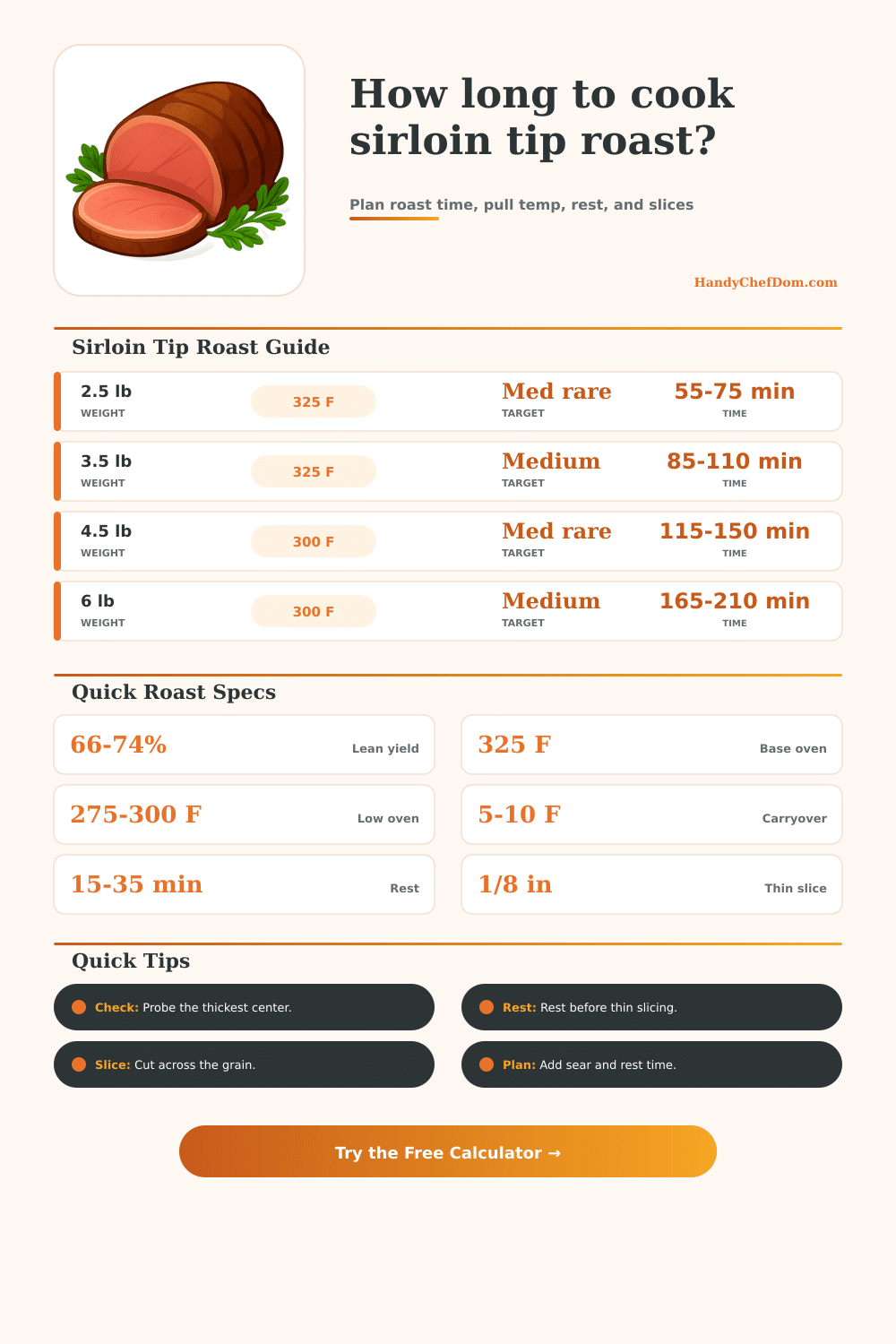
| Raw Weight | Typical Center | 325 F Medium Rare Window | Best Serving Style |
|---|---|---|---|
| 2 to 2.5 lb | 2.2 to 2.8 in | 45 to 70 minutes | Small dinner roast |
| 3 to 3.5 lb | 3.0 to 3.6 in | 70 to 100 minutes | Family roast slices |
| 4 to 4.5 lb | 3.6 to 4.3 in | 95 to 135 minutes | Platter or leftovers |
| 5 to 6 lb | 4.2 to 5.0 in | 130 to 180 minutes | Buffet thin slices |
| 7 to 8 lb | 5.0 to 6.0 in | 175 to 235 minutes | Large gathering roast |
| Target Doneness | Final Center Goal | Base Pace At 325 F | Lean Roast Result |
|---|---|---|---|
| Rare | 125 F / 52 C | 18 to 20 min per lb | Red center, very lean bite |
| Medium rare | 135 F / 57 C | 21 to 24 min per lb | Rosy center for thin slicing |
| Medium | 145 F / 63 C | 25 to 28 min per lb | Light pink center |
| Medium well | 155 F / 68 C | 29 to 32 min per lb | Faint pink center |
| Well | 165 F / 74 C | 33 to 37 min per lb | Fully cooked lean slices |
| Oven Or Sear Plan | Timing Effect | Carryover Effect | Planning Note |
|---|---|---|---|
| No separate sear | Baseline oven estimate | Moderate center rise | Simplest schedule with rest added after cooking |
| Pan sear before oven | Small oven-time credit | Adds about 1 F | Count the active browning minutes in the plan |
| High heat oven start | Shorter roast window | Adds about 2 F | Useful for dry exterior and larger roasts |
| Reverse sear finish | Gentler oven estimate | Adds about 1 F | Good for thin slicing and more even color |
| Lower oven, 275 F | Longer clock | Lower edge heat | Start checking before the range ends |
| Slice Thickness | Cooked Portion | Yield Use | Good Match |
|---|---|---|---|
| Shaved, 1/8 inch | 3.5 oz per guest | Highest portion count | Sandwiches and wraps |
| Thin, 1/4 inch | 4.5 oz per guest | Buffet-friendly yield | Platters with sides |
| Dinner, 1/3 inch | 5.5 oz per guest | Standard roast plate | Family meals |
| Carving, 1/2 inch | 7 oz per guest | Lower portion count | Hearty plates |
| Meal prep portions | 4 oz per portion | Predictable packs | Bowls and salads |
Calculator estimates are planning guides for sirloin tip roast timing. Oven behavior, roast shape, starting temperature, thermometer placement, and rest length can change the final window.
Sirloin tip roast are a lean cut of meat. Because sirloin tip roast is a lean cut of meat, sirloin tip roast can become dry if it is cooked in the same manner than a fatty cut of meat. Many peoples attempt to cook a sirloin tip roast using only one time estimate for cooking the roast.
The time required to cook a sirloin tip roast, however, depends upon a variety of different variables. For instance, each of the variables that affect cooking time include the thickness of the center of the roast, the starting temperature of the roast, the intensity of the searing process that the roast is subject to, and the thickness of the slices of roast that are to be cut after the roast has rested for at least fifteen minutes. The weight of the sirloin tip roast is one variable that can help to determine the approximate cooking time for the roast.
How to Cook a Sirloin Tip Roast
However, the thickness of the center of the roast is a more important variable to consider when determining cooking time. A sirloin tip roast that is both wide and flat will cook at a fasterer rate than a compact and tied roast of the same weight. The temperature setting of the oven in which you cook the roast will also affect the cooking time.
For instance, a lower oven temperature will provide a gentler cooking process to the sirloin tip roast than a higher oven temperature; the higher the temperature to which the oven is to be set, the less time that will be required to cook the roast. The target doneness of the roast will also have an impact on the cooking time of the sirloin tip roast. Sirloin tip roast contain very little marbling throughout the roast.
As a result, cooking the roast to a doneness level of medium-rare will remove more moisture from the roast than cooking the roast to a medium doneness level. The amount of moisture that is contained within the roast will impact the resting process of the roast. Additionally, you can use a tool to select a target finish temperature for the roast; this tool will calculate the pull temperature for the roast.
Accounting for carryover cooking will prevent the roast from being pulled from the oven too late; pulling the roast from the oven too late will result in dry edges on the roast. Another variable that will impact the cooking time of the roast is the method in which the cook sears the roast. For instance, pan searing the roast prior to placing it into the oven will add color to the roast without adding to the cooking time of the roast.
Placing the sirloin tip roast into the oven at high heat will shorten the cooking time of the roast, but will increase the amount of heat that is placed into the outer layers of the roast. Additionally, searing the roast at the end of the cooking process will allow for even cooking of the roast; the amount of time that is required for this process, however, will change the cooking time of the roast. Additionally, a sirloin tip roast that has been marinated in a wet ingredient will take longer to cook than a dry brined roast; the dry brined roast will require less time to rehydrate the muscle of the roast.
The time that the roast is rested after it is removed from the oven is another variable that will impact the cooking time; resting allows the muscles of the roast to relax. Additionally, resting the roast allows for the even distribution of heat throughout the roast. If the roast is sliced too soon after cooking, the juices of the roast will run out onto the cutting board.
Furthermore, the longer that the roast is rested, the more that the carryover cooking will impact the roast; a large sirloin tip roast that rests for thirty minutes or more will often experience an increase in the internal temperature of the roast of several degrees. Thus, planning the rest of the roast will allow for the roast to be pulled from the oven at the correct temperature. The thickness of the slices of roast that will be served and the number of guest that will be fed are additional variables that must be considered prior to cooking the roast.
Thinly sliced sirloin tip roast will tend to be more tender than thicker slices. Thinly sliced roast will also provide more servings of roast. A thicker slice of sirloin tip roast will provide more protein to each guest that is served, but will provide fewer servings of roast.
By considering the thickness of the slices that will be served, you can estimate the total weight of the cooked roast, as well as the number of servings that can be obtained from the roast. Thus, the thickness of the slices provides a means of determining if the roast will be sufficient for the individuals that are to be fed. Finally, there are a variety of mistake that may occur during the cooking of a sirloin tip roast that are the result of attempting to cook the roast in the same manner as a different type of roast.
For instance, many individuals may attempt to cook a sirloin tip roast to the same temperature that is used for cooking a rib roast; cooking sirloin tip roast to such high temperatures will result in the center of the roast becoming dry. Additionally, another mistake that may be made is attempting to pull the roast from the oven to the target temperature; because of carryover cooking, the roast will be too hot to handle once it is removed from the oven. Finally, another mistake is not allowing the roast to rest after it is cooked.
Not allowing the roast to rest will cause the roast to become tight when it is sliced. By accounting for each of these variables (thickness of roast, weight of roast, cooking temperature, searing of roast, resting of roast, thickness of slices, number of guest), however, these mistake can be avoided altogether.