🍔 Turkey Burgers Calorie Calculator
Estimate calories per burger, full batch calories, protein per patty, and bun, cheese, sauce, and topping calories for turkey burger meals.
Use raw patty weight and cooked yield to estimate turkey burger calories. Add buns, cheese, sauces, and toppings to see the full burger and batch total.
| Turkey Type | 4 Oz Calories | Protein | Fat | Best Use |
|---|---|---|---|---|
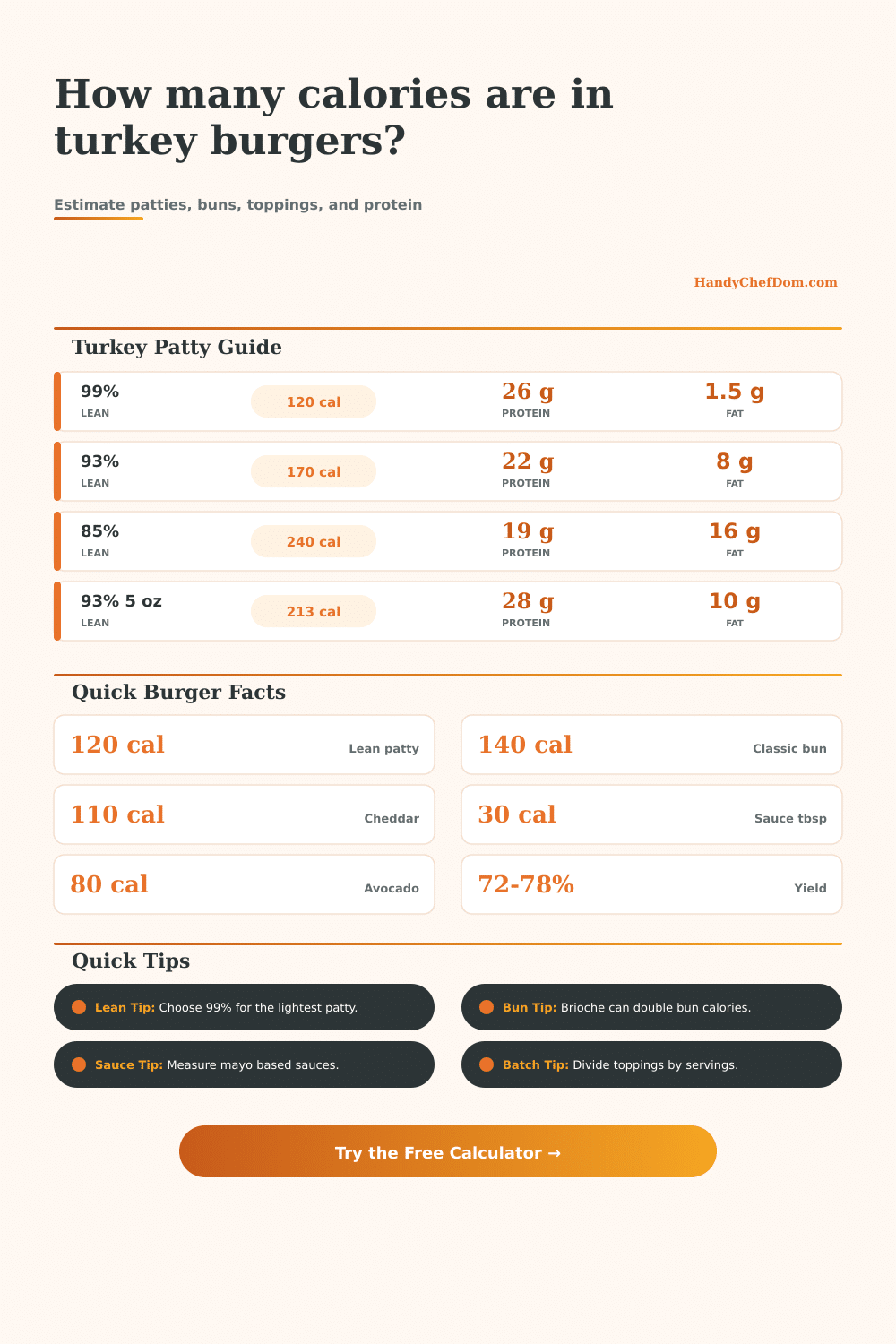
| 99% extra lean | 120 | 26 g | 1.5 g | Lean meal |
| 97% lean | 150 | 24 g | 5 g | Light burger |
| 93% lean | 170 | 22 g | 8 g | Weeknight |
| 90% lean | 200 | 21 g | 11 g | Grill batch |
| 85% lean | 240 | 19 g | 16 g | Juicier patty |
| Seasoned blend | 210 | 21 g | 12 g | Meal prep |
| Bun Type | Calories | Carbs | Protein | Note |
|---|---|---|---|---|
| No bun | 0 | 0 g | 0 g | Patty only |
| Lettuce wrap | 10 | 2 g | 1 g | Low carb |
| Sandwich thin | 100 | 21 g | 4 g | Lighter bun |
| Classic bun | 140 | 26 g | 5 g | Standard |
| Whole wheat | 150 | 28 g | 6 g | Hearty |
| Brioche bun | 230 | 34 g | 7 g | Rich bun |
| Pretzel bun | 250 | 46 g | 9 g | Dense roll |
| Slider bun | 90 | 17 g | 3 g | Small burger |
| Cheese Or Sauce | Calories | Protein | Fat | Portion |
|---|---|---|---|---|
| American slice | 60 | 3 g | 5 g | 1 slice |
| Cheddar slice | 110 | 7 g | 9 g | 1 oz |
| Swiss slice | 100 | 8 g | 8 g | 1 oz |
| Ketchup | 20 | 0 g | 0 g | 1 tbsp |
| Light mayo | 35 | 0 g | 3.5 g | 1 tbsp |
| Special sauce | 90 | 0 g | 8 g | 1 tbsp |
| Topping Set | Calories | Carbs | Fat | Serving Idea |
|---|---|---|---|---|
| Plain vegetables | 5 | 1 g | 0 g | Lettuce only |
| Pickle and onion | 10 | 2 g | 0 g | Classic stack |
| Tomato lettuce | 15 | 3 g | 0 g | Fresh crunch |
| Grilled onions | 35 | 8 g | 0 g | Sweeter top |
| Mushrooms | 25 | 4 g | 0 g | Savory top |
| Avocado slices | 80 | 4 g | 7 g | Creamy top |
| Turkey bacon | 70 | 0 g | 5 g | Extra protein |
| Loaded vegetables | 45 | 9 g | 0 g | Big stack |
A packet of ground turkey labeled ninety-nine percent lean (aka practically no fat) sits in your hand, while you stand before the grill. A warm, fragrant loaf of brioche bun from bakery goes into your shopping cart. Some avocado slice, a slice of sharp cheddar, and a hefty slathering of mayo complete your burger. It’s a work of art, one that, despite the healthy poultry label, probably has more calories then a double cheeseburger.
Once you input your own ingredient list, the calculator above do the math, sparing you the brain cramp of guessing how many calories are lurking in your breads and sauces. It breaks down the patties, the buns, the toppings, and delivers a grand total that actualy makes sense.
How to Count Calories in Your Turkey Burger
When most people switch to turkey they think they is cutting the calories in half automatically. That’s almost never true unless you also tweak the other part of burger. By itself, even the leanest cut of turkey meat are terribly dry. To make up for moisture, cooks add more fat back into the mix, such as cream-based sauces or cheese. This sets off a trap: instead of swapping out one kind of fat (beef) you’re swapping another (dairy or seed-oil), getting a similar amount of energy density while changing the taste. The tool shows you this tradeoff in a clear way, splitting out the calories from the meat vs. Those from the condiments. Watch as total jumps when you go from ketchup to special sauce (which is basically just mayo plus some spices & sweeteners). Small thing, but it makes a difference to your daily budget.
Finally, there’s the matter of cooked weight versus raw weight, which is something most home cooks fail to take into account. When turkey goes into oven, it loses both water (and some fat), this means you’ll wind up with a much smaller bird at the end. So if you measure your patty afterwards, scale will read differently… but it will have exact same amount of calories as it did before you popped it in the pan. For nutritional labels and grocery shopping purposes, we ask for raw weight, since that’s how things is standardized. Then we add a yield percentage based off how much turkey is likely to shrink, so you can get an accurate idea of what will end up on your plate. That way, you don’t fall into the trap of thinking a small burger = a small meal.
Any time you’re comparing sandwiches, there’s one part that’s frequently the unspoken calorie bomb: the bun. It may be an innocuous-seeming sesame seed bun, but it could pack as many as two hundred calories and twenty six grams of carbohydrates all by itself before you’ve put meat onto it. And then there are those delicious brioche buns. Those are essentially baked pastries that will double number. With the calorie and nutritional calculator, you’ll also be able to toggle among different buns to see what kind makes sense for you if you’re keeping carbs in check. Sometimes you’ll find that using a lettuce wrap instead of a bun saves you more effort than trying to increase your meat’s leanness by a small amount (for instance, changing from ninety three percent lean turkey to ninety nine). That’s laid out in the reference table on the page, which show how a heavier bun might counteract the benefit of a leaner patty.
Toppings is the wildcard. Bacon and avocados, while delicious, also pack in a lot of calories and fat. Just one-quarter of an avocado or turkey bacon slice can add fifty to eighty calories in no time at all. With the tool, you can begin to layer on these extras; and understand how added calories will add up. This isn’t to say you shouldn’t ever eat them; rather, it’s understanding what you’re getting when you do.
Every ingredient you place on your burger is another building block to its nutrition. It’s a matter of piecing together what you want to eat. And what you don’t. Use the calculator to tinker with various burger combinations until you reach your sweet spot: filling, yet within your caloric goals.
In the end, however, whether it’s a turkey burger or anything else, it comes down to addition by subtraction. If we’re willing to account for fat content of the sauce and cheese, then we can still enjoy their creaminess and richness. This tool gives us all the information we need to do this on purpose: instead of making an educated guess, we know exactly where each calorie came from. We know how much avocado costs us; we decide if it’s worth it; we choose whether a simple stack will do better than an indulgent one on this day. Suddenly what used to be a general idea of “health” becomes a concrete plan, something you can manage. It begins with the lean meat and ends up as a burger that suits your lifestyle, not just your diet. Now, the grill is waiting. And so are you.