Microwave Size Calculator
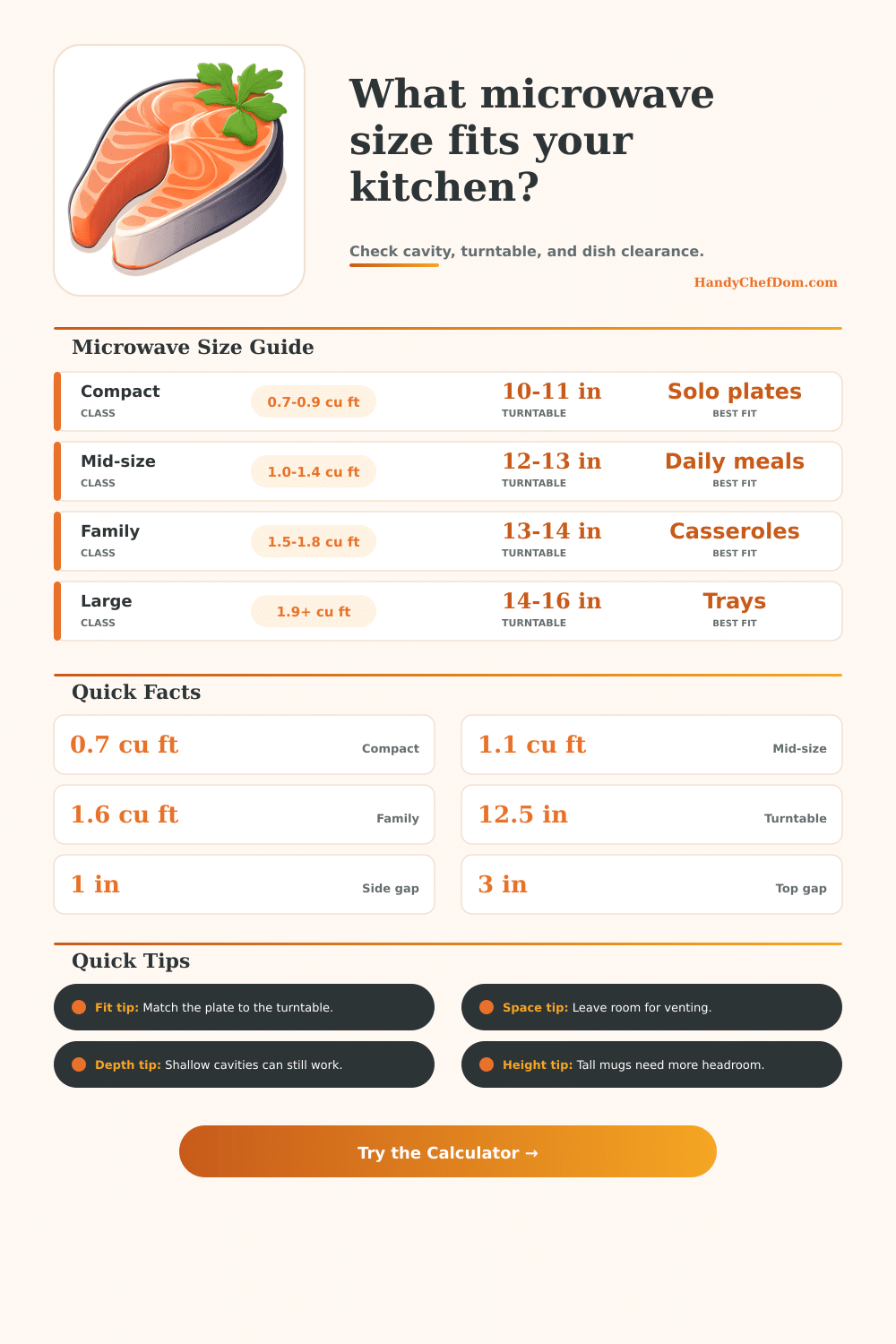
Check cavity volume, turntable room, and dish height before you choose a microwave that actually suits your kitchen layout.
| Class | Volume | Turntable | Best fit |
|---|---|---|---|
| Compact | 0.7-0.9 cu ft | 10-11 in | Solo plates |
| Mid-size | 1.0-1.4 cu ft | 12-13 in | Daily meals |
| Family | 1.5-1.8 cu ft | 13-14 in | Casseroles |
| Large | 1.9+ cu ft | 14-16 in | Trays |
| Plate | Safe turntable | Typical cavity | Notes |
|---|---|---|---|
| 9 in | 10.5 in | 11.5 in | Tea plates |
| 10.5 in | 12 in | 13 in | Everyday dinner |
| 12 in | 13.5 in | 14.5 in | Wide plates |
| 13 in | 14.5 in | 15.5 in | Platters |
| Item | Height | Safe cavity | Notes |
|---|---|---|---|
| Mug | 4.5 in | 6.5 in | Drinks |
| Cereal bowl | 5.5 in | 7.5 in | Soup |
| Casserole | 7.5 in | 9.5 in | Bake and reheat |
| Tall tumbler | 8.5 in | 10.5 in | Deep cups |
| Area | Minimum | Why | Risk |
|---|---|---|---|
| Sides | 1 in | Air flow | Overheat |
| Top | 3 in | Vent space | Steam trap |
| Rear | 1 in | Cable bend | Pinched cord |
| Front | 4 in | Door swing | Blocked access |
When choosing a microwave, there is two main considerations: the interior dimensions of the microwave and the exterior clearance requirement of the appliance. Many people will choose a microwave based on its external size. However, when choosing a microwave, the internal size of the microwave are a more important consideration than the external size of the appliance.
Consider the size of your largest cooking plate and the height of your cooking container when choosing a microwave. Another of the most important dimension of a microwave to consider is the turntable diameter. If you use large dinner plates, ensure that the turntable of the microwave is of a large enough diameter to allow the plates to clear the sides of the microwave.
How to Choose the Right Microwave Size
Should the plates be too large for the turntable, the plates will become jam within the microwave, which will prevent the plates from rotating within the microwave. Additionally, ensure that the depth of the microwave allow for the turntable to rotate front to back within the microwave. Measure your largest plates before purchasing a microwave to ensure that the plates will fit on the turntable.
The height of the turntable of the microwave is another measurement that you should consider when purchasing a microwave. If your cooking containers is relatively tall, you will want to make sure that there is enough room for those containers within the microwave. Should the height of your containers be too tall for the height of the microwave, the steam that the heating containers create may become trapped within the appliance.
Additionally, cooking containers often have handles and lids that increases the total height of the items that you are cooking. Therefore, you want to make sure that the height of the turntable provides enough room for these increased height. Another consideration for the exterior of the microwave is the required clearance for the operation of the microwave.
You need to leave clearance on the side of the microwave for the steam that the food within the microwave releases to clear the appliance. If you place the microwave too close to the side of the kitchen counter, the microwave may overheat. You should also provide clearance behind the microwave.
The power cord that connects the microwave to power may bend too sharp if there is no clearance behind the appliance. Additionally, you should leave enough space behind the microwave to provide clearance for the door swings of the microwave. You should also consider the direction in which the microwave door will swing.
The door may hit another appliance or the wall if you dont position the microwave correct. The volume of the microwave is often measured in cubic feet. However, the number of cubic feet that the microwave contains do not necessarily reflect the usability of the microwave.
Compact microwaves are usually under 0.9 cubic feet in size and are suitable for small household with few kitchen appliances. Mid-size microwaves contain approximately 1.1 cubic feet of space and are suitable for cooking meal daily. Family-sized microwaves contain 1.6 cubic feet and are best for those who prepare large casserole.
Large microwaves have over 1.9 cubic feet of space and are best for preparing large meal platter. The size of the microwave that you purchase should match your cooking habit to ensure that the size provides the space that you need. When choosing a microwave, do not make the mistake of estimating the size of the microwave.
Use a measuring tool to measure the dimensions of your kitchen and your cookware. Additionally, measure your largest cooking plate, your tallest cooking mug, and the area of the counter where you intend to place the microwave. This will ensure that you purchase a microwave that is the correct size for your kitchen.
If you do not measure these dimensions, you may end up purchasing a microwave that is too small for your cooking need, or it may not fit within your kitchen. One last consideration of a microwave that you should make is ensuring that the wattage of the microwave is appropriate in relation to the size of the microwave. The larger the microwave, the higher the wattage of the microwave.
Higher wattage allow the microwave to heat dense food. Additionally, think about the way in which you use your kitchen and the workflow of your countertop. If you have cooking habit of preparing large meals, a microwave with a large depth and turntable may be the best for your kitchen.
However, if you want to save space on your countertop, a compact microwave may be best for your kitchen. However, compact microwaves will have less space within the appliance for the food that you cook.