🦃 Turkey Frying Time Calculator
Estimate deep-fried turkey timing by weight, oil temperature, pot size, cavity status, starting temperature, batch count, rest time, and target internal temperature.
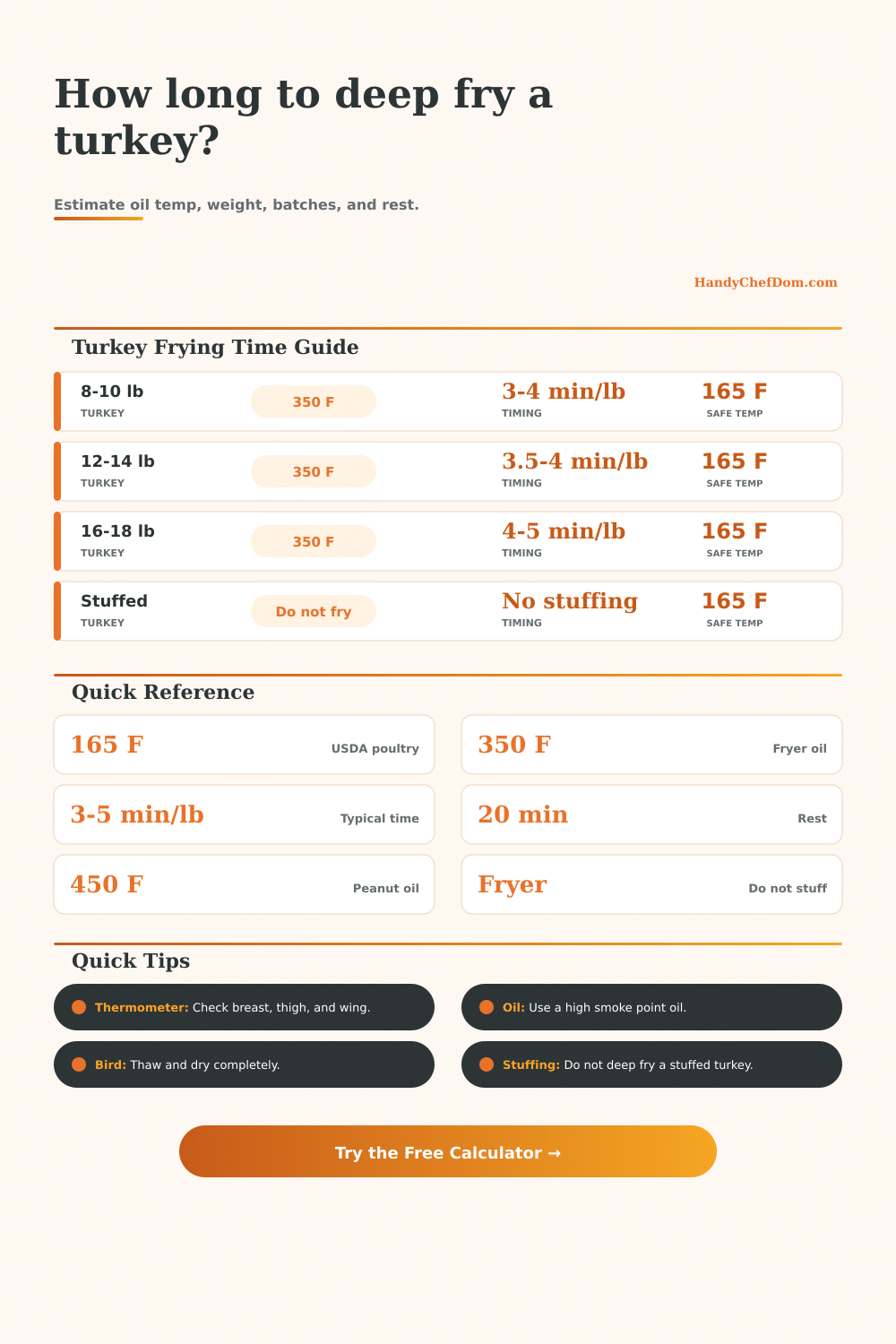
Use this as a planning estimate. USDA guidance points to about 3 to 5 minutes per pound for deep-fat turkey frying, oil maintained near 350 F, no stuffing, and a final poultry temperature of 165 F measured with a food thermometer.
| Turkey Weight | Typical Fry Time | Oil Temp | Internal Temp |
|---|---|---|---|
| 8 to 10 lb | 24 to 50 min | 350 F | 165 F |
| 11 to 14 lb | 33 to 70 min | 350 F | 165 F |
| 15 to 18 lb | 45 to 90 min | 350 F | 165 F |
| Over 18 lb | Split or use large rated fryer | 350 F | 165 F |
| Oil Situation | Calculator Effect | Kitchen Meaning | Action |
|---|---|---|---|
| 325 F | Slower estimate | Oil recovery is weak | Allow more time, verify temp |
| 350 F | Baseline | Classic turkey fryer target | Maintain steady heat |
| 375 F | Faster estimate | Closer to smoke and flare risk | Watch oil carefully |
| Over 375 F | Warning zone | Higher burn and smoke risk | Lower heat before lowering turkey |
| Oil Type | Approx Smoke Point | Fryer Use | Note |
|---|---|---|---|
| Refined peanut oil | 450 F | Common turkey fryer oil | Check allergies |
| Canola oil | 400 to 435 F | Neutral frying option | Less margin above 350 F |
| Refined avocado oil | 480 to 520 F | High heat margin | Often expensive for large batches |
| Vegetable frying blend | 400 to 450 F | Depends on blend | Read the label |
| Safety Check | Why It Matters | Target | Calculator Warning |
|---|---|---|---|
| Fully thawed turkey | Ice and hot oil are dangerous | No icy cavity | Starting temp below 35 F |
| Dry surface | Water causes splatter | Pat dry inside and out | Shown in status note |
| Unstuffed bird | Stuffing slows heat transfer | Cook stuffing separately | Stuffed warning |
| Thermometer check | Time is only an estimate | 165 F minimum | Target below 165 F |
Thanksgiving cooking is very different when deep frying. Yes, the heat transfers even quicker than in roasting, but it’s also less forgiving. A little bit more oil or moisture and all of a sudden, youve got a Hazard Zone in your kitchen. That’s where a good estimate before lighting that burner becomes necessary. Otherwise, you find out too late that you have no clue about timing the bird. Now you’re fearful of having served rubbery, dry meat to all your guests or even worse, you might serve raw poultry because you guessed the turkey weight wrong.
Once you enter your variables, the calculator do the math for you (above). You won’t have to guess about conversions and coefficients based off factors beyond your control. It bases those calculations on the tried-and-true three-to-five-minute-per-pound-at-350-degrees-Fahrenheit guideline. That’s a good baseline, assuming you’re cooking in a perfect world.
Why Use a Turkey Fryer Calculator?
Real-world factors can include a cold turkey (colder than refrigerator air), a frypot that’s too small (and thus can not hold enough displaced oil), or multiple batches (frying two birds back-to-back). The tool handle such real-world factors by taking into account batch recovery time and starting temperature. Instead of treating your fryer like a timer, it considers the fryer as a system.
Know what’s going into the equation, so that you can avoid some typical mistakes. The starting temperature field is not just an extra detail. When your cold turkey goes into the hot oil, all that cold mass hitting the surface cause the oil to plummet in temperature. Not only does this lengthen your cook time (until proper internal temps are reached), but it reduces your overall efficiency. The turketry calculator factors in this thermal shock.
It also verifies that the bird’s weight isn’t too large for your pot. Remember: a bigger bird take up more space, displacing more oil as well. You’ll want extra room above that bird to keep the hot oil from overflowing. Listen to the tool if it flags a close call. Overflowing hot oil is dangerous.
The other key is whether or not you are stuffing your bird. The calculator specificially cautions against deep-frying a stuffed turkey. Safety and quality reasons makes this non-negotiable. A stuffed turkey has the stuffing act as an insulator. It slows the transfer of heat into the interior of the bird, causing the exterior to cook too rapidy. The stuffing also forms a moisture trap that violently splatters when it meets the hot oil. Bake your dressing instead in the oven.
And your turkey? The turkey is empty, dry, and waiting for its bath. Dryness is just as essential on the skin. Water on the surface immediately converts to steam. This leads to oil explosions that’ll singe your eyebrows. Give it a good thwack with a towel.
What does that get you? You get a complete window of time, from start to finish, including rest time. Rest time is very important here, don’t forget it. As soon as you carve the bird, all those juices you’ve worked so hard to keep inside comes gushing out. If you let it rest for 20 minutes, the juices will be redistributed throughout the muscle fibers. This makes the difference between a good meal and a great meal.
On the page are some useful reference tables showing the interaction between oil type, smoke point and these times. Peanut oil is widely used for its ability to handle high temps. If you watch your temp gauge, canola/avocado oils may work too. But ultimately, time estimates are just that: estimates. Thermometer readings is always the final word on doneness. To be sure, the turkey must register 165 degrees Fahrenheit in the wing joint, thigh, and breast.
Your schedule can be worked out using this tool, not in place of your own taste buds. If the skin is golden and the temp is perfect at thirty-five minutes? Pull it out. Perfect skin temperature plus the right internal temp? Pull it out. Forty minutes on the dot but still at 140? Keep frying. Check against reality; trust in the data.
But you don’t want a dry turkey; you want that golden, crispy skin without a dry interior. Taking out the guesswork of those heat transfer factors will get you pretty darn close to that sweet spot, the one that the calculator help you achieve. You should of used it sooner. Transforming chaos into something you can manage over time creates an easily planned-for outcome. Combine that with attention to detail, and you get a turkey that’s as good to look at as it is to eat. Don’t forget to dry the bird, monitor the oil and let it rest. That’s the secret to a stress-free fry.