🦃 Turkey Marinating Time Calculator
Estimate a refrigerated turkey marinating window by part, weight, thickness, acidity, salt level, injection or soak method, flavor intensity, and target service time.
Use the service-time fields to count backward. The calculator estimates when to start marinating and when to pull the turkey before the cooking and drying buffer.
| Turkey Part | Typical Weight | Base Marinating Range | Best Timing Use |
|---|---|---|---|
| Whole turkey | 10 to 20 lb | 18 to 36 hours | Low-acid soak, skin-on bird, holiday prep |
| Spatchcock turkey | 8 to 16 lb | 12 to 24 hours | Flatter shape with faster surface contact |
| Bone-in turkey breast | 4 to 8 lb | 8 to 18 hours | Mild citrus, herb oil, or injection plus soak |
| Boneless turkey breast | 2 to 5 lb | 4 to 12 hours | Medium salt, buttermilk, or paste marinade |
| Thighs or drumsticks | 2 to 6 lb | 8 to 20 hours | Soy, herb, garlic, or savory marinades |
| Turkey wings | 1.5 to 4 lb | 2 to 8 hours | Bold surface flavor without a long soak |
| Cutlets or tenderloins | 1 to 3 lb | 30 minutes to 4 hours | Quick marinades, thin pieces, weeknight timing |
| Marinade Style | Acid and Salt Effect | Suggested Cap | Pairs Well With |
|---|---|---|---|
| Low-acid herb and oil | Gentle flavor transfer, longest window | 40 to 48 hours | Whole birds, spatchcock turkey, skin-on breast |
| Mild citrus or wine | Moderate acid, balanced aroma | 18 to 30 hours | Breast, whole turkey, tenderloins |
| High-citrus lemon or lime | Fast surface flavor, shorter texture window | 6 to 18 hours | Cutlets, wings, boneless breast |
| Vinegar-forward marinade | Sharp acid with quick penetration | 4 to 12 hours | Wings, thighs, drumsticks |
| Buttermilk or yogurt | Gentler tang with steady cling | 12 to 24 hours | Breast roasts, tenders, dark meat |
| Soy-ginger savory marinade | Salt-forward with strong seasoning | 6 to 14 hours | Thighs, drumsticks, wings |
| Method | Timing Effect | Marinade Amount | Best Fit |
|---|---|---|---|
| Covered soak | Full timing estimate | About 0.30 to 0.40 cup per lb | Whole turkey, large parts, holiday prep |
| Injection only | About half the soak time | About 0.08 to 0.12 cup per lb | Large breast or whole turkey when time is tight |
| Injection plus short soak | About two-thirds the soak time | About 0.18 to 0.28 cup per lb | Balanced interior and surface flavor |
| Bag soak with rotations | Slightly more even contact | About 0.25 to 0.35 cup per lb | Breasts, thighs, wings, spatchcock turkey |
| Paste under skin | Shorter than liquid soak | About 0.08 to 0.16 cup per lb | Skin-on breast, whole turkey, spatchcock turkey |
| Service Target | Pull From Marinade | Start Example | Timing Note |
|---|---|---|---|
| Thursday 3:00 PM | Thursday 10:00 AM | Wednesday 10:00 AM for 24 hr | Fits a balanced whole-bird herb soak |
| Sunday 6:00 PM | Sunday 2:00 PM | Sunday 6:00 AM for 8 hr | Works for injected breast or thighs |
| Friday 7:00 PM | Friday 5:00 PM | Friday 3:30 PM for 90 min | Use for thin cutlets or tenderloins |
| Saturday 1:00 PM | Saturday 8:00 AM | Friday 8:00 PM for 12 hr | Good for dark meat or buttermilk breast |
| Holiday noon | Early morning | Prior morning for 18 to 24 hr | Works when the cooking buffer is long |
You’ve got a raw turkey glaring back at you, Friday afternoon, and you’re likely feeling just as lost. You’d really love some flavour to penetrate beyond the skin, but how do you marinate without making that breast meat into a chalky mushy mess? Turkey isn’t exactly red meat: That’s when instinct typically deserts you. While beef can spend days in the fridge without ill effect, turkey is far more delicate; far more reactive; far less forgiving. A few hours in the fridge, hours that most cooks simply guess at instead of calculating, are margin between moist holiday delight and dry disaster.
To do that, you can simply plug in your bird’s characteristics into the calculator above (no need to guess at conversions or coefficients). Then it begins with the biggest factor: what part of the bird are you preparing? Because there is thin parts (like at the wing tips) and thick parts (around the drumstick), every piece of meat absorbs marinade differently throughout the bird. To account for this, the calculator considers weight of the bird but only counts the thickness of the thickest part. Marinading a turkey that’s been spatchcocked mean the surface area increases dramatically, making flavor absorption happen more quicker than it would if it were still a rounded, bone-in whole bird. That’s why the times differs so significantly between these types of prep.
How to Marinate Turkey Safely and Well
The other great divider in marinades is acidity. This is also the factor most misunderstood by home cooks. That’s why ceviche is cooked in lime juice: acid denatures proteins. If you take a thin turkey cutlet, for instance, and marinate it with high-acidity marinade containing vinegar or a lot of citrus, like lemon, then what happens is the outside of your meat basically gets cooked before it ever sees any heat. You end up with something grainy and wrong feeling on your tongue, even if it tastes properly seasoned. To avoid this, the calculator tapers down the window for high-vinegar or citrus-forward combinations. For a mild mix of oils and herbs, the window opens way up because flavor transfers more slowly and doesn’t damage meat structure as much.
Same goes for salt, which draws moisture out and allows flavor in, but again, too salty for too long and you risk the meat tasting preserved instead of just seasoned. People will tell you it doesn’t matter how you brine; the important thing is that you brine. They’re wrong. How does it matter? It is a choice between gravity and chance versus injection, which goes right to the meat without stopping for an appearance on the outside. If you inject, length of time spent soaking on the surface doesn’t contribute much toward penetration, that’s what the calculator accounts for. It knows that when injection is involved, there’s no reason to wait hours with a steak sitting in a plastic bag in your fridge: the flavor goes straight to the fibers without needing to work its way around any barriers.
And what about the temperature in your fridge? Is it a cold crisp thirty-six? Or is it a lazy forty-five? The warmer it gets, the quicker bacteria spread. So every degree up in temperature shortens the safe period to marinate. That’s not just a tweak to the timer, but a measure of safety.
The prep buffer allows you to work backwards from service: How long do you need to soak? How long will it be in the oven? A wet bird doesn’t crisp as well, so the key to good texture is getting it out of there in time to dry off.
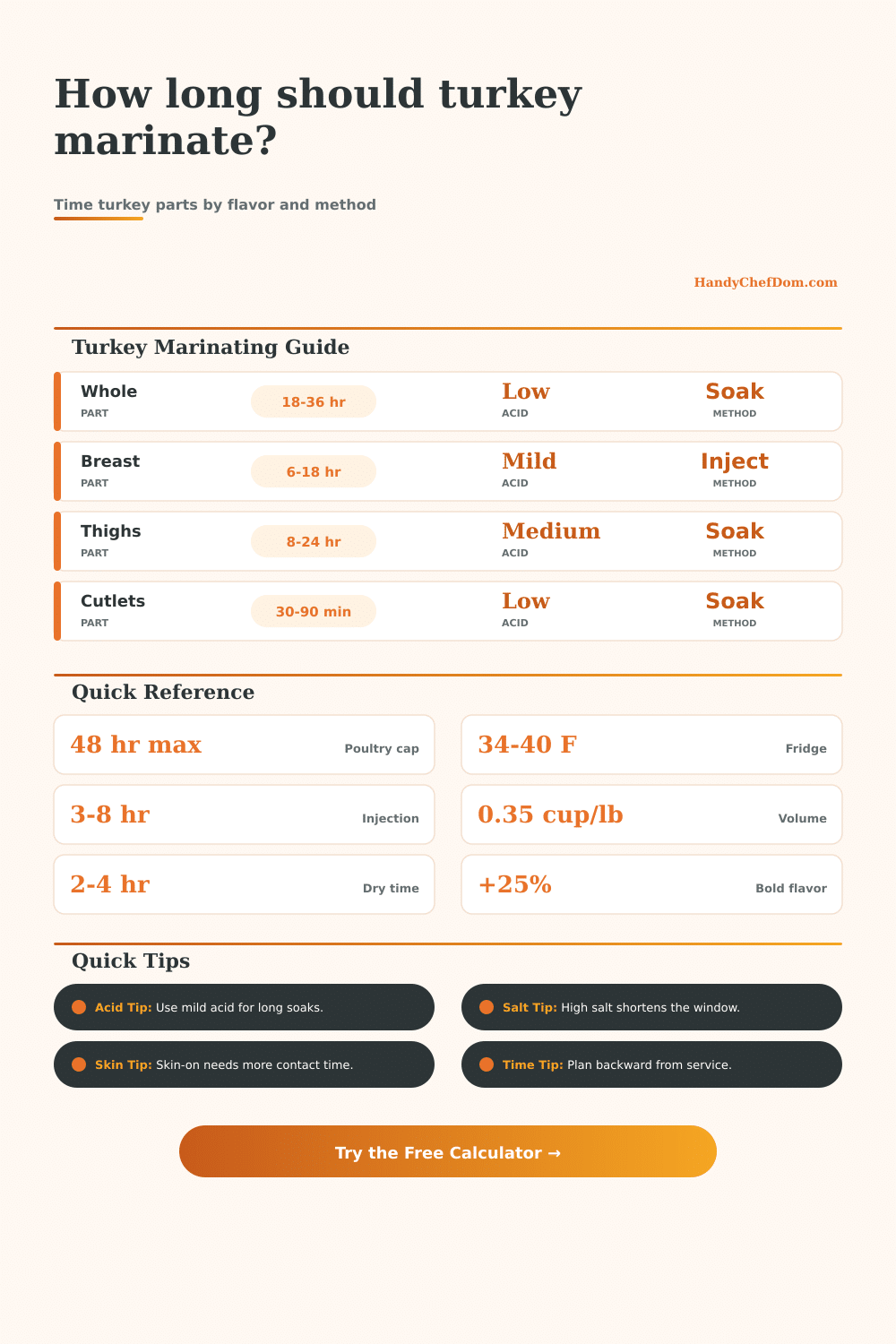
This chart makes it easy to see at a glance which areas is delicate (breast) and which are bold (thighs). It also shows which ones can soak a little longer without fear of being overpowered. It’s the little things; but they matter.
Once you know that marination is about winning the fight for texture as much as adding flavor, you won’t guess anymore. You’ll cook with purpose and know precisely when to lift the bird… Safely, deliciousy and just right.
The fridge door opens and the timer begins. The moment you remove the bird from the oven, it’s done. You should of gotten those settings correct and everything else becomes simply heat.