🦃 Turkey Roll Cooking Time Calculator
Estimate a boneless turkey roll timing window from weight, center diameter, stuffing, oven setting, convection, target internal temperature, and rest.
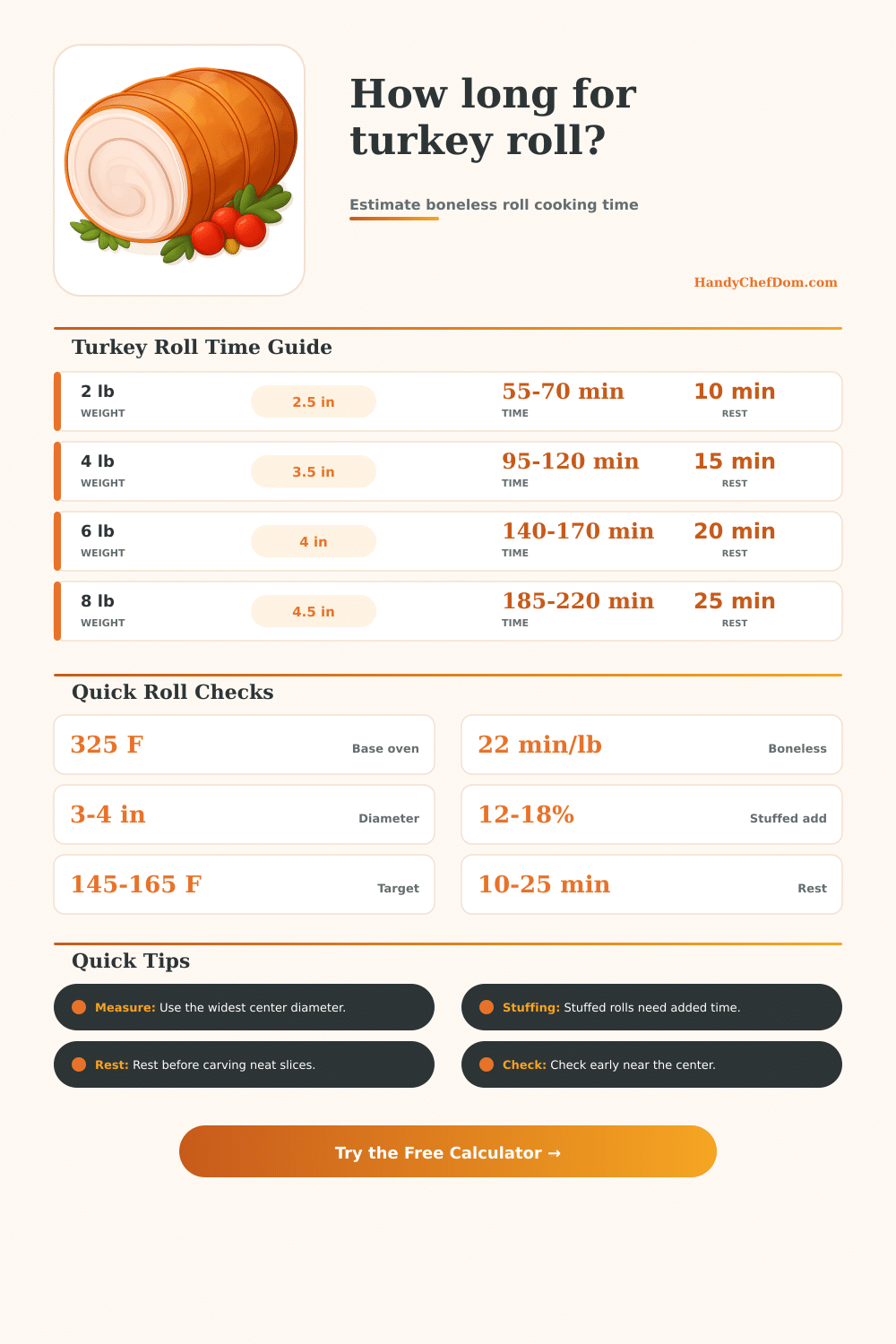
Enter the tied roll weight and the widest center diameter. The calculator blends weight-based roasting time with diameter-based center heating so compact and thick rolls are treated differently.
| Roll weight | Typical diameter | 325 F conventional | Suggested check point |
|---|---|---|---|
| 2 lb boneless roll | 2.5 to 3 in | 55 to 75 min | Check around 45 min |
| 3 lb boneless roll | 3 to 3.5 in | 75 to 100 min | Check around 60 min |
| 4 lb boneless roll | 3.5 to 4 in | 95 to 125 min | Check around 80 min |
| 5 lb boneless roll | 3.75 to 4.25 in | 115 to 150 min | Check around 95 min |
| 6 lb boneless roll | 4 to 4.5 in | 140 to 175 min | Check around 115 min |
| 8 lb boneless roll | 4.5 to 5 in | 185 to 225 min | Check around 160 min |
| Stuffing level | Time effect | Best input use | Calculator factor |
|---|---|---|---|
| No stuffing | Base timing | Plain tied turkey breast | 1.00x |
| Light herb layer | Slightly longer | Herb butter or thin greens | 1.06x |
| Medium layer | Longer center heat | Bread, spinach, mushrooms | 1.13x |
| Dense layer | Noticeably longer | Firm packed stuffing | 1.20x |
| Moist layer | Longest estimate | Fruit or very moist filling | 1.24x |
| Oven setting | Conventional effect | Convection effect | Good roll style |
|---|---|---|---|
| 300 F | About 12% longer | About base time | Large or dense rolls |
| 325 F | Base reference | About 12% shorter | Most boneless rolls |
| 350 F | About 10% shorter | About 20% shorter | Small to medium rolls |
| 375 F | About 18% shorter | About 26% shorter | Small fast roasts |
| 400 F | About 25% shorter | About 30% shorter | Thin roulades |
| Roll shape | Diameter cue | Timing behavior | Planning note |
|---|---|---|---|
| Tight breast roll | 3 to 4 in center | Balanced weight and diameter | Use standard estimate |
| Wide roulade | 2 to 3 in center | Usually faster | Check earlier |
| Round stuffed roll | 3.5 to 5 in center | Center leads timing | Use filling level |
| Deli slicer roll | 3 to 3.5 in center | Even cylinder timing | Rest for clean slices |
| Large buffet roll | 4.5 in or more | Longer middle heating | Build in checks |
This calculator estimates time from roll geometry and oven settings. Use the result as a planning window and confirm the chosen internal target at the center of the roll.
To cook a turkey rolls correctly, one must understand how the size and shape of the turkey roll impact the cooking time. A turkey roll are a cylinder. The cook must heat the turkey roll to the center of a roll.
If it take too long for the heat to reach the center of the roll, the turkey roll will be dry at the edges. However, if the heat reach the center of the roll too quick, the edges of the roll will begin to overcook. The calculator that is provided will allow an individual to determines the cooking time of a turkey roll by inputting the weight and diameter of the roll.
How to Find Cooking Time for a Turkey Roll
Many individuals use a standard rule that states that it take a certain number of minutes per pound for a turkey roll to cook through. However, the cooking time for a turkey roll is not the same than the cooking time for a whole turkey. Whole turkeys contains bones and a cavity that allow for even cooking, whereas turkey rolls contain no bone and no cavity.
As such, the thickness of a turkey roll is more important than its weight. A four-pound turkey roll that is thick may require more cooking time than a four pound turkey roll that is thin and flat. To account for this, the calculator will ask for the diameter of the roll to ensure that the cooking time are accurate.
The type of stuffing that is contained within the roll will also impact how long it take for the roll to cook. Rolls that includes dense stuffings, such as bread or sausage, will likely take longer to heat through the roll than rolls that have a thin layer of herb or other less dense ingredients. Additionally, moist stuffings will absorb heat from the roll, which may impact the evenness of the cooking of that roll.
As such, the calculation of the cooking time of a turkey rolls will also ask for the type of stuffing. Additionally, the temperature of the oven in which the roll will be cooked will also impact its cooking time. If the roll is cooked in a moderate oven, like an oven that is set to 325 degree, the roll will cook more even.
If you set the oven to a higher temperature, however, the roll may cook too quickly. Convection oven, which circulate the heat within the oven, may cook the roll faster but may also strip the insulating layer of the roll. The calculator will ask for whether convection or conventional heat will be used to cook the roll.
Additionally, the starting temperature of the roll will also impact how long it will take to cook the roll through to the center. If the roll starts at a refrigerator temperature, it will need to cook for longer than if the roll is allowed to sit on a counter for approximately thirty minutes to reach the desired cooking temperature. The calculator will ask if the roll will start at a cold or an room temperature to calculate the appropriate cooking time.
It is also necessary for turkey rolls to rest after they have been removed from the oven. The internal temperature of the roll will continue to rise after the roll is removed from the oven; this is referred to as carryover cooking. Carryover cooking is more prominent in turkey rolls of thick diameter than in turkey rolls of thin diameter.
Additionally, if the roll is sliced too soon after being removed from the oven, the juice will exit the roll. Therefore, the roll need to rest so that it can reach its internal cooking temperature without being slice. The calculator will provide information regarding the estimated carryover cooking of the roll so that an individual can decide at what temperature to remove the roll from the oven.
The tables that are provided on this page include information regarding the cooking time of rolls of different weights. The cooking times for unstuffed rolls are provided within these table. The cooking times within the tables are not to be relied upon as rules.
The cooking time may differ from the time provided in the tables due to the diameter, the stuffing, or the oven setting in which the roll is cooked. The tables are only provided for individuals to ensure that the cooking time calculated by the calculator is within the parameter of expected cooking times. Finally, the use of this calculator that is based off geometric calculation will prevent the turkey roll from being overcooked.
With the knowledge of the diameter of the roll and the target cooking temperature of the roll, the individual can determine the temperature of the roll with confidence. The breast meat of the roll will dry out if the roll is cooked past a safe temperature, so it is important that the roll is cooked to an appropriate temperature. If the roll is weigh, if the diameter is measure, and if the stuffing is determine, then the calculator will provide the cooking time for that roll.